Clinical Trial
. 2022 Jan 6;14(1):3.
doi: 10.1186/s13148-021-01226-y.

Pembrolizumab plus azacitidine in patients with chemotherapy refractory metastatic colorectal cancer: a single-arm phase 2 trial and correlative biomarker analysis

Affiliations
Clinical Trial

Pembrolizumab plus azacitidine in patients with chemotherapy refractory metastatic colorectal cancer: a single-arm phase 2 trial and correlative biomarker analysis

Chaoyuan Kuang et al. Clin Epigenetics. .

Abstract

Background: DNA mismatch repair proficient (pMMR) metastatic colorectal cancer (mCRC) is not responsive to pembrolizumab monotherapy. DNA methyltransferase inhibitors can promote antitumor immune responses. This clinical trial investigated whether concurrent treatment with azacitidine enhances the antitumor activity of pembrolizumab in mCRC.

Methods: We conducted a phase 2 single-arm trial evaluating activity and tolerability of pembrolizumab plus azacitidine in patients with chemotherapy-refractory mCRC (NCT02260440). Patients received pembrolizumab 200 mg IV on day 1 and azacitidine 100 mg SQ on days 1-5, every 3 weeks. A low fixed dose of azacitidine was chosen in order to reduce the possibility of a direct cytotoxic effect of the drug, since the main focus of this study was to investigate its potential immunomodulatory effect. The primary endpoint of this study was overall response rate (ORR) using RECIST v1.1., and secondary endpoints were progression-free survival (PFS) and overall survival (OS). Tumor tissue was collected pre- and on-treatment for correlative studies.

Results: Thirty chemotherapy-refractory patients received a median of three cycles of therapy. One patient achieved partial response (PR), and one patient had stable disease (SD) as best confirmed response. The ORR was 3%, median PFS was 1.9 months, and median OS was 6.3 months. The combination regimen was well-tolerated, and 96% of treatment-related adverse events (TRAEs) were grade 1/2. This trial was terminated prior to the accrual target of 40 patients due to lack of clinical efficacy. DNA methylation on-treatment as compared to pre-treatment decreased genome wide in 10 of 15 patients with paired biopsies and was significantly lower in gene promoter regions after treatment. These promoter demethylated genes represented a higher proportion of upregulated genes, including several immune gene sets, endogenous retroviral elements, and cancer-testis antigens. CD8+ TIL density trended higher on-treatment compared to pre-treatment. Higher CD8+ TIL density at baseline was associated with greater likelihood of benefit from treatment. On-treatment tumor demethylation correlated with the increases in tumor CD8+ TIL density.

Conclusions: The combination of pembrolizumab and azacitidine is safe and tolerable with modest clinical activity in the treatment for chemotherapy-refractory mCRC. Correlative studies suggest that tumor DNA demethylation and immunomodulation occurs. An association between tumor DNA demethylation and tumor-immune modulation suggests immune modulation and may result from treatment with azacitidine. Trial registration ClinicalTrials.gov, NCT02260440. Registered 9 October 2014, https://clinicaltrials.gov/ct2/show/NCT02260440 .

Keywords: Azacitidine; Colorectal cancer; DNA methyltransferase inhibitor; Epigenetic therapy; Immunotherapy; Mismatch repair proficient; PD-1; PD-L1; Pembrolizumab.


Conflict of interest statement

WS is the principal investigator of an investigator-initiated trial using pembrolizumab. NB serves on advisory boards for AstraZeneca, Bristol Meyer Squibb, Exelixis, and ThermoFisher. The remaining authors declare no potential conflicts of interest.

Figures
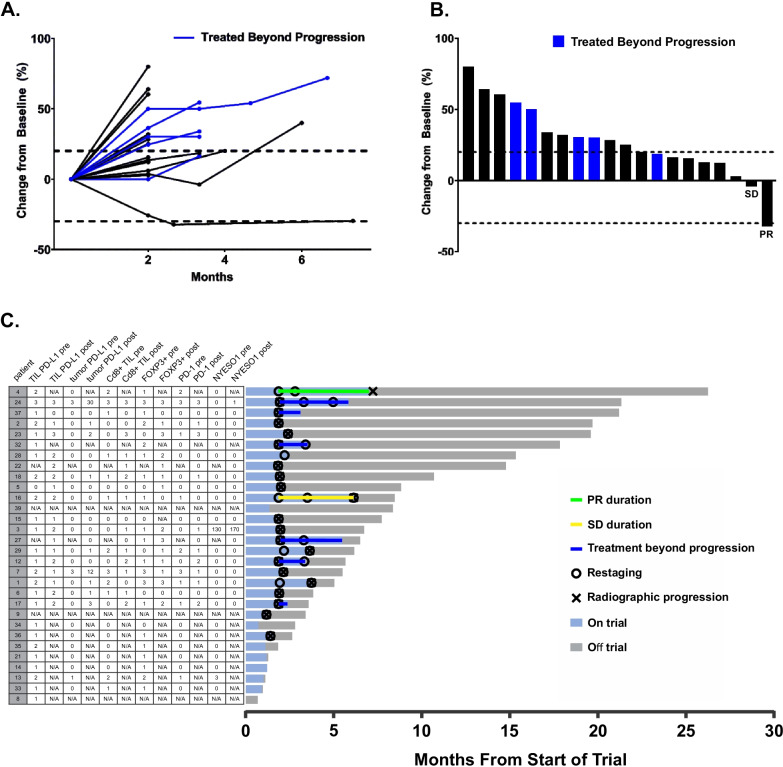
Fig. 1
Fig. 1
Activity and immune biomarkers of pembrolizumab in combination with azacitidine. A Percent change from baseline by RECIST 1.1 at each restaging time point by computed tomography. B Best response seen by RECIST 1.1. C Swimmers plot of treatment course of each patient in the intent to treat population. Immunohistochemistry of immune biomarkers in pre-treatment and on-treatment samples are indicated by numbers in adjacent table. The following were scored based on overall staining strength on scale of + 1 to + 3: TIL PD-L1 pre, TIL PD-L1 post, CD8+ TIL pre, CD8+ TIL post, FOXP3+ pre, FOXP3+ post, PD-1 pre, PD-1 post. The following were scored using a modified H-score (0 to 300): tumor PD-L1 pre, tumor PD-L1 post, NY-ESO-1. N/A is not assessed due to either no evaluable tumor or no biopsy obtained. CD8+ TIL and PD-1 indicate only intratumoral staining, does not include stromal or tumor/stroma interface staining. FOXP3+ are all intratumoral or stromal FOXP3+ Treg, although almost every sample had FOXP3 at the tumor/stroma interface. See Additional file 1: methods for additional details
Fig. 2
Fig. 2
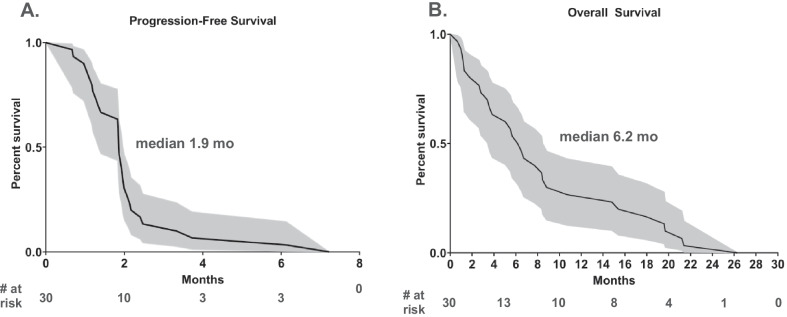
Patient survival data. A Progression-free survival (PFS) and B Overall survival (OS). Gray area demarcates 95% confidence intervals. All survival data are uncensored
Fig. 3
Fig. 3
Tumor DNA methylation analysis. A Global DNA methylation beta plots for pre- and on-treatment samples are shown. X-axis (beta value) represents the ratio of methylated alleles to total alleles (methylated plus unmethylated) for each genomic site, and Y-axis represents the prevalence of the genomic sites with the corresponding beta values. Loci are unmethylated (beta values < 0.2). Green boxes highlight patients in whom many hypermethylated genomic loci decreased in methylation on-treatment compared to pre-treatment levels, indicating demethylation. B Average DNA methylation at promoter sites across the genome in pre- and on-treatment samples. **p < 0.005. C Difference between on-treatment and pre-treatment promoter site methylation for each patient, plotted with mean and 95% CI
Fig. 4
Fig. 4
RNA sequencing. A RNA expression changes of all genes. Gray dotted line indicates p = 0.05, red and green dotted lines indicate − 0.7 and 0.7 log(fold change) decrease and increase, respectively. B RNA expression changes of genes that were determined to have the largest promoter region demethylation as determined by methylation analysis. Gray dotted line indicates p = 0.05, red and green dotted lines indicate − 0.7 and 0.7 log(fold change) decrease and increase, respectively. C Histogram and Gaussian distribution curves of the frequency of each degree of RNA expression change between pre- and on-treatment tumors. Gray and pink histogram bars indicate the individual frequencies of each level of RNA expression change in the non-promoter demethylated genes and promoter demethylated genes, respectively. Black and red lines are the Gaussian curves for the non-promoter demethylated genes and the promoter demethylated genes, respectively. Solid black and red bars indicate the 95% confidence intervals of the mean RNA expression change for the non-promoter demethylated genes and the promoter demethylated genes, respectively
Fig. 5
Fig. 5
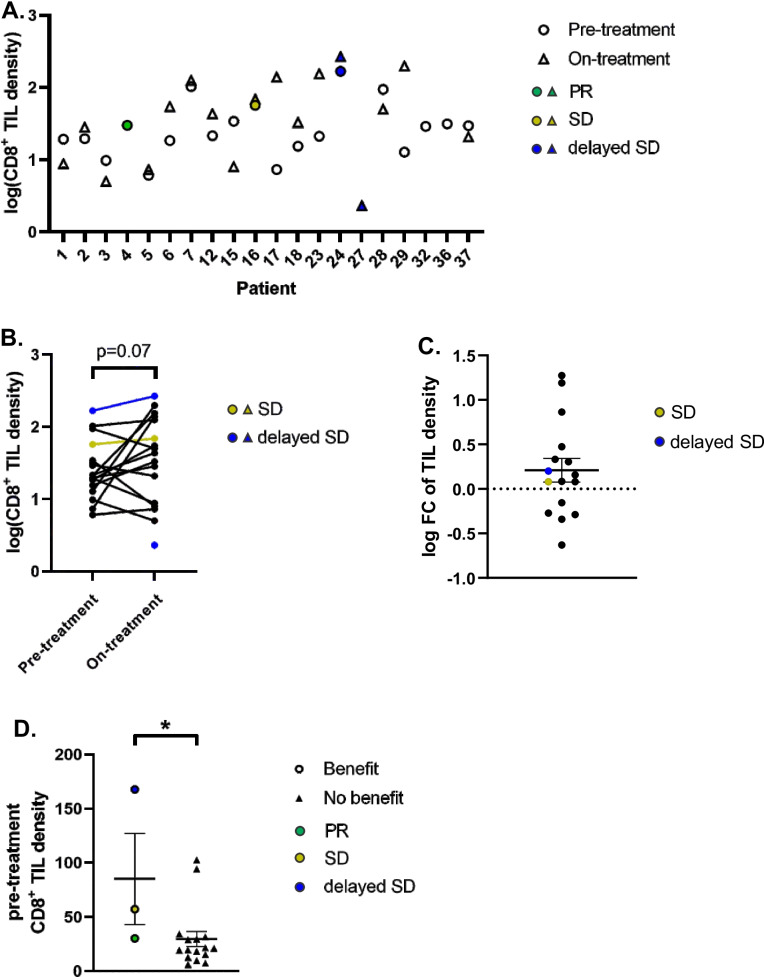
CD8+ TIL density. A TIL density in all evaluable pre-treatment and on-treatment samples, plotted on log scale. B Change in TIL density within individual pairs of tumors from pre- to on-treatment, plotted on log scale. Patient 4 (PR) had no assessable tumor on post-treatment biopsy. C Difference in TIL density within each patient’s tumor pairs, plotted with mean and SEM. D Pre-treatment TIL density in patients who benefitted versus patients who did not benefit from treatment, plotted with mean and SEM. *p < 0.05

References

    1. Siegel RL, Miller KD, Jemal A. Cancer statistics, 2020. CA Cancer J Clin. 2020;70:7–30. - PubMed
    1. Mayer RJ, Van Cutsem E, Falcone A, Yoshino T, Garcia-Carbonero R, Mizunuma N, et al. Randomized trial of TAS-102 for refractory metastatic colorectal cancer. N Engl J Med. 2015;372:1909–1919. doi: 10.1056/NEJMoa1414325. - DOI - PubMed
    1. Grothey A, Van Cutsem E, Sobrero A, Siena S, Falcone A, Ychou M, et al. Regorafenib monotherapy for previously treated metastatic colorectal cancer (CORRECT): an international, multicentre, randomised, placebo-controlled, phase 3 trial. Lancet (London, England) 2013;381:303–312. doi: 10.1016/S0140-6736(12)61900-X. - DOI - PubMed
    1. Topalian SL, Hodi FS, Brahmer JR, Gettinger SN, Smith DC, McDermott DF, et al. Safety, activity, and immune correlates of anti–PD-1 antibody in cancer. N Engl J Med. 2012;366:2443–2454. doi: 10.1056/NEJMoa1200690. - DOI - PMC - PubMed
    1. Le DT, Durham JN, Smith KN, Wang H, Bartlett BR, Aulakh LK, et al. Mismatch repair deficiency predicts response of solid tumors to PD-1 blockade. Science. 2017;357:409–413. doi: 10.1126/science.aan6733. - DOI - PMC - PubMed

Publication types

Associated data