


Comment
doi: 10.1038/s41423-021-00831-4.
Epub 2022 Jan 7.
Restoration of established systemic inflammation and autoimmunity by Foxp3+ regulatory T cells
Affiliations
- PMID: 34992284
- PMCID: PMC8803871
- DOI: 10.1038/s41423-021-00831-4
Item in Clipboard
Comment
Restoration of established systemic inflammation and autoimmunity by Foxp3+ regulatory T cells
Cell Mol Immunol.
2022 Feb.
No abstract available
Conflict of interest statement
The authors declare no competing interests.
Figures
A
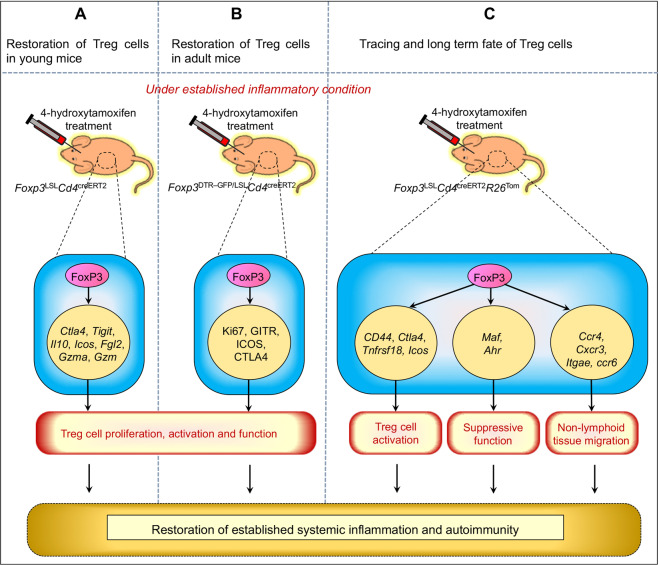
Foxp3LSLCd4creERT2L mice develop fatal severe inflammation and autoimmune responses affecting multiple organs early in life. Treatment of these young mice with 4-hydroxytamoxifen restores Foxp3 expression and, consequently, Treg cells that protect the mice from fatality. Compared to steady-state Treg cells, these Treg cells have higher expression of various genes associated with immunosuppression and are more potent suppressors of T cells. B Administration of diphtheria toxin to adult Foxp3DTR–GFP/LSLCd4creERT2 mice causes depletion of Treg cells, leading to massive immune activation, widespread autoimmune responses and fatality within two weeks. However, restoration of Foxp3 in Treg ‘wannabes’ in these mice by 4-hydroxytamoxifen injection protects the mice and ameliorates systemic inflammation. These Treg cells also exhibit enhanced proliferation, activation and immunosuppression-related protein expression. C Restored Thy-1.1−GFP+ Treg cells from Foxp3LSL/yCd4creERT2R26Tom mice exhibit the capacity for self-renewal and are maintained for a long period, possibly due to a unique subset of tissue-resident γREG+ Treg cells
Comment on
-
Regulatory T cells function in established systemic inflammation and reverse fatal autoimmunity.Nat Immunol. 2021 Sep;22(9):1163-1174. doi: 10.1038/s41590-021-01001-4. Epub 2021 Aug 23. Nat Immunol. 2021. PMID: 34426690 Free PMC article.
References
Publication types
MeSH terms
Substances
LinkOut - more resources
Full Text Sources
