Review
. 2021 Dec 21:14:7143-7172.
doi: 10.2147/JIR.S344730. eCollection 2021.

Spotlight on NLRP3 Inflammasome: Role in Pathogenesis and Therapies of Atherosclerosis

Affiliations
Review

Spotlight on NLRP3 Inflammasome: Role in Pathogenesis and Therapies of Atherosclerosis

Chunteng Jiang et al. J Inflamm Res. .

Abstract

Inflammation is an intricate biological response of body tissues to detrimental stimuli. Cardiovascular disease (CVD) is the leading cause of death worldwide, and inflammation is well documented to play a role in the development of CVD, especially atherosclerosis (AS). Emerging evidence suggests that activation of the NOD-like receptor (NLR) family and the pyridine-containing domain 3 (NLRP3) inflammasome is instrumental in inflammation and may result in AS. The NLRP3 inflammasome acts as a molecular platform that triggers the activation of caspase-1 and the cleavage of pro-interleukin (IL)-1β, pro-IL-18, and gasdermin D (GSDMD). The cleaved GSDMD forms pores in the cell membrane and initiates pyroptosis, inducing cell death and the discharge of intracellular pro-inflammatory factors. Hence, the NLRP3 inflammasome is a promising target for anti-inflammatory therapy against AS. In this review, we systematically summarized the current understanding of the activation mechanism of NLRP3 inflammasome, and the pathological changes in AS involving NLRP3. We also discussed potential therapeutic strategies targeting NLRP3 inflammasome to combat AS.

Keywords: NLRP3 inflammasome; atherosclerosis; cardiovascular disease; mechanisms; therapeutic strategies.


Conflict of interest statement

The authors declare that they have no conflicts of interest for this work.

Figures

Figure 1
Figure 1
Schematic of atherogenesis. Risk factors such as high cholesterol, hyperglycemia, and smoking are contributors of atherogenesis. These activators gain access to the intima via damaged endothelial cells (ECs). Damaged ECs trigger NLRP3 inflammasome activation, IL-1β and IL-18 release, thus further leading to inflammation. On the other hand, damaged ECs express adhesion molecules that capture the monocytes, which get into the intima and differentiate into macrophages. Macrophages ingest lipid and turn into foams cells, which gradually die and release their contents (such as IL-1β and IL-18), giving rise to the inflammatory response. The inflammatory response stimulates the migration and proliferation of smooth muscles cells (SMCs), which aggregate in the plaques to form fibroproliferative lesions.
Figure 2
Figure 2
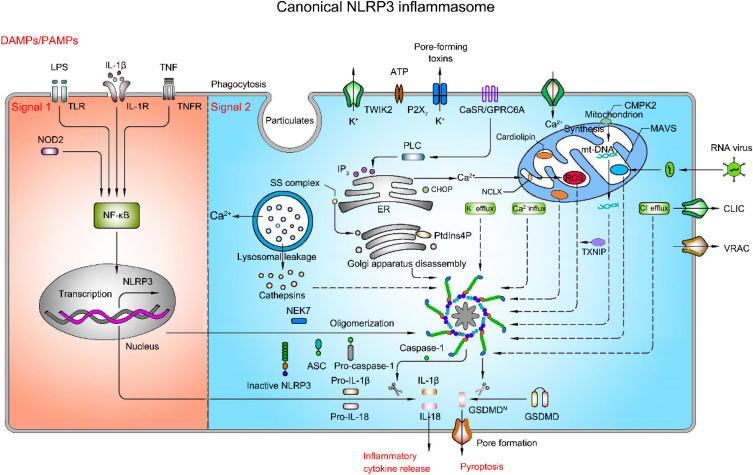
Mechanism of activation of canonical NLRP3 inflammasome pathway (priming-signal 1 and activation-signal 2). Priming process (saffron yellow background) is triggered by pattern recognition receptors (PRR), such as TLR4 and NOD2, or cytokine receptors, such as IL-1R and TNFR, and then activate NF-κB, in turn contributing to the transcription and translation of NLRP3, pro-IL-1β and pro-IL-18. Activation process (light blue background) is boosted by pathogen-associated molecular patterns (PAMPs) or damage-associated molecular patterns (DAMPs), such as ATP, particulates and pore-forming toxins, which activate a number of upstream signaling events. These signaling events include ion fluxes, lysosomal leakage, reactive oxygen species (ROS) production, the release of oxidized mitochondrial DNA (mtDNA), and trans-Golgi disintegration. In addition, other specific events activate the NLRP3 inflammasome as well. For instance, RNA virus triggers the NLRP3 inflammasome activation via mitochondrial antiviral signaling protein (MAVS). The translocation of sterol regulatory element-binding proteins (SREBPs)-SREBP cleavage-activating proteins (SCAP) complex (SS complex) from endoplasmic reticulum to Golgi also can initiate NLRP3 inflammasome assembly. Likewise, phosphatidylinositol-4-phosphate (PtdIns4P) on dispersed trans-Golgi network can trigger NLRP3 inflammasome activation. The NLRP3 inflammasome activation leads to the cleavage of caspase-1, which in turn cleaves pro-IL-1β and pro-IL-18 as well as gasdermin D (GSDMD). The N-terminal cleaved GSDMD embeds into the membrane, forming pores and triggering cell swelling and lysis called pyroptosis.
Figure 3
Figure 3
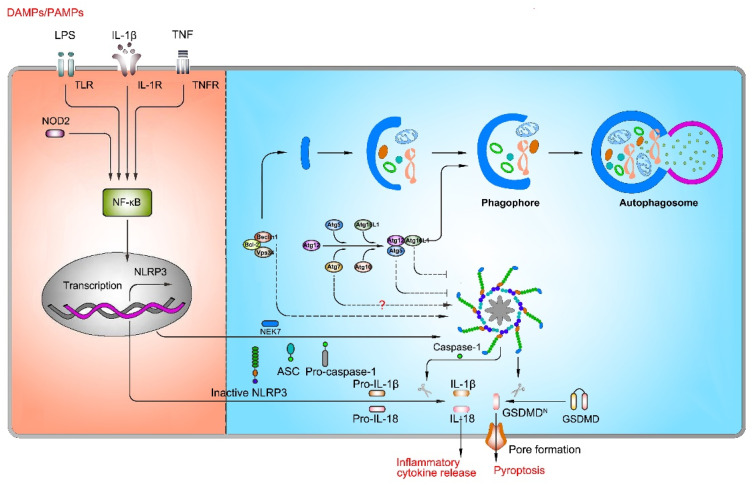
The role of autophagy in NLRP3 inflammasome activation. Autophagy plays a key role in NLRP3 inflammasome activation, but the role of autophagy remains controversial. On one hand, inhibition of autophagy-related genes (Atg5, Atg7, and Atg16L1) suppresses NLRP3 inflammasome activation; on the other hand, inhibition of autophagy-related genes (Atg7 and Beclin1) promotes NLRP3 inflammasome activation.
Figure 4
Figure 4
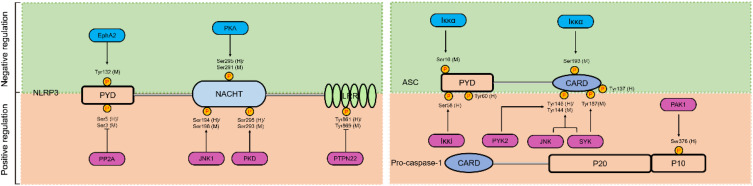
The role of phosphorylation in NLRP3 inflammasome activation. Phosphorylation plays a dual role in the activation of NLRP3 inflammasome. The pale green background represents phosphorylation of NLRP3 or ASC inhibits NLRP3 inflammasome activation, and the saffron yellow background represents phosphorylation of NLRP3 or pro-caspase-1 promote NLRP3 inflammasome activation. Activators and inhibitors of the NLRP3 inflammasome are represented by red and blue rounded rectangle, and phosphorylation sites on different domains of NLRP3 (LRR, NACHT, and PYD), ASC (PYD and CARD), and pro-caspase-1 (CARD, p10, and p20) from human and mouse species are indicated with (h) and (m), respectively.
Figure 5
Figure 5
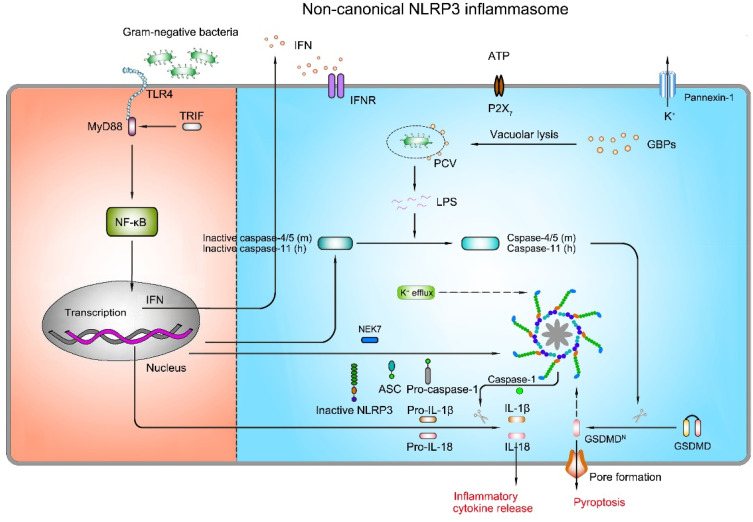
Mechanism of activation for non-canonical NLRP3 inflammasome pathway. The non-canonical NLRP3 inflammasome activation is induced by LPS of Gram-negative bacteria. Extracellular LPS induces the expression of pro-IL-1β, pro-IL-18, NLRP3, and type I interferon (IFN) via the TLR4/TRIF/MyD88-dependent pathway. IFN provides a feedback loop and activates type I interferon receptor (IFNR) to induce caspase-4/5 (mouse) or caspase-11 (human) expression. Guanylate-binding proteins (GBPs) are recruited to the pathogen-containing vacuole (PCV), where they mediate rupture of the PCV to permit the LPS release into the cytoplasm. Gram-negative bacteria deliver LPS into the cytosol. Cytosolic LPS binds to caspase-11 leading to caspase-11 activation. Activated caspase-11 then drives pyroptosis and activation of the non-canonical NLRP3 inflammasome.
Figure 6
Figure 6
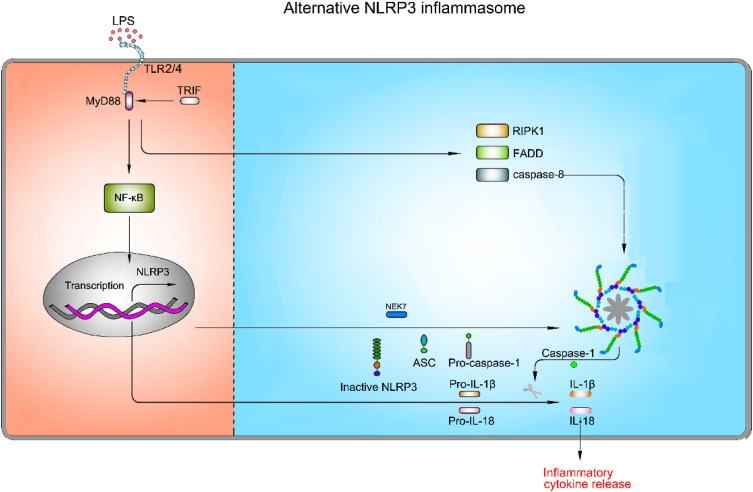
Mechanism of activation for alternative NLRP3 inflammasome pathway. The alternative NLRP3 inflammasome pathway is triggered by TLR2/TLR4. LPS binds to TLR2/TLR4, which results in up-regulation of pro-1β, pro-18, and NLRP3 via the NF-κB signaling pathway. However, this type of NLRP3 inflammasome activation is mediated by the TRIF-RIPK1-FADD-caspase-8 axis, whereas K+ efflux, ASC speck formation and pyroptosis are not required in this pathway.
Figure 7
Figure 7
Possible factors that are involved in NLRP3 inflammasome activation. Many risks influence different cells so as to affect human bodies by activating NLRP3 inflammasome.

References

    1. Ezzati M, Obermeyer Z, Tzoulaki I, Mayosi BM, Elliott P, Leon DA. Contributions of risk factors and medical care to cardiovascular mortality trends. Nat Rev Cardiol. 2015;12(9):508–530. doi: 10.1038/nrcardio.2015.82 - DOI - PMC - PubMed
    1. Tall AR, Yvan-Charvet L. Cholesterol, inflammation and innate immunity. Nat Rev Immunol. 2015;15(2):104–116. doi: 10.1038/nri3793 - DOI - PMC - PubMed
    1. Libby P, Hansson GK. Inflammation and immunity in diseases of the arterial tree: players and layers. Circ Res. 2015;116(2):307–311. doi: 10.1161/CIRCRESAHA.116.301313 - DOI - PMC - PubMed
    1. Kim YK, Shin JS, Nahm MH. NOD-like receptors in infection, immunity, and diseases. Yonsei Med J. 2016;57(1):5–14. doi: 10.3349/ymj.2016.57.1.5 - DOI - PMC - PubMed
    1. Newton K, Dixit VM. Signaling in innate immunity and inflammation. Cold Spring Harb Perspect Biol. 2012;4(3):a006049–a006049. doi: 10.1101/cshperspect.a006049 - DOI - PMC - PubMed