


Review
doi: 10.1016/j.bjae.2021.07.009.
Epub 2021 Oct 14.
Drug-receptor interactions in anaesthesia
Affiliations
- PMID: 34992797
- PMCID: PMC8703152
- DOI: 10.1016/j.bjae.2021.07.009
Item in Clipboard
Review
Drug-receptor interactions in anaesthesia
BJA Educ.
2022 Jan.
No abstract available
Keywords: drug action; opioid; pharmacology; receptors.
Conflict of interest statement
DGL is chair of the board of the British Journal of Anaesthesia, He is also a non-executive director of Cellomatics and has previously has held consultancy and received funding from Grunenthal. JM declares no conflicts of interest.
Figures

Images and facts for the different receptor types regarding how they function to produce changes in cellular activity. GABA, gamma-aminobutyric acid type A; MOP, mu opioid receptor; CNS, central nervous system.
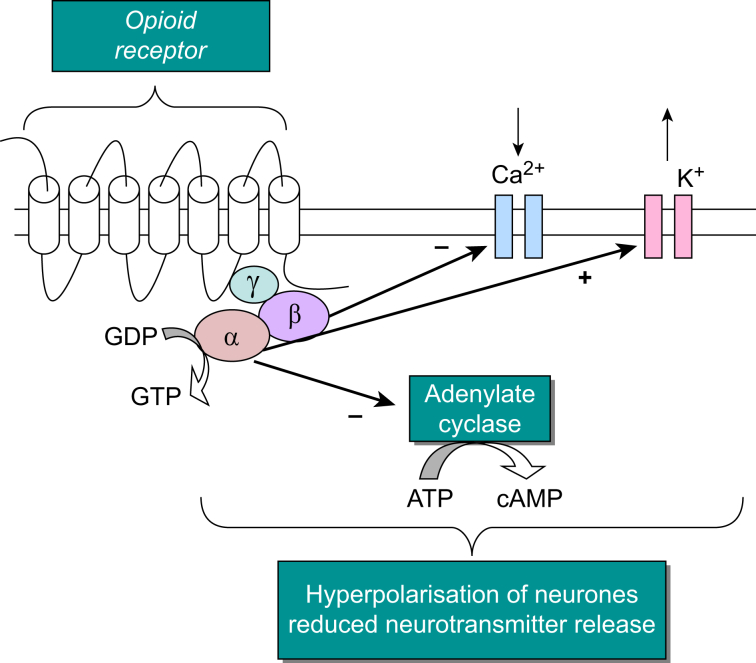
Depiction of the intracellular responses and pathways after the binding of an opioid agonist to a G-protein-coupled opioid receptor, for example morphine binding the (μ)MOP receptor. Image adapted from McDonald and Lambert. ATP, adenosine triphosphate; cAMP, cyclic adenosine monophosphate; GDP, guanosine diphosphate; GPCR, G-protein coupled receptor; GTP, guanosine-5′-triphosphate; MOP, mu opioid receptor.
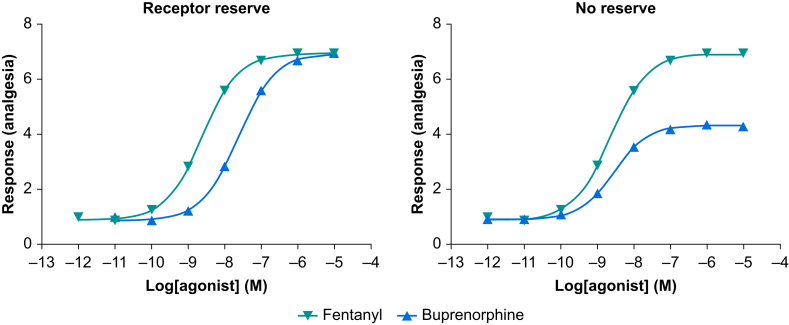
Hypothetical concentration response curves for the full MOP agonist fentanyl and the partial MOP agonist buprenorphine in a tissue preparation (receptor system) containing a receptor reserve (i.e. a high density of receptors, not all of which need to be occupied to give a maximal tissue response) and a tissue preparation where there is no receptor reserve (i.e. 100% occupancy of receptors is needed to generate a maximal tissue response). The functional response of the lower efficacy partial agonist buprenorphine is susceptible to the change in receptor density between tissues whereas the higher efficacy of the full agonist fentanyl results in a maximal functional response in both tissues. MOP, μ-opioid receptor.

Response profiles for unbiased and biased agonists acting at the MOP receptor. (a) An unbiased agonist would have efficacy for both the G–protein pathway (green) and beta–arrestin pathway (red) leading to analgesia and adverse effects. (b) A drug with bias for the G-protein signalling pathway, would lead to analgesia but with reduced adverse effects. (c) A drug with a bias for the β-arrestin pathway would lead a higher incidence of adverse effects and reduced analgesic efficacy, taken from Azzam and colleagues. MOP, μ-opioid receptor.
References
-
- Azzam A.A.H., McDonald J., Lambert D.G. Hot topics in opioid pharmacology: mixed and biased opioids. Br J Anaesth. 2019;122:e136–e145. - PubMed
-
- Wootten D., Christopoulos A., Marti-Solano M., et al. Mechanisms of signalling and biased agonism in G protein-coupled receptors. Nat Rev Mol Cell Biol. 2018;19:638–653. - PubMed
-
- Lambert D.G. Drugs and receptors. Contin Educ Anaesth Crit Care Pain. 2006;4:181–184.
-
- McDonald J., Lambert D.G. Opioid receptors. BJA Educ. 2015;15:219–224.
Additional general reading
-
- Rang H.P., Ritter J.M., Flower R.J., Henderson G., editors. Rang and dales pharmacology. 8th Edn. Elsevier; 2015.
Publication types
LinkOut - more resources
Full Text Sources
Other Literature Sources
