


Chicken Coccidiosis: From the Parasite Lifecycle to Control of the Disease
- PMID: 34993246
- PMCID: PMC8724208
- DOI: 10.3389/fvets.2021.787653
Chicken Coccidiosis: From the Parasite Lifecycle to Control of the Disease
Abstract
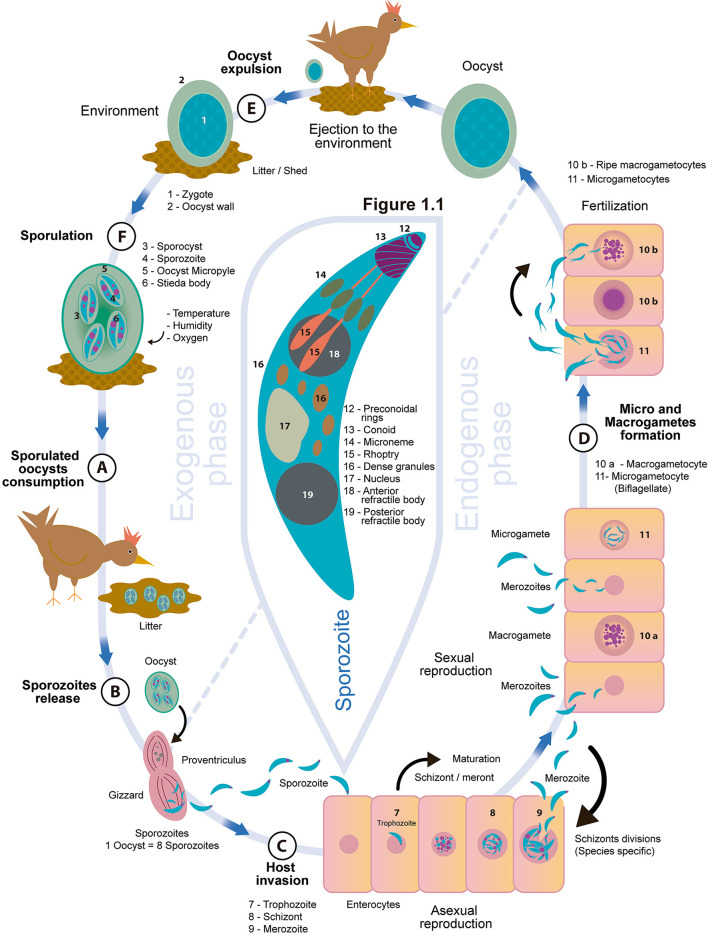
The poultry industry is one of the main providers of protein for the world's population, but it faces great challenges including coccidiosis, one of the diseases with the most impact on productive performance. Coccidiosis is caused by protozoan parasites of the genus Eimeria, which are a group of monoxenous obligate intracellular parasites. Seven species of this genus can affect chickens (Gallus gallus), each with different pathogenic characteristics and targeting a specific intestinal location. Eimeria alters the function of the intestinal tract, generating deficiencies in the absorption of nutrients and lowering productive performance, leading to economic losses. The objective of this manuscript is to review basic concepts of coccidiosis, the different Eimeria species that infect chickens, their life cycle, and the most sustainable and holistic methods available to control the disease.
Keywords: Eimeria; anticoccidials; chickens; diagnostic; oocysts.
Copyright © 2021 Mesa-Pineda, Navarro-Ruíz, López-Osorio, Chaparro-Gutiérrez and Gómez-Osorio.
Conflict of interest statement
LG-O was employed by the company Alura Animal Health and Nutrition and CM-P was employed by the company Solla S.A. The remaining authors declare that the research was conducted in the absence of any commercial or financial relationships that could be construed as a potential conflict of interest.
Figures
References
-
- Bogosavljevic-Boskovic S, Mitrovic S, Djokovic R, Doskovic V, Djermanovic V. Chemical composition of chicken meat produced in extensive indoor and free range rearing systems. Afr J Biotechnol. (2010) 9:9069–75. 10.5897/AJB10.1084 - DOI
-
- USDA. Livestock and Poultry: World Markets and Trade. United States Department of Agriculture Foreign Agricultural Service January 10, 2020. (2020). Available at: https://apps.fas.usda.gov/psdonline/circulars/livestock_poultry.pdf. (accessed: March 10, 2021).
Publication types
LinkOut - more resources
Full Text Sources
Other Literature Sources
