Trauma-informed care: recognizing and resisting re-traumatization in health care
- PMID: 34993351
- PMCID: PMC8689164
- DOI: 10.1136/tsaco-2021-000815
Trauma-informed care: recognizing and resisting re-traumatization in health care
Abstract
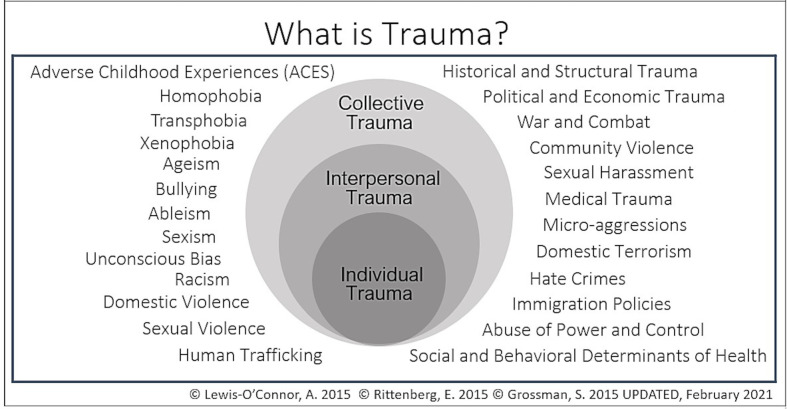
Trauma is often viewed as an individual or interpersonal issue. This paper expands the definition of trauma to include the impact collective and structural elements on health and well-being. The need for a trauma-informed response is demonstrated, with instruction as to how to implement this type of care in order to resist re-traumatization. Three examples from healthcare settings across the nation are provided, to demonstrate the ways in which organizations are bringing forward this patient-centered, trauma-informed approach to care.
Keywords: patient-centered care; post-traumatic; stress disorders; vulnerable populations.
© Author(s) (or their employer(s)) 2021. Re-use permitted under CC BY-NC. No commercial re-use. See rights and permissions. Published by BMJ.
Conflict of interest statement
Competing interests: The curriculum used in the OHSU study included text from the book Training for Change: Transforming Systems to be Trauma-Informed, Culturally Responsive, and Neuroscientifically Focused written by Dr Alisha Moreland. This is the only related disclosure.
Figures
References
-
- CNTR . Coalition for National Trauma Research. 2021. https://www.east.org/content/documents/cntr_infopiece.pdf.
-
- Felitti VJ, Anda RF, Nordenberg D, Williamson DF, Spitz AM, Edwards V, Koss MP, Marks JS. Relationship of childhood abuse and household dysfunction to many of the leading causes of death in adults. The Adverse Childhood Experiences (ACE) Study. Am J Prev Med 1998;14:245–58. 10.1016/s0749-3797(98)00017-8 - DOI - PubMed
-
- Merrick MT, Ford DC, Ports KA, Guinn AS, Chen J, Klevens J, Metzler M, Jones CM, Simon TR, Daniel VM, et al. . Vital Signs: Estimated Proportion of Adult Health Problems Attributable to Adverse Childhood Experiences and Implications for Prevention – 25 States, 2015–2017. MMWR Morb Mortal Wkly Rep 2019;68:999–1005. 10.15585/mmwr.mm6844e1 - DOI - PMC - PubMed
-
- Kelly-Irving M, Delpierre C. A critique of the adverse childhood experiences framework in epidemiology and public health: uses and misuses. Social Policy and Society 2019;18:445–56. 10.1017/S1474746419000101 - DOI
Publication types
LinkOut - more resources
Full Text Sources