. 2022 Jan 13;3(1):100070.
doi: 10.1016/j.xhgg.2021.100070. Epub 2021 Nov 19.

Genetic Factors Associated with Prostate Cancer Conversion from Active Surveillance to Treatment

Yu Jiang  1   2 Travis J Meyers  1   2 Adaeze A Emeka  3 Lauren Folgosa Cooley  3 Phillip R Cooper  3 Nicola Lancki  4 Irene Helenowski  4 Linda Kachuri  1 Daniel W Lin  5   6 Janet L Stanford  7   8 Lisa F Newcomb  5   6 Suzanne Kolb  7   8 Antonio Finelli  9 Neil E Fleshner  9 Maria Komisarenko  9 James A Eastham  10 Behfar Ehdaie  10 Nicole Benfante  10 Christopher J Logothetis  11 Justin R Gregg  11 Cherie A Perez  11 Sergio Garza  11 Jeri Kim  11 Leonard S Marks  12 Merdie Delfin  12 Danielle Barsa  12 Danny Vesprini  13 Laurence H Klotz  13 Andrew Loblaw  13 Alexandre Mamedov  13 S Larry Goldenberg  14 Celestia S Higano  14 Maria Spillane  14 Eugenia Wu  14 H Ballentine Carter  15 Christian P Pavlovich  15 Mufaddal Mamawala  15 Tricia Landis  15 Peter R Carroll  16 June M Chan  1   16 Matthew R Cooperberg  16   17 Janet E Cowan  16 Todd M Morgan  18 Javed Siddiqui  19 Rabia Martin  19 Eric A Klein  20 Karen Brittain  20 Paige Gotwald  20 Daniel A Barocas  21 Jeremiah R Dallmer  21   22 Jennifer B Gordetsky  21   23 Pam Steele  21 Shilajit D Kundu  3 Jazmine Stockdale  3 Monique J Roobol  24 Lionne D F Venderbos  24 Martin G Sanda  25 Rebecca Arnold  25 Dattatraya Patil  25 Christopher P Evans  26 Marc A Dall'Era  26 Anjali Vij  26 Anthony J Costello  27 Ken Chow  27 Niall M Corcoran  27 Soroush Rais-Bahrami  28   29 Courtney Phares  28 Douglas S Scherr  30 Thomas Flynn  30 R Jeffrey Karnes  31 Michael Koch  32 Courtney Rose Dhondt  32 Joel B Nelson  33 Dawn McBride  33 Michael S Cookson  34 Kelly L Stratton  34 Stephen Farriester  34 Erin Hemken  34 Walter M Stadler  35 Tuula Pera  35 Deimante Banionyte  35 Fernando J Bianco Jr  36 Isabel H Lopez  36 Stacy Loeb  37 Samir S Taneja  37 Nataliya Byrne  37 Christopher L Amling  38 Ann Martinez  38 Luc Boileau  38 Franklin D Gaylis  39 Jacqueline Petkewicz  40 Nicholas Kirwen  40 Brian T Helfand  40 Jianfeng Xu  40 Denise M Scholtens  4 William J Catalona  3   41 John S Witte  1   16   17   42   41
Affiliations

Genetic Factors Associated with Prostate Cancer Conversion from Active Surveillance to Treatment

Yu Jiang et al. HGG Adv. .

Abstract

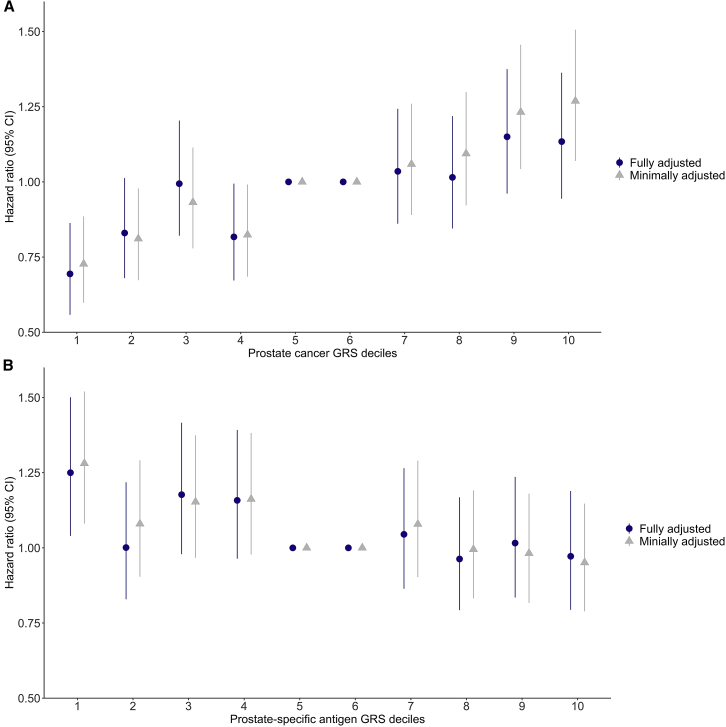
Men diagnosed with low-risk prostate cancer (PC) are increasingly electing active surveillance (AS) as their initial management strategy. While this may reduce the side effects of treatment for prostate cancer, many men on AS eventually convert to active treatment. PC is one of the most heritable cancers, and genetic factors that predispose to aggressive tumors may help distinguish men who are more likely to discontinue AS. To investigate this, we undertook a multi-institutional genome-wide association study (GWAS) of 5,222 PC patients and 1,139 other patients from replication cohorts, all of whom initially elected AS and were followed over time for the potential outcome of conversion from AS to active treatment. In the GWAS we detected 18 variants associated with conversion, 15 of which were not previously associated with PC risk. With a transcriptome-wide association study (TWAS), we found two genes associated with conversion (MAST3, p = 6.9×10⁻⁷ and GAB2, p = 2.0×10⁻⁶). Moreover, increasing values of a previously validated 269-variant genetic risk score (GRS) for PC was positively associated with conversion (e.g., comparing the highest to the two middle deciles gave a hazard ratio [HR] = 1.13; 95% Confidence Interval [CI]= 0.94-1.36); whereas, decreasing values of a 36-variant GRS for prostate-specific antigen (PSA) levels were positively associated with conversion (e.g., comparing the lowest to the two middle deciles gave a HR = 1.25; 95% CI, 1.04-1.50). These results suggest that germline genetics may help inform and individualize the decision of AS-or the intensity of monitoring on AS-versus treatment for the initial management of patients with low-risk PC.

Keywords: genetics; genome-wide association study; prostate; prostatic neoplasms.


Conflict of interest statement

Declaration of Interests The authors declare no competing interests.

Figures
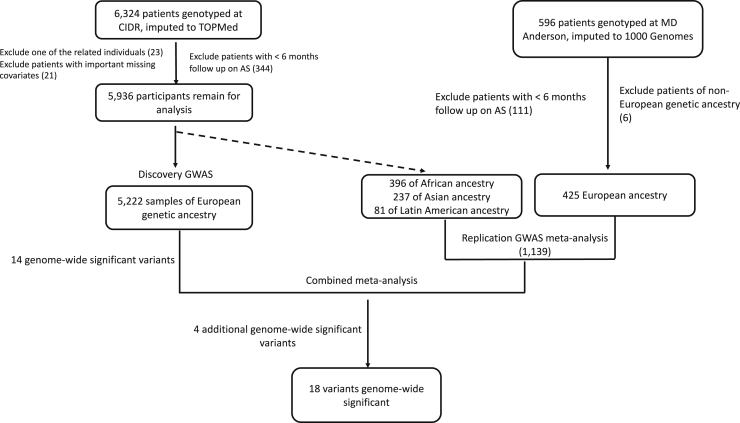
Figure 1
Figure 1
Flow chart highlighting the approach and samples used in the genome-wide association analysis First, we undertook a discovery GWAS in men of European ancestry. Fourteen variants were associated with conversion (p < 5 × 10−8). All variants were evaluated for replication in the replication cohorts alone and then in a meta-analysis combining the discovery and replication cohorts. Four additional variants reached statistical significance in the combined meta-analysis (p < 5 × 10−8).
Figure 2
Figure 2
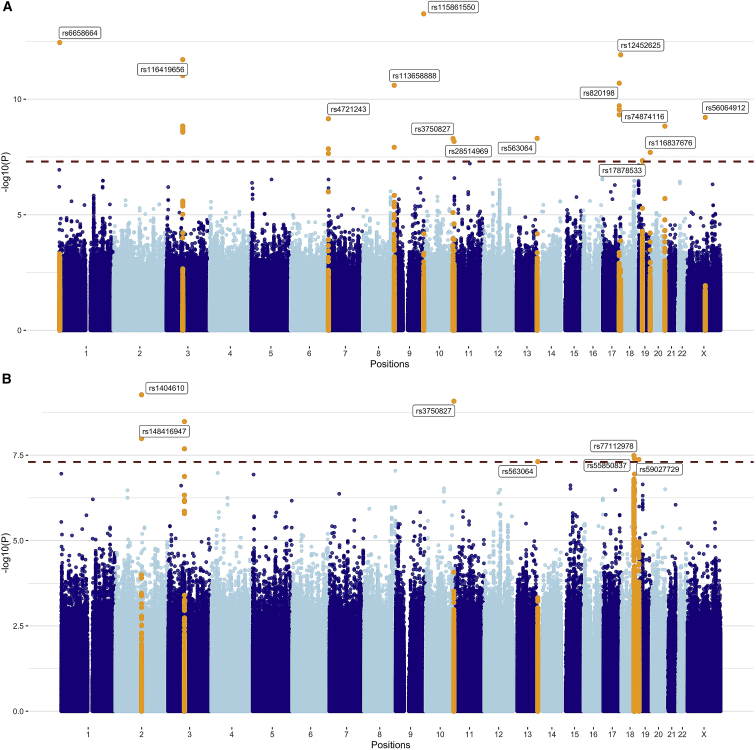
Results from the GWASs of conversion from AS to treatment (A) in 5,222 prostate cancer (PC) patients of European ancestry; and (B) in discovery and replication cohorts. p values are for variant associations with conversion, adjusted for age and 10 ancestry principal components using Cox proportional hazards models. Blue dashed line denotes the genome-wide significance threshold. Orange peaks indicate genome-wide significant hits (p < 5 × 10−8). The top variants in each chromosome are annotated with their rsID.
Figure 3
Figure 3
Association between time to conversion from AS to treatment (A) with the PC genetic risk score (GRS); and (B) with the prostate-specific antigen (PSA) GRS. The fifth and sixth deciles of PC GRSs are used as the reference. Bars indicate 95% confidence intervals (CIs) around the hazard ratio (HR) estimates. The minimally adjusted model includes age and the first 10 genetic principal components. The fully adjusted model also includes Gleason grade group (GG1, GG2, or ≥GG3), PSA concentration (ng/mL), clinical stage (cT1, cT2, or cT3/cT4), and number of positive biopsy cores (1–2, 3, or ≥4).
Figure 4
Figure 4
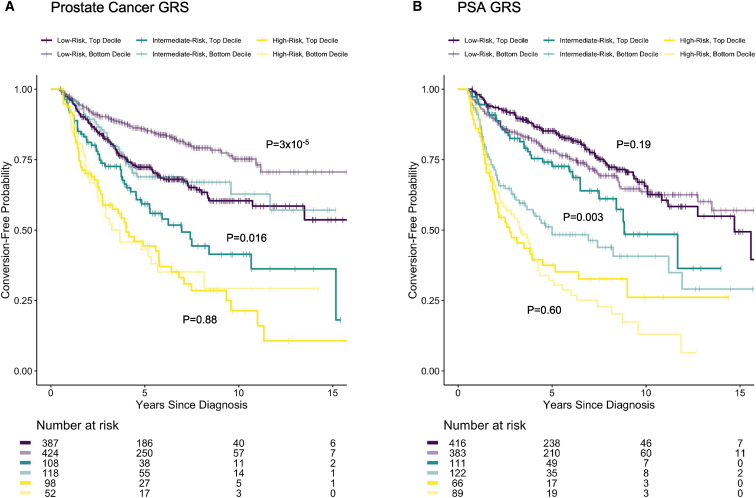
Kaplan-Meier plots of active surveillance conversion-free probability for low, intermediate, and high clinicopathological risk categories The plots are stratified by the top and bottom deciles of GRSs for PC (GRSPC, A) and for PSA levels (GRSPSA, B). The curves within each risk category are compared between the top and bottom GRS deciles using a log-rank test (p values given next to corresponding curves).

References

    1. Washington S.L., 3rd, Jeong C.W., Lonergan P.E., Herlemann A., Gomez S.L., Carroll P.R., Cooperberg M.R. Regional Variation in Active Surveillance for Low-Risk Prostate Cancer in the US. JAMA Netw. Open. 2020;3:e2031349. - PMC - PubMed
    1. Mohler J.L., Antonarakis E.S., Armstrong A.J., D’Amico A.V., Davis B.J., Dorff T., Eastham J.A., Enke C.A., Farrington T.A., Higano C.S., et al. Prostate Cancer, Version 2.2019, NCCN Clinical Practice Guidelines in Oncology. J. Natl. Compr. Canc. Netw. 2019;17:479–505. - PubMed
    1. Loeb S., Byrne N., Makarov D.V., Lepor H., Walter D. Use of Conservative Management for Low-Risk Prostate Cancer in the Veterans Affairs Integrated Health Care System From 2005-2015. JAMA. 2018;319:2231–2233. - PMC - PubMed
    1. Parikh R.B., Robinson K.W., Chhatre S., Medvedeva E., Cashy J.P., Veera S., Bauml J.M., Fojo T., Navathe A.S., Malkowicz S.B., et al. Comparison by Race of Conservative Management for Low-Risk and Intermediate-Risk Prostate Cancers in Veterans From 2004 to 2018. JAMA Netw. Open. 2020;3:e2018318. - PMC - PubMed
    1. Loeb S., Folkvaljon Y., Curnyn C., Robinson D., Bratt O., Stattin P. Uptake of Active Surveillance for Very-Low-Risk Prostate Cancer in Sweden. JAMA Oncol. 2017;3:1393–1398. - PMC - PubMed