


The stability of autistic traits in transgender adults following cross-sex hormone treatment
- PMID: 34993521
- PMCID: PMC8726673
- DOI: 10.1080/26895269.2020.1783738
The stability of autistic traits in transgender adults following cross-sex hormone treatment
Abstract
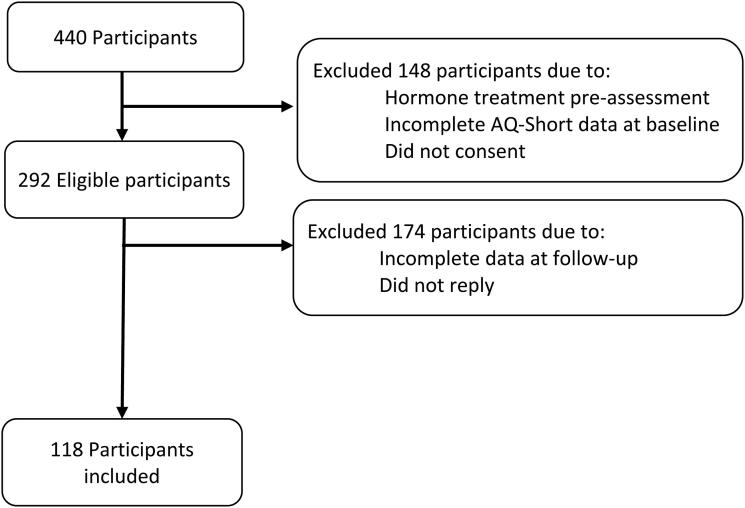
Background: Recent research has shown that a high percentage of treatment-seeking transgender adults who were assigned female at birth (AFAB) reported scores above the clinical cutoff for autistic traits. It is unclear whether those scores reflect a stable trait or may be inflated by the high levels of anxiety typically associated with transgender people attending clinical services. Aims: This longitudinal study aims to explore the impact of Cross-sex Hormone Treatment (CHT) on levels autistic traits, independent of changes in anxiety. Method: Transgender adults who were assessed at a national transgender health service in the UK, who had not previously received CHT and who had completed the AQ-Short as a measure of autistic traits pre- and one-year post-CHT were included in the study (n = 118). Anxiety was assessed at the same time points using the Hospital Anxiety and Depression Scale. Results: AQ-Short scores remained very stable over time (ICC = 0.7; CIs 0.591-0.779) but anxiety showed little consistency (ICC = 0.386; CIs 0.219 to 0.531). Repeated measures ANOVA found a main effect of assigned sex with AFAB having higher AQ-Short scores. There was no change in AQ-Short scores and no significant interaction between assigned sex and change in AQ-Short scores. Conclusion: This study confirmed that treatment seeking transgender AFAB people have higher levels of autistic traits at follow-up compared to AMAB transgender people and that these traits are stable following one year of CHT regardless of assigned sex. This may have clinical implications regarding the support that transgender people may require following medical transition.
Keywords: anxiety; autism spectrum conditions; autistic traits; cross-sex hormone treatment; gender dysphoria; transgender.
© 2020 Taylor & Francis Group, LLC.
Figures
References
LinkOut - more resources
Full Text Sources
