Association Between Assistance With Medicaid Enrollment and Use of Health Care After Incarceration Among Adults With a History of Substance Use
- PMID: 34994791
- PMCID: PMC8742194
- DOI: 10.1001/jamanetworkopen.2021.42688
Association Between Assistance With Medicaid Enrollment and Use of Health Care After Incarceration Among Adults With a History of Substance Use
Abstract
Importance: The transition from prison to community is characterized by elevated morbidity and mortality, particularly owing to drug overdose. However, most formerly incarcerated adults with substance use disorders do not use any health care, including treatment for substance use disorders, during the initial months after incarceration.
Objective: To evaluate whether a prerelease Medicaid enrollment assistance program is associated with increased health care use within 30 days after release from prison.
Design, setting, and participants: This retrospective cohort study included 16 307 adults aged 19 to 64 years with a history of substance use who were released from state prison between April 1, 2014, and December 31, 2016. The Wisconsin Department of Corrections implemented prerelease Medicaid enrollment assistance in January 2015. Statistical analysis was performed from January 1 to August 31, 2021.
Exposure: A statewide Medicaid prerelease enrollment assistance program.
Main outcomes and measures: The main outcome was Medicaid-reimbursed health care, associated with substance use disorders and for any cause, within 30 days of prison release, including outpatient, emergency department, and inpatient care. Mean outcomes were compared for those released before and after implementation of prerelease Medicaid enrollment assistance using an intention-to-treat analysis and person-level data from the Wisconsin Department of Corrections and Medicaid.
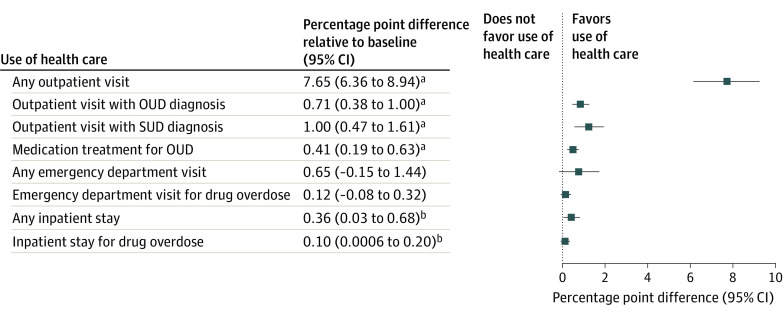
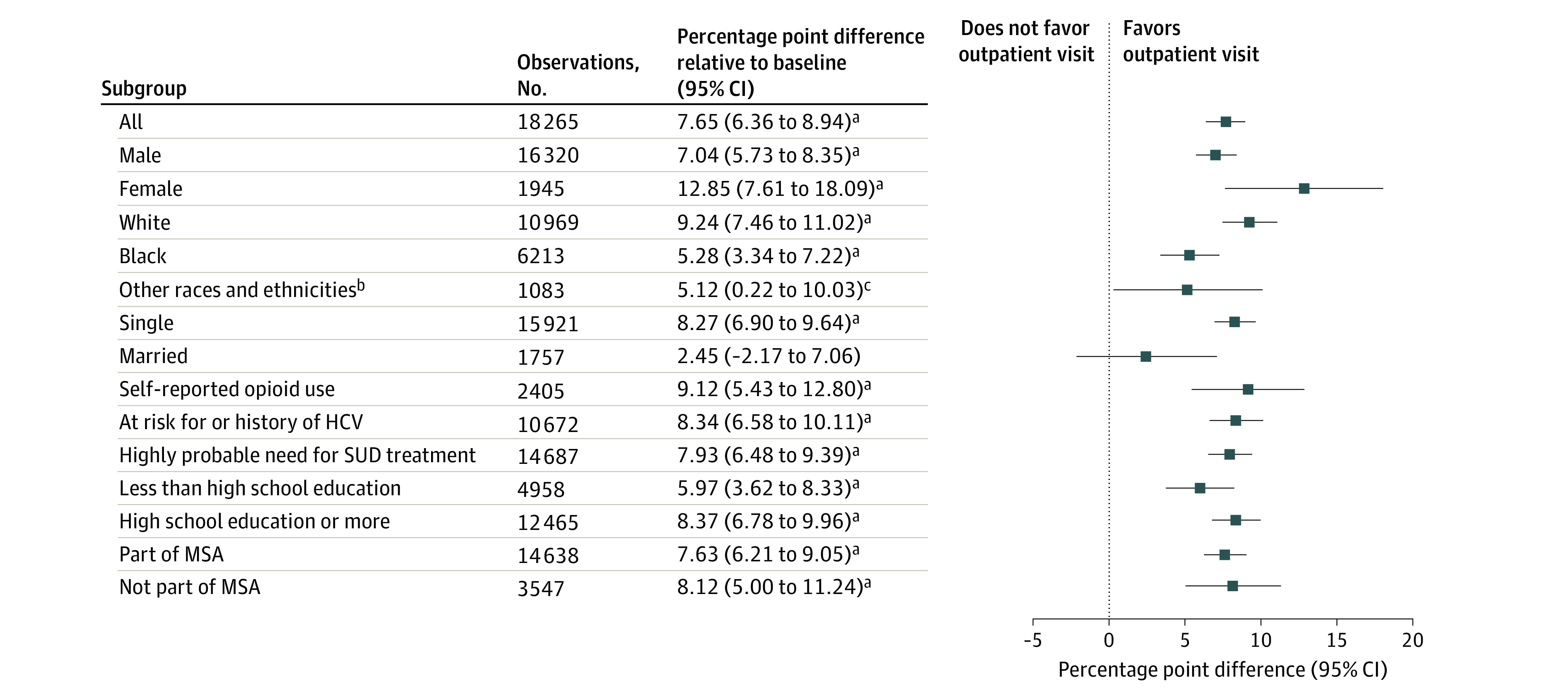
Results: The sample included 16 307 individuals with 18 265 eligible releases (men accounted for 16 320 of 18 265 total releases, and 6213 of 18 265 releases were among Black individuals; mean [SD] age at release, 35.5 [10.7] years). The likelihood of outpatient care use within 30 days of release increased after implementation of enrollment assistance relative to baseline by 7.7 percentage points for any visit (95% CI, 6.4-8.9 percentage points; P < .001), by 0.7 percentage points for an opioid use disorder visit (95% CI, 0.4-1.0 percentage points; P < .001), by 1.0 percentage point for any substance use disorder visit (95% CI, 0.5-1.6 percentage points; P < .001), and by 0.4 percentage points for receipt of medication for opioid use disorder (95% CI, 0.2-0.6 percentage points; P < .001). There was no significant change in use of the emergency department (0.7 percentage points [95% CI, -0.15 to 1.4 percentage points]). The probability of an inpatient stay increased by 0.4 percentage points (95% CI, 0.03-0.7 percentage points; P = .03).
Conclusions and relevance: The results of this cohort study suggest that prerelease Medicaid enrollment assistance was associated with increased use of outpatient health care after incarceration and highlights the value of making this assistance universally available within correctional settings. More tailored interventions may be needed to increase the receipt of treatment for substance use disorders.
Conflict of interest statement
Figures
Comment in
-
Medicaid Enrollment Assistance for People Released From Prison-One Step on a Long Road.JAMA Netw Open. 2022 Jan 4;5(1):e2142695. doi: 10.1001/jamanetworkopen.2021.42695. JAMA Netw Open. 2022. PMID: 34994798 No abstract available.
References
-
- Carson EA. Prisoners in 2019. Bureau of Justice Statistics, US Department of Justice. October 2020. Accessed March 2, 2021. https://bjs.ojp.gov/content/pub/pdf/p19.pdf
-
- American Psychiatric Association . Diagnostic and Statistical Manual of Mental Disorders. 4th ed. American Psychiatric Association; 1994.
-
- Bronson J, Stroop J, Zimmer S, Berzofsky M. Drug use, dependence, and abuse among state prisoners and jail inmates, 2007-2009. Bureau of Justice Statistics, US Department of Justice. June 2017. Accessed January 27, 2021. https://bjs.ojp.gov/content/pub/pdf/dudaspji0709.pdf
-
- Mallik-Kane K, Visher CA. Health and Prisoner Reentry: How Physical, Mental, and Substance Abuse Conditions Shape the Process of Reintegration. Urban Institute; 2008.
MeSH terms
Grants and funding
LinkOut - more resources
Full Text Sources
Medical
Miscellaneous