


Comment
doi: 10.1016/j.jhep.2021.12.030.
Epub 2022 Jan 5.
Mathematical modeling suggests that entry-inhibitor bulevirtide may interfere with hepatitis D virus clearance from circulation
Affiliations
- PMID: 34995688
- PMCID: PMC9018506
- DOI: 10.1016/j.jhep.2021.12.030
Item in Clipboard
Comment
Mathematical modeling suggests that entry-inhibitor bulevirtide may interfere with hepatitis D virus clearance from circulation
J Hepatol.
2022 May.
No abstract available
Keywords: HDV kinetics; bulevirtide; mathematical modeling.
Conflict of interest statement
Conflicts of interest The authors declare no conflicts of interest that pertain to this work. Please refer to the accompanying ICMJE disclosure forms for further details.
Figures
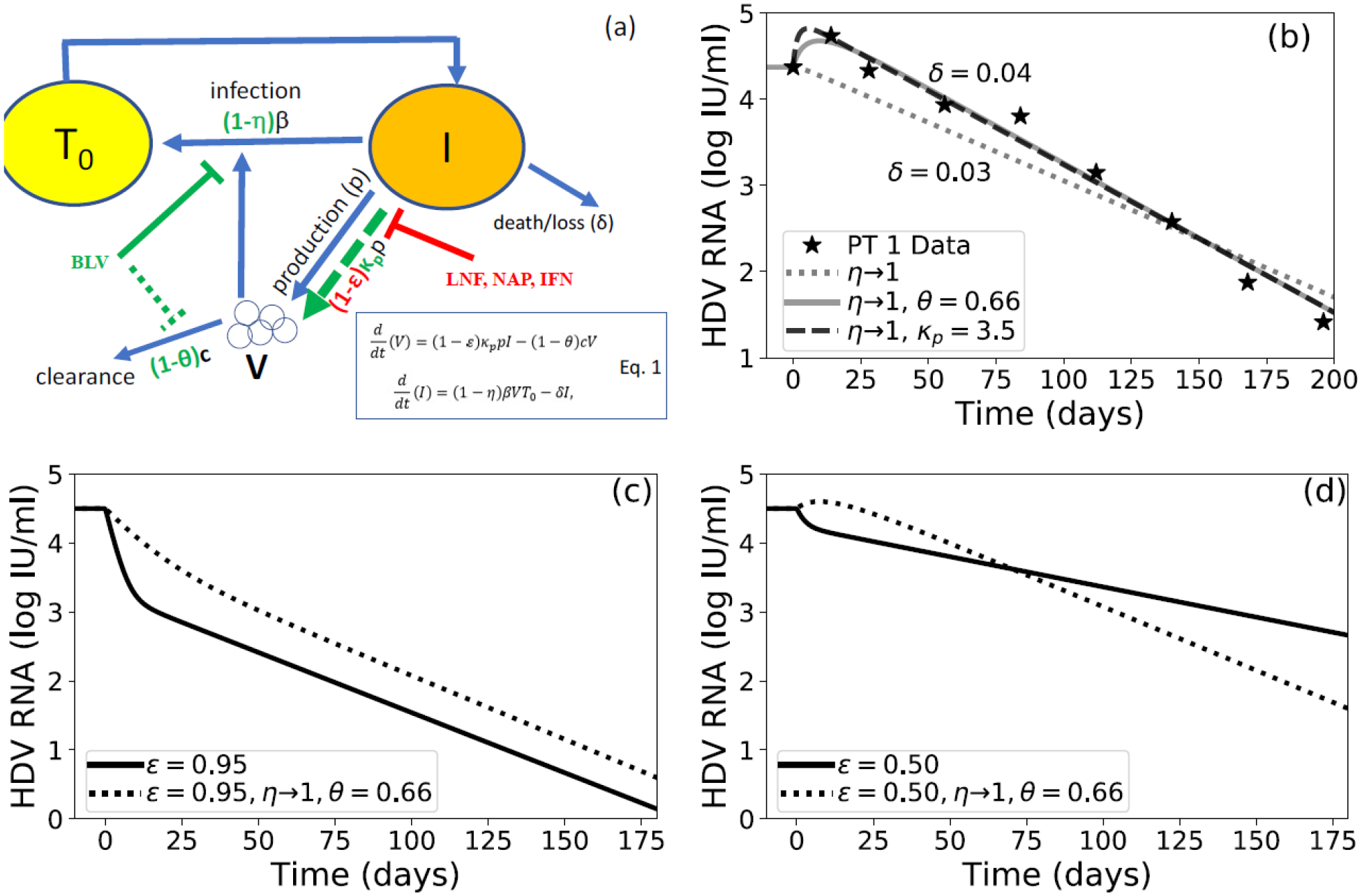
(a) Schematic and model equations (Eq. 1) of HDV infection and treatment. Target cells, T0, become HDV-infected cells, I, at rate β. Infected cells are then lost or die at rate δ. Infected cells also produce virions, V, at rate p. Virions in circulation are cleared at rate c. Bulevirtide (BLV) known mode of action (MOA) in blocking entry/infection is shown using solid green line (parameter η) and theoretical MOA are shown using dashed green lines (parameters θ representing reduced viral clearance and κp representing increase of viral production). Blocking HDV production by interferon-α (IFN), lonafarnib (LNF) or nucleic acid polymer (NAP) is shown using red symbols (parameter ε). (b) Model fitting, using Python version 3.7.4 and Scipy version 1.3.1, with measured HDV kinetics from patient 1 in [1] (symbols) assuming BLV MOA is blocking only viral infection (η~100%) does not fit the data well (dotted line). Assuming that in additional to BLV η~100%, viral clearance decreases (θ=66%, dashed line) or viral production increases (κp=3.5, solid line) fits the data well. Fixed parameters were c=0.42 day−1, p=10 virions/infected cell/day, and β=1e-7 mL ·virions−1·day−1. Initial conditions were set such that V0 equaled its value at the first data point, and I0 and T0 were set by steady state conditions as done in [6]. (c) Model simulations of HDV decline under antivirals that block HDV production (ε=95%, solid line) alone or in combination with BLV (ε=95%, η~100%) assuming a BLV-induced decrease in viral clearance of θ=66% (dashed line). We fixed δ=0.042 day−1 with other model parameters fixed as described in (b). (d) Same as (c) but with ε=50%.
Comment on
-
Safety and effectiveness of up to 3 years' bulevirtide monotherapy in patients with HDV-related cirrhosis.J Hepatol. 2022 Feb;76(2):464-469. doi: 10.1016/j.jhep.2021.10.012. Epub 2021 Oct 23. J Hepatol. 2022. PMID: 34699951
References
-
- Loglio A, Ferenci P, Uceda Renteria SC, Tham CYL, Scholtes C, Holzmann H, et al. Safety and effectiveness of up to 3 years’ bulevirtide monotherapy in patients with HDV-related cirrhosis. Journal of Hepatology. 2021. in press. - PubMed
-
- Urban S, Bartenschlager R, Kubitz R, Zoulim F. Strategies to inhibit entry of HBV and HDV into hepatocytes. Gastroenterology. 2014;147(1):48–64. - PubMed
-
- Goyal A Modeling HBV DNA and ALT responses observed under an entry inhibitor in HBV monoinfected individuals supports heterogeneity in the infected cell population. 5th Workshop on Virus Dynamics. https://www.fredhutch.org/en/events/workshop-on-virus-dynamics/agenda.ht....
Publication types
MeSH terms
Substances
Grants and funding
LinkOut - more resources
Full Text Sources
