


Serum neurofilament light chain level as a predictor of cognitive stage transition
- PMID: 34996525
- PMCID: PMC8742445
- DOI: 10.1186/s13195-021-00953-x
Serum neurofilament light chain level as a predictor of cognitive stage transition
Abstract
Background: Neurofilament light chain (NFL) level has been suggested as a blood-based biomarker for neurodegeneration in dementia. However, the association between baseline NFL levels and cognitive stage transition or cortical thickness is unclear. This study aimed to investigate whether baseline NFL levels are associated with cognitive stage transition or cortical thickness in mild cognitive impairment (MCI) and cognitively unimpaired (CU) participants.
Methods: This study analyzed data on participants from the independent validation cohort of the Korea Brain Aging Study for the Early Diagnosis and Prediction of Alzheimer's disease (KBASE-V) study. Among the participants of KBASE-V study, 53 MCI and 146 CU participants who were followed up for ≥ 2 years and had data on the serum NFL levels were eligible for inclusion in this study. Participants were classified into three groups according to baseline serum NFL levels of low, middle, or high.
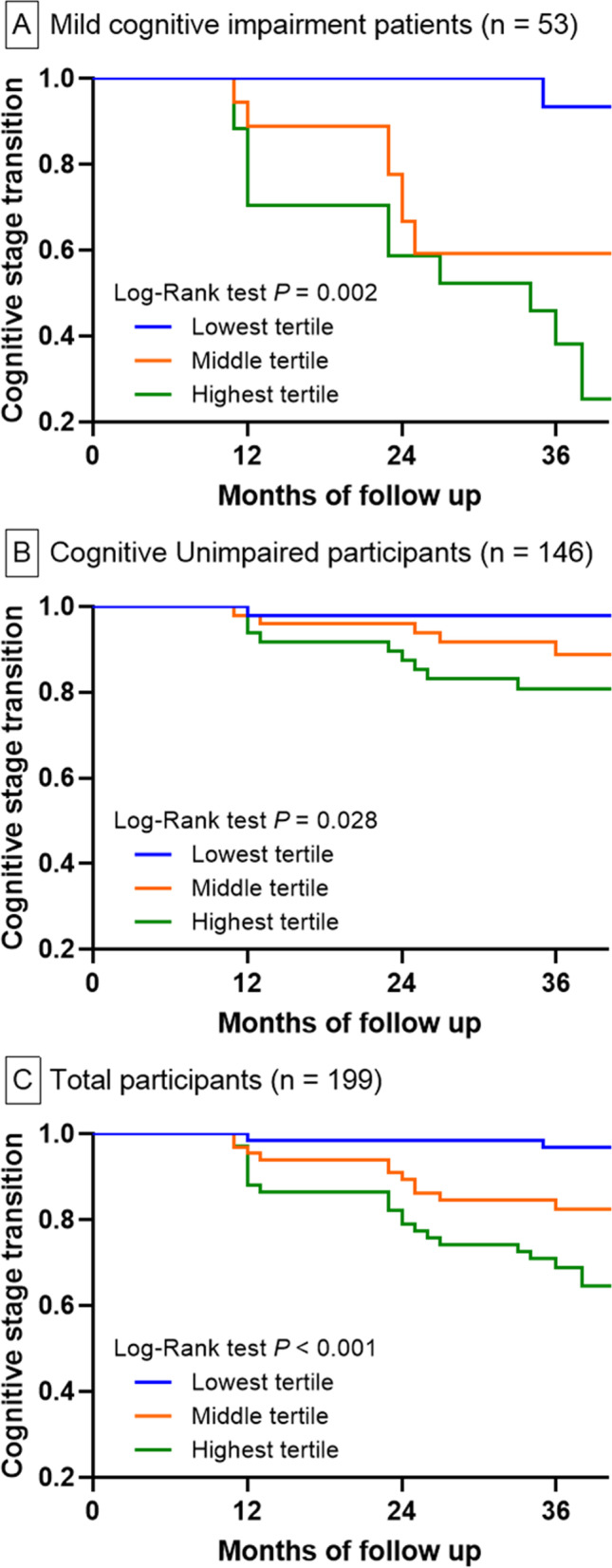
Results: The Kaplan-Meier analysis showed association between the serum NFL tertiles and risk of cognitive stage transition in MCI (P = 0.002) and CU (P = 0.028) participants, analyzed separately. The same is true upon analysis of MCI and CU participants together (P < 0.001). In MCI participants, the highest serum NFL tertile and amyloid-beta positivity were independent predictors for cognitive stage transition after adjusting for covariates. For CU participants, only amyloid-beta positivity was identified to be an independent predictor.
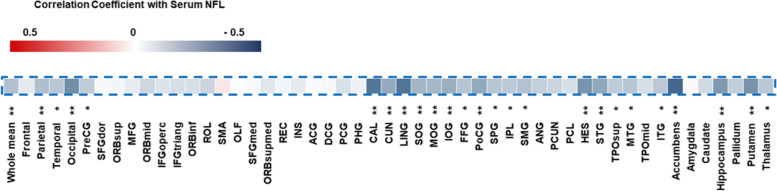
Conclusion: The study shows that higher serum NFL tertile levels correlate with increased risk of cognitive stage transition in both MCI and CU participants. Serum NFL levels were negatively correlated with the mean cortical thickness of the whole-brain and specific brain regions.
Keywords: Alzheimer’s disease; Amyloid pathology; Cognitive stage; Cortical thickness; Neurofilament light chain.
© 2022. The Author(s).
Conflict of interest statement
The authors declare that they have no competing interests.
Figures
References
-
- Sperling RA, Aisen PS, Beckett LA, Bennett DA, Craft S, Fagan AM, Iwatsubo T, Jack CR, Jr, Kaye J, Montine TJ, et al. Toward defining the preclinical stages of Alzheimer’s disease: recommendations from the National Institute on Aging-Alzheimer’s Association workgroups on diagnostic guidelines for Alzheimer’s disease. Alzheimers Dement. 2011;7(3):280–292. - PMC - PubMed
-
- Scheltens P, Blennow K, Breteler MM, de Strooper B, Frisoni GB, Salloway S, Van der Flier WM. Alzheimer’s disease. Lancet. 2016;388(10043):505–517. - PubMed
Publication types
MeSH terms
Substances
LinkOut - more resources
Full Text Sources
