


Prediction scenarios of past, present, and future environmental suitability for the Mediterranean species Arbutus unedo L
- PMID: 34997024
- PMCID: PMC8742115
- DOI: 10.1038/s41598-021-03996-0
Prediction scenarios of past, present, and future environmental suitability for the Mediterranean species Arbutus unedo L
Abstract
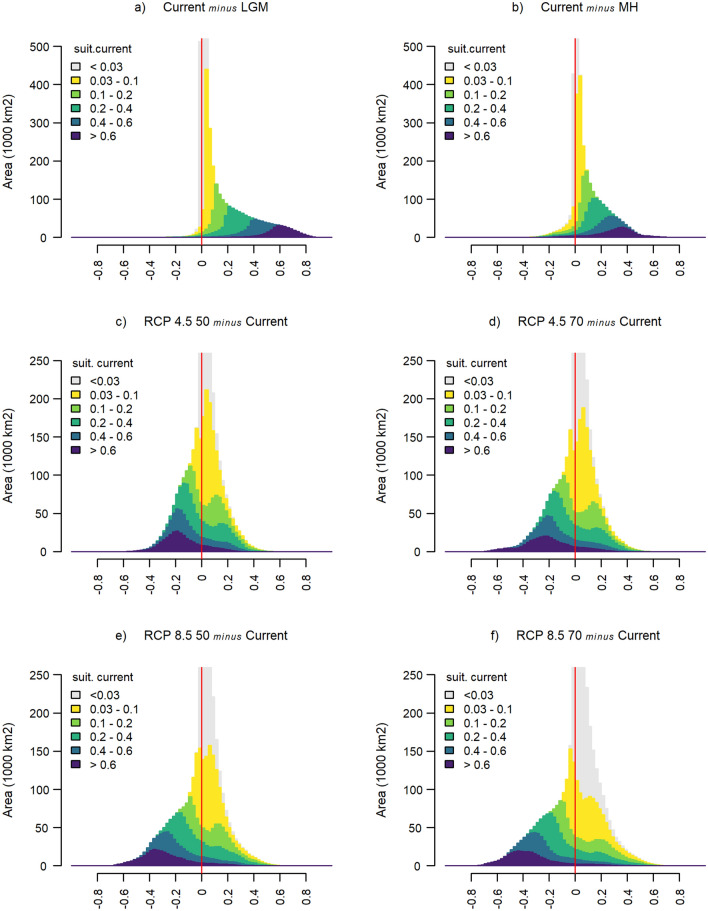
Climate change is a challenge for forests in the coming decades, with a major impact on species adaptation and distribution. The Mediterranean Basin is one of the most vulnerable hotspots for biodiversity conservation under climate change in the world. This research aimed at studying a Mediterranean species well adapted to the region: the Arbutus unedo L. (strawberry tree). The MaxEnt, a presence-only species-distribution software, was used to model A. unedo's environmental suitability. The current species potential distribution was accessed based on actual occurrences and selected environmental variables and subsequently projected for the Last Glacial Maximum (LGM), the Mid-Holocene (MH), and the years 2050 and 2070, considering the two Representative Concentration Pathways: RCP4.5 and RCP8.5. Results from the LGM projection suggest the presence of refugia in the core of the Mediterranean Basin, in particular the Iberian Peninsula (IP). The projections for the MH indicate increasing climatic suitability for the species and an eastward expansion, relatively to LGM. The predicted future environmental changes will most likely act as a catalyst for suitable habitat loss and a range shift towards the North is likely to occur.
© 2022. The Author(s).
Conflict of interest statement
The authors declare no competing interests.
Figures



References
-
- Barredo JI, Caudullo G, Dosio A. Mediterranean habitat loss under future climate conditions: assessing impacts on the Natura 2000 protected area network. Appl. Geogr. 2016;75:83–92. doi: 10.1016/j.apgeog.2016.08.003. - DOI
-
- Peñuelas J, et al. Impacts of global change on Mediterranean forests and their services. Forests. 2017;8:463. doi: 10.3390/f8120463. - DOI
-
- Carrión J, van Geel B. Fine-resolution Upper Weichselian and Holocene palynological record from Navarrés (Valencia, Spain) and a discussion about factors of Mediterranean forest succession. Rev. Palaeobot. Palyno. 1999;106:209–236. doi: 10.1016/S0034-6667(99)00009-3. - DOI
-
- Rick T, et al. Human-environmental interactions in Mediterranean climate regions from the Pleistocene to the Anthropocene. Anthropocene. 2020;31:100253. doi: 10.1016/j.ancene.2020.100253. - DOI
Publication types
Grants and funding
- Centro-01-0145-FEDER-000019 - C4 - Centro de Competências em Cloud Computing/Programa Operacional Regional do Centro (CENTRO 2020)
- Centro-01-0145-FEDER-000019 - C4 - Centro de Competências em Cloud Computing/Programa Operacional Regional do Centro (CENTRO 2020)
- Centro-01-0145-FEDER-000019 - C4 - Centro de Competências em Cloud Computing/Programa Operacional Regional do Centro (CENTRO 2020)
- Centro-01-0145-FEDER-000019 - C4 - Centro de Competências em Cloud Computing/Programa Operacional Regional do Centro (CENTRO 2020)
- Centro-01-0145-FEDER-000019 - C4 - Centro de Competências em Cloud Computing/Programa Operacional Regional do Centro (CENTRO 2020)
- UIDB/00239/2020/Fundação para a Ciência e a Tecnologia
- UIDB/00239/2020/Fundação para a Ciência e a Tecnologia
- UIDB/05183/2020/Fundação para a Ciência e a Tecnologia
- UIDB/00681/2020/Fundação para a Ciência e a Tecnologia
- UIDB/00681/2020/Fundação para a Ciência e a Tecnologia
- UIDB/05183/2020/Fundação para a Ciência e a Tecnologia
LinkOut - more resources
Full Text Sources
Miscellaneous
