


Emergence of two distinct variants of SARS-CoV-2 and an explosive second wave of COVID-19: the experience of a tertiary care hospital in Pune, India
- PMID: 35000004
- PMCID: PMC8742689
- DOI: 10.1007/s00705-021-05320-7
Emergence of two distinct variants of SARS-CoV-2 and an explosive second wave of COVID-19: the experience of a tertiary care hospital in Pune, India
Abstract
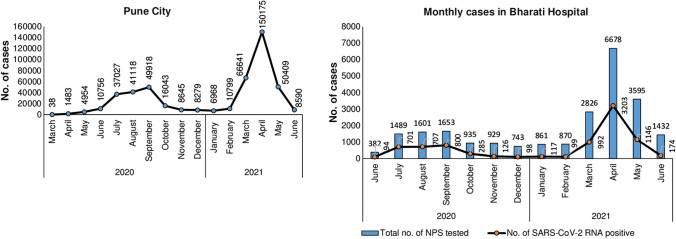
The emergence of novel variants of SARS-CoV-2 in several countries has been associated with increased transmissibility or reduced neutralization potential of antibodies against the Wuhan virus (wild type). From August 2021 onwards, India experienced a progressive decline in the number of active SARS-CoV-2 infections, indicative of a downward trend in the explosive second wave. This prospective study was conducted quarterly for one year (May 2020 to June 2021) at a tertiary care hospital in the city of Pune in western India. Receptor-binding domain (RBD, n = 319) and full genome (n = 20) sequences from viral-RNA-positive nasopharyngeal swabs of COVID-19 patients representing the first and second waves were used for analysis. No Brazilian, South African, or California variants were detected in this study. Until December 2020, only the wild-type strain was prevalent. Concurrent with the upsurge of the second wave in March 2021, 73% (33/45) of RBD sequences harboured L452R/E484Q mutations characteristic of the Kappa variant. In April 2021, co-circulation of Kappa (37%) and Delta (L452R/T478K, 59%) variants was recorded. During May and June 2021, the Delta variant became the predominant circulating variant, and this coincided with a significant decline in the number of COVID-19 cases. Of the 20 full genome sequences, six isolates each exhibited signature mutations of the Kappa and Delta variant. With several states witnessing a reduction in the number of COVID-19 cases, continuous monitoring of newer mutations and assessment of their effect on virus transmissibility and their impact on vaccinated or previously exposed individuals is necessary.
© 2021. The Author(s), under exclusive licence to Springer-Verlag GmbH Austria, part of Springer Nature.
Conflict of interest statement
None of the authors have any conflict of interest.
Figures
References
-
- Geneva: World Health Organization (2020) WHO coronavirus disease (COVID-19) dashboard. https://covid19.who.int/. Accessed 23 Apr 2021
-
- World Health Organization (2020) Status of COVID-19 vaccines within WHO EUL/PQ evaluation process. https://extranet.who.int/pqweb/sites/default/files/documents/Status_COVI.... Accessed 23 Apr 2021
-
- (2021) https://www.covid19india.org/state/TT. Accessed 23 Apr 2021
MeSH terms
Substances
Supplementary concepts
Grants and funding
LinkOut - more resources
Full Text Sources
Medical
Miscellaneous
