


Growth patterns of infants with in- utero HIV and ARV exposure in Cape Town, South Africa and Lusaka, Zambia
- PMID: 35000577
- PMCID: PMC8744341
- DOI: 10.1186/s12889-021-12476-z
Growth patterns of infants with in- utero HIV and ARV exposure in Cape Town, South Africa and Lusaka, Zambia
Abstract
Background: Infants born HIV-exposed yet remain uninfected (HEU) are at increased risk of poorer growth and health compared to infants born HIV-unexposed (HU). Whether maternal antiretroviral treatment (ART) in pregnancy ameliorates this risk of poorer growth is not well understood. Furthermore, whether risks are similar across high burden HIV settings has not been extensively explored.
Methods: We harmonized data from two prospective observational studies conducted in Cape Town, South Africa, and Lusaka, Zambia, to compare weight-for-age (WAZ), length-for-age (LAZ) and weight-for-length (WLZ) Z-scores between infants who were HEU and HU, converting infant anthropometric measures using World Health Organisation Growth Standards adjusted for age and sex. Linear mixed effects models were fit to identify risk factors for differences in anthropometrics at 6-10 weeks and 6 months by infant HIV exposures status and by timing of exposure to maternal ART, either from conception or later in gestation.
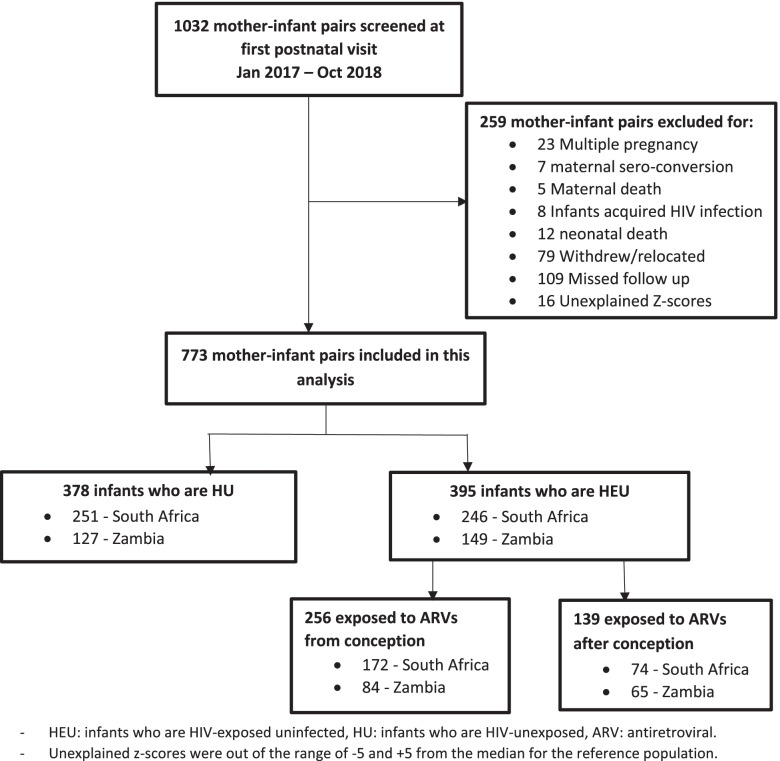
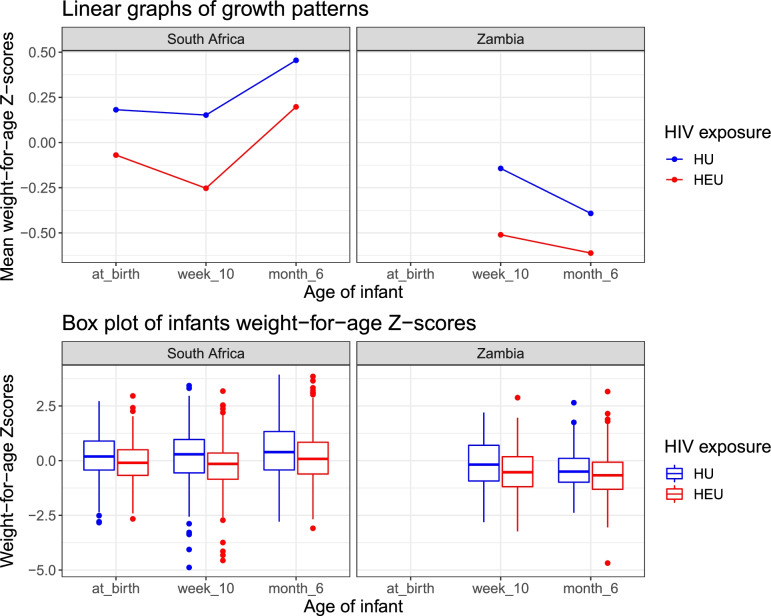
Results: Overall 773 mother-infant pairs were included across two countries: women living with HIV (WLHIV), 51% (n = 395) with 65% on ART at conception and 35% initiating treatment in pregnancy. In linear mixed effects models, WAZ and WLZ at 6-10 weeks were lower among infants who were HEU vs HU [β = - 0.29 (95% CI: - 0.46, - 0.12) and [β = - 0.42 (95% CI: - 0.68, - 0.16)] respectively after adjusting for maternal characteristics and infant feeding with a random intercept for country. At 6 months, LAZ was lower [β = - 0.28 CI: - 0.50, - 0.06)] among infants who were HEU, adjusting for the same variables, with no differences in WAZ and WLZ. Within cohort evaluations identified different results with higher LAZ among infants who were HEU from Zambia at 6-10 weeks, [β = + 0.34 CI: + 0.01, + 0.68)] and lower LAZ among infants who were HEU from South Africa [β = - 0.30 CI: - 0.59, - 0.01)] at 6 months, without other anthropometric differences at either site.
Conclusion: Infant growth trajectories differed by country, highlighting the importance of studying contextual influences on outcomes of infants who were HEU.
Keywords: HIV-exposed uninfected; HIV-unexposed; South Africa; Zambia; antiretroviral therapy; length-for-age; weight-for-age.
© 2022. The Author(s).
Conflict of interest statement
The authors declare that they have no competing interests.
Figures
References
-
- UNAIDS. AIDSinfo http://aidsinfo.unaids.org/ (accessed May 2, 2019). 2018.
-
- Chilyabanyama ON, Chilengi R, Laban NM, Chirwa M, Simunyandi M, Hatyoka LM, et al. Comparing growth velocity of HIV exposed and non-exposed infants: An observational study of infants enrolled in a randomized control trial in Zambia. PLoS One. 2021;16(8):e0256443. doi: 10.1371/journal.pone.0256443. - DOI - PMC - PubMed
-
- le Roux SM, Abrams EJ, Donald KA, Brittain K, Phillips TK, Nguyen KK, et al. Growth trajectories of breastfed HIV-exposed uninfected and HIV-unexposed children under conditions of universal maternal antiretroviral therapy: a prospective study. Lancet Child Adolesc Health. 2019;3(4):234–244. doi: 10.1016/S2352-4642(19)30007-0. - DOI - PubMed
Publication types
MeSH terms
Substances
Grants and funding
LinkOut - more resources
Full Text Sources
Medical
