Review
. 2022 Jan 9;10(1):2.
doi: 10.1186/s40364-021-00345-1.

Structures and biological functions of zinc finger proteins and their roles in hepatocellular carcinoma

Affiliations
Review

Structures and biological functions of zinc finger proteins and their roles in hepatocellular carcinoma

Xinxin Li et al. Biomark Res. .

Abstract

Zinc finger proteins are transcription factors with the finger domain, which plays a significant role in gene regulation. As the largest family of transcription factors in the human genome, zinc finger (ZNF) proteins are characterized by their different DNA binding motifs, such as C2H2 and Gag knuckle. Different kinds of zinc finger motifs exhibit a wide variety of biological functions. Zinc finger proteins have been reported in various diseases, especially in several cancers. Hepatocellular carcinoma (HCC) is the third leading cause of cancer-associated death worldwide, especially in China. Most of HCC patients have suffered from hepatitis B virus (HBV) and hepatitis C virus (HCV) injection for a long time. Although the surgical operation of HCC has been extremely developed, the prognosis of HCC is still very poor, and the underlying mechanisms in HCC tumorigenesis are still not completely understood. Here, we summarize multiple functions and recent research of zinc finger proteins in HCC tumorigenesis and progression. We also discuss the significance of zinc finger proteins in HCC diagnosis and prognostic evaluation.

Keywords: Biological function; Hepatocellular carcinoma; Transcription factor; Transcription regulation; Zinc finger protein.


Conflict of interest statement

The authors have declared that no competing interest exists.

Figures
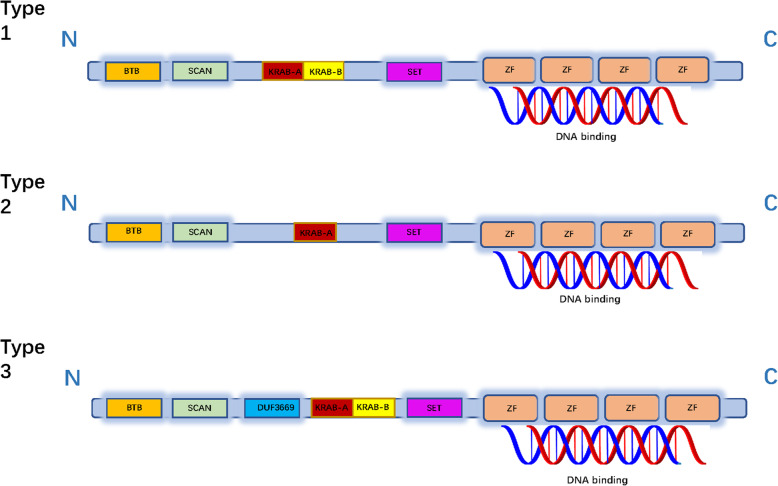
Fig. 1
Fig. 1
Several domain structures of C2H2-ZFPs. Three diverse forms of C2H2-ZFPs are described. Each C2H2-ZFP contains at least one KRAB structural domain, BTB domain, SCAN domain, SET domain and several zinc fingers which can bind to DNA sequences. In brief, the KRAB domain can be divided into two parts: the A-box (KRAB-A) and the B-box (KRAB-B). As shown in type 4, some C2H2-ZFPs contain a DUF3669 domain. Functionally, BTB domain is mainly responsible for transcriptional repression and protein degradation; SCAN domain is mainly responsible for protein binding and protein oligomerization; KRAB domain is mainly responsible for repression of transposable elements; SET domain is mainly responsible for protein methylation (mainly histones); C2H2 motif can bind to DNA, RNA, and proteins to perform different functions, but most of them bind to DNA.ZF: zinc finger; BTB: Broad-Complex, Tramtrack, and Bric-a-brac. KRAB:Krüppel-associated box; SCAN: SRE-ZBP, CTfin51, AW-1, and Number 18 cDNA; DUF3669:domain of unknown function 3669
Fig. 2
Fig. 2
Zinc finger proteins influence hepatocarcinogenesis through different ways. A: ZNF384 activates Cyclin D1 transcription by directly binding to its promoter, and facilitates G1/S phase transition, ultimately promotes proliferation of HCC. B: ZNF703 promotes HCC metastasis and induces through transactivating CLDN4 expression. C: A20 decreases the protein level of PFKL by promoting ubiquitination and degradation of PFKL, then inhibits progression of HCC through downregulating glycolysis
Fig. 3
Fig. 3
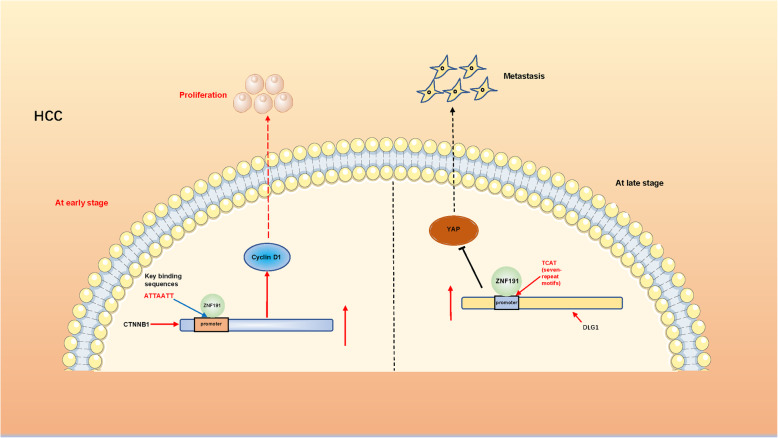
ZNF191 plays an opposite role in different stages of hepatocellular carcinoma. At early stage, ZNF191 activated the expression of CTNNB1 and its downstream gene Cyclin D1 by binding to the promoter region of CTNNB1, ultimately promoted the proliferation of HCC. At late stage, ZNF191 activated its expression by binding to the promoter of DLG1, thereby inhibited the activation of YAP and the migration of HCC cells, eventually inhibited the metastasis of HCC

References

    1. Kim S, Shendure J. Mechanisms of interplay between transcription factors and the 3D genome. Mol Cell. 2019;76(2):306–319. doi: 10.1016/j.molcel.2019.08.010. - DOI - PubMed
    1. Chen A, Koehler AN. Transcription factor inhibition: lessons learned and emerging targets. Trends Mol Med. 2020;26:508–518. - PMC - PubMed
    1. Krishna SS, Majumdar I, Grishin NV. Structural classification of zinc fingers: survey and summary. Nucleic Acids Res. 2003;31:532–550. - PMC - PubMed
    1. Jen J, Wang YC. Zinc finger proteins in cancer progression. J Biomed Sci. 2016;23:53. - PMC - PubMed
    1. Gong D, Feng PC, Ke XF, Kuang HL, Pan LL, Ye Q, et al. Silencing long non-coding RNA LINC01224 inhibits hepatocellular carcinoma progression via MicroRNA-330-5p-induced inhibition of CHEK1. Mol Ther Nucleic Acids. 2020;19:482–497. - PMC - PubMed