


Developing a predictive model for spinal shock in dogs with spinal cord injury
- PMID: 35001437
- PMCID: PMC8965241
- DOI: 10.1111/jvim.16352
Developing a predictive model for spinal shock in dogs with spinal cord injury
Abstract
Background: Reduced pelvic limb reflexes in dogs with spinal cord injury typically suggests a lesion of the L4-S3 spinal cord segments. However, pelvic limb reflexes might also be reduced in dogs with a T3-L3 myelopathy and concurrent spinal shock.
Hypothesis/objectives: We hypothesized that statistical models could be used to identify clinical variables associated with spinal shock in dogs with spinal cord injuries.
Animals: Cohort of 59 dogs with T3-L3 myelopathies and spinal shock and 13 dogs with L4-S3 myelopathies.
Methods: Data used for this study were prospectively entered by partner institutions into the International Canine Spinal Cord Injury observational registry between October 2016 and July 2019. Univariable logistic regression analyses were performed to assess the association between independent variables and the presence of spinal shock. Independent variables were selected for inclusion in a multivariable logistic regression model if they had a significant effect (P ≤ .1) on the odds of spinal shock in univariable logistic regression.
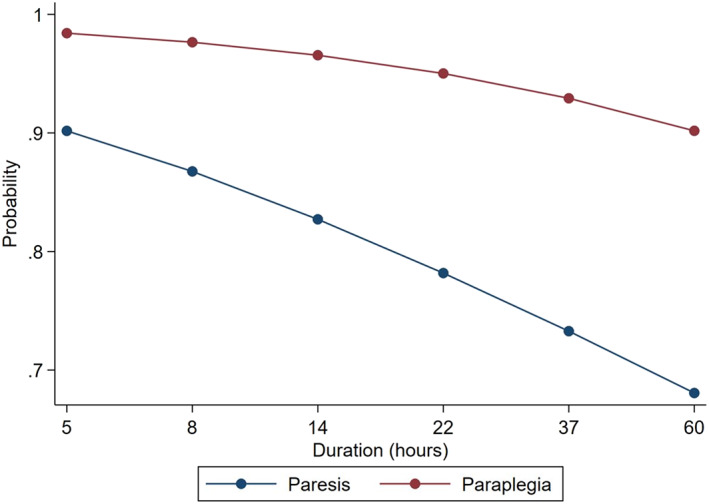
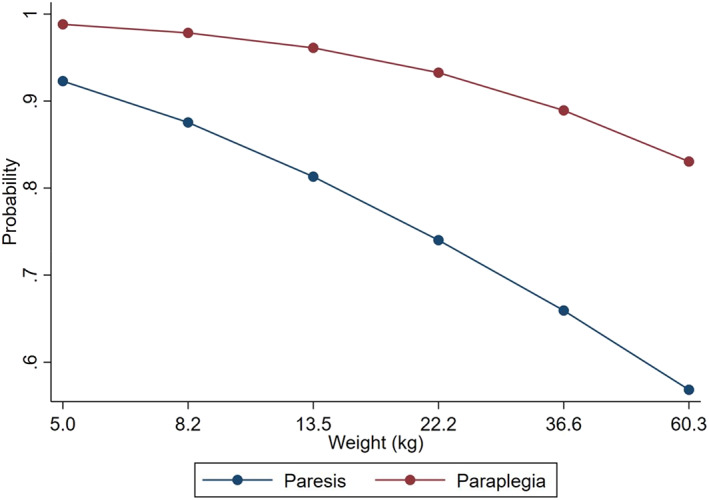
Results: The final multivariable model included the natural log of weight (kg), the natural log of duration of clinical signs (hours), severity (paresis vs paraplegia), and pelvic limb tone (normal vs decreased/absent). The odds of spinal shock decreased with increasing weight (odds ratio [OR] = 0.28, P = .09; confidence interval [CI] 0.07-1.2), increasing duration (OR = 0.44, P = .02; CI 0.21-0.9), decreased pelvic limb tone (OR = 0.04, P = .003; CI 0.01-0.36), and increased in the presence of paraplegia (OR = 7.87, P = .04; CI 1.1-56.62).
Conclusions and clinical importance: A formula, as developed by the present study and after external validation, could be useful for assisting clinicians in determining the likelihood of spinal shock in various clinical scenarios and aid in diagnostic planning.
Keywords: fibrocartilaginous infarct; herniation; intervertebral disc disease; neurology; spinal cord disease; spinal shock.
© 2022 The Authors. Journal of Veterinary Internal Medicine published by Wiley Periodicals LLC on behalf of American College of Veterinary Internal Medicine.
Conflict of interest statement
Andrea Tipold serves as Associate Editor for the Journal of Veterinary Internal Medicine. She was not involved in review of this manuscript. No other authors have a conflict of interest.
Figures
Comment in
-
Letter regarding "Developing a predictive model for spinal shock in dogs with spinal cord injury".J Vet Intern Med. 2023 Mar;37(2):400-401. doi: 10.1111/jvim.16631. Epub 2023 Jan 23. J Vet Intern Med. 2023. PMID: 36689101 Free PMC article. No abstract available.
References
-
- Lahunta A d, Glass E, Kent M. Veterinary Neuroanatomy and Clinical Neurology. 4th ed. St. Louis, Missouri: Saunders; 2015.
-
- Dewey CW, Costa RC d. Practical Guide to Canine and Feline Neurology. 3rd ed. Ames, Iowa: Wiley Blackwell; 2016.
-
- Hodshon AW, Thomas WB. Transient depression of pelvic limb reflexes in dogs with acute focal thoracolumbar myelopathy. J Am Vet Med Assoc. 2018;253:1022‐1031. - PubMed
-
- Full AM, Heller HLB, Mercier M. Prevalence, clinical presentation, prognosis, and outcome of 17 dogs with spinal shock and acute thoracolumbar spinal cord disease. J Vet Emerg Crit Care. 2016;26:412‐418. - PubMed
-
- Smith PM, Jeffery ND. Spinal shock—comparative aspects and clinical relevance. J Vet Int Med. 2005;19:788‐793. - PubMed
Publication types
MeSH terms
LinkOut - more resources
Full Text Sources
Medical
