


Investigation of early puberty prevalence and time of addition thelarche to pubarche in girls with premature pubarche: two-year follow-up results
- PMID: 35002065
- PMCID: PMC8713059
- DOI: 10.1297/cpe.2021-0042
Investigation of early puberty prevalence and time of addition thelarche to pubarche in girls with premature pubarche: two-year follow-up results
Abstract
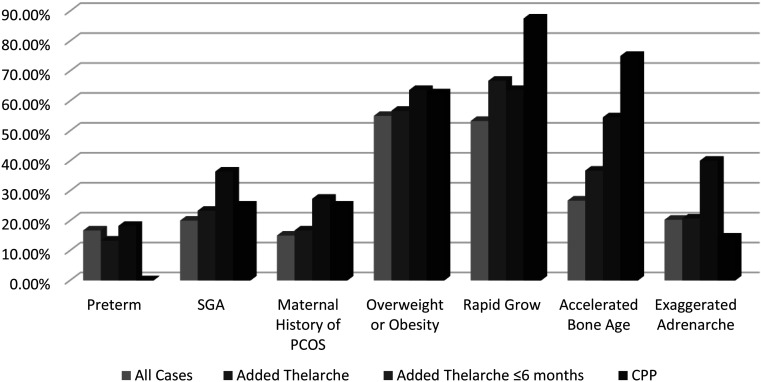
We aimed to determine the prevalence of early puberty in girls with premature pubarche and analyze the time interval between their pubarche and succeeding thelarche. This study included 60 female children with premature pubarche. We retrospectively collected clinical, laboratory, and radiological findings from all participants. We investigated the time interval between pubarche and thelarche in cases wherein premature pubarche was followed by thelarche. The mean age at onset of pubarche was 6.93 ± 0.79 yr old. Among the participants, 16.7% were preterm, 20% were small for gestational age (SGA), and 55% were overweight or obese. The mean time interval between pubarche and thelarche was 11.20 ± 7.41 mo. The mean serum DHEA-S level was higher in the preterm group (p = 0.016), and DHEA-S levels were generally higher in the SGA group (p = 0.004). This study documented the presence of being overweight or obese and having more advanced growth than their genetic potential in half of the patients who had premature pubarche. In addition to these identified risk factors, obesity-independent DHEA-S levels were observed to be higher in patients who had early puberty with the first six months of their follow-up considered to be the most critical time in predicting early puberty.
Keywords: dehydroepiandrosterone sulfate (DHEA-S); exaggerated adrenarche; precocious puberty; premature adrenarche; premature pubarche.
2022©The Japanese Society for Pediatric Endocrinology.
Conflict of interest statement
The authors have no conflicts of interest to declare.
Figures
References
-
- Ibáñez L, de Zegher F. Puberty after prenatal growth restraint. Horm Res 2006;65(Suppl 3): 112–5. - PubMed
LinkOut - more resources
Full Text Sources