. 2021 Dec 23:12:790072.
doi: 10.3389/fphar.2021.790072. eCollection 2021.

Qingwenzhike Prescription Alleviates Acute Lung Injury Induced by LPS via Inhibiting TLR4/NF-kB Pathway and NLRP3 Inflammasome Activation

Affiliations

Qingwenzhike Prescription Alleviates Acute Lung Injury Induced by LPS via Inhibiting TLR4/NF-kB Pathway and NLRP3 Inflammasome Activation

Cai Zhang et al. Front Pharmacol. .

Abstract

Background: Acute lung injury (ALI) is characterized by dysfunction of the alveolar epithelial membrane caused by acute inflammation and tissue injury. Qingwenzhike (QWZK) prescription has been demonstrated to be effective against respiratory viral infections in clinical practices, including coronavirus disease 2019 (COVID-19) infection. So far, the chemical compositions, protective effects on ALI, and possible anti-inflammatory mechanisms remain unknown. Methods: In this study, the compositions of QWZK were determined via the linear ion trap/electrostatic field orbital trap tandem high-resolution mass spectrometry (UHPLC-LTQ-Orbitrap MS). To test the protective effects of QWZK on ALI, an ALI model induced by lipopolysaccharide (LPS) in rats was used. The effects of QWZK on the LPS-induced ALI were evaluated by pathological changes and the number and classification of white blood cell (WBC) in bronchoalveolar lavage fluid (BALF). To investigate the possible underlying mechanisms, the contents of interleukin-6 (IL-6), tumor necrosis factor-α (TNF-α), monocyte chemoattractant protein (MCP-1), interleukin-1β (IL-1β), interleukin-18 (IL-18), and immunoregulatory-related factors interferon-γ (IFN-γ) were detected by ELISA. Furthermore, the expression of Toll-like receptor 4 (TLR4), p-IKKα/β, IKKα, IKKβ, p-IκBα, IκBα, p-NF-κB, nuclear factor-κB (NF-κB), NOD-like receptor family pyrin domain containing 3 (NLRP3), cleaved caspase-1, pro-caspase-1, apoptosis-associated speck-like protein containing CARD (ASC), and β-actin were tested by Western blot. Results: A total of 99 compounds were identified in QWZK, including 33 flavonoids, 23 phenolic acids, 3 alkaloids, 3 coumarins, 20 triterpenoids, 5 anthraquinones, and 12 others. ALI rats induced by LPS exhibited significant increase in neutrophile, significant decrease in lymphocyte, and evidently thicker alveolar wall than control animals. QWZK reversed the changes in WBC count and alveolar wall to normal level on the model of ALI induced by LPS. ELISA results revealed that QWZK significantly reduced the overexpression of proinflammatory factors IL-6, TNF-α, MCP-1, IL-1β, IL-18, and IFN-γ induced by LPS. Western blot results demonstrated that QWZK significantly downregulated the overexpression of TLR4, p-IKKα/β, p-IκBα, p-NF-κB, NLRP3, cleaved caspase-1, and ASC induced by LPS, which suggested that QWZK inhibited TLR4/NF-κB signaling pathway and NLRP3 inflammasomes. Conclusions: The chemical compositions of QWZK were first identified. It was demonstrated that QWZK showed protective effects on ALI induced by LPS. The possible underlying mechanisms of QWZK on ALI induced by LPS was via inhibiting TLR4/NF-kB signaling pathway and NLRP3 inflammasome activation. This work suggested that QWZK is a potential therapeutic candidate for the treatments of ALI and pulmonary inflammation.

Keywords: Acute Lung Injury (ALI); NLRP3; Qingwenzhike (QWZK) prescription; TLR4/NF-κB signaling pathway; inflammasome; inflammation cytokines.


Conflict of interest statement

The authors declare that the research was conducted in the absence of any commercial or financial relationships that could be construed as a potential conflict of interest.

Figures
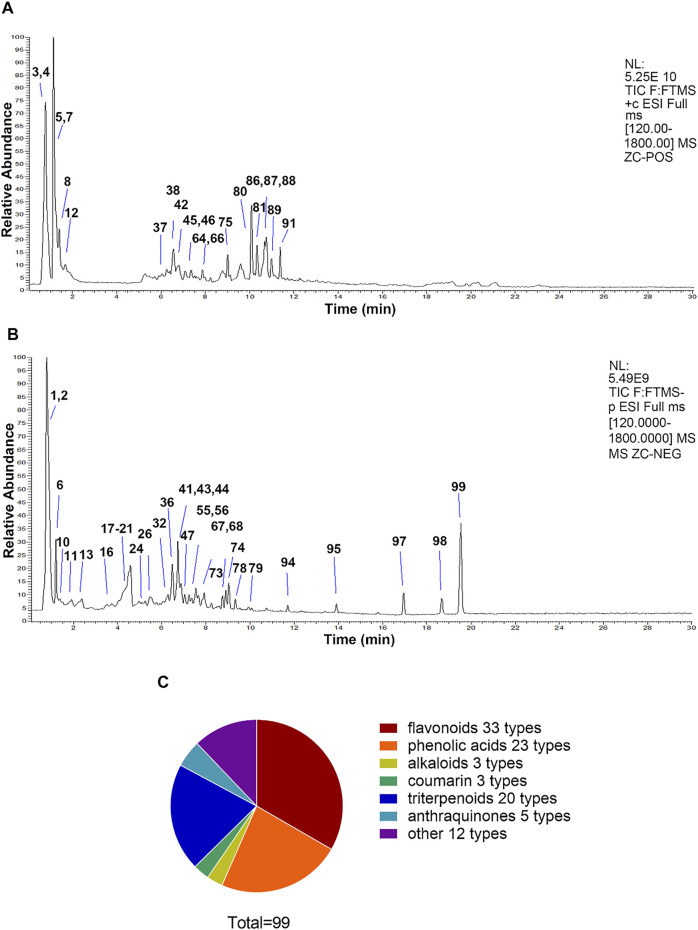
FIGURE 1
FIGURE 1
The compositions of QWZK were determined by UHPLC-LTQ-Orbitrap MS. (A) Total ion flow diagram of QWZK in positive mode. (B) Total ion flow diagram of QWZK in anion mode. (C) Number of monomer components in QWZK identified by positive and anion UHPLC-LTQ-Orbitrap MS.
FIGURE 2
FIGURE 2
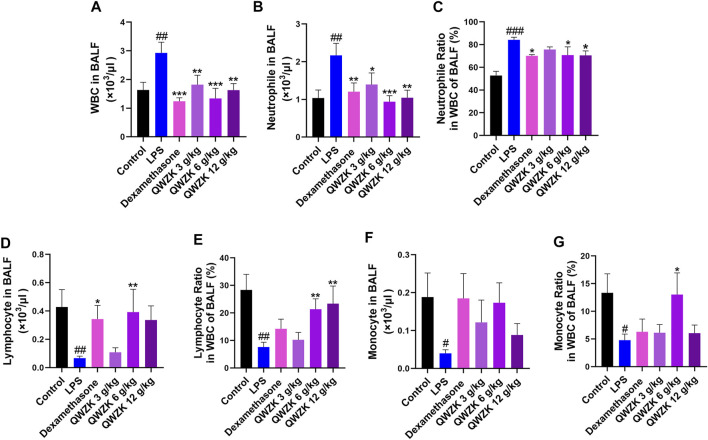
QWZK recovered the WBC counts and classification in ALI rats induced by LPS. (A) The number of WBC in BALF was detected by globulimeter. (B, C) Globulimeter was used to detect the number and ratio of neutrophils in BALF. (D, E) The number and ratio of lymphocyte were detected by a globulimeter in different groups. (F, G) The globulimeter was used to detect the number and ratio of monocyte in different groups. Data were presented as the mean ± SEM, n ≥ 8. # p < 0.05 vs. control group, ## p < 0.01 vs. control group, ### p < 0.001 vs. control group. *p < 0.05 vs. LPS group, ** p < 0.vs. LPS group, *** p < 0.001 vs. LPS group.
FIGURE 3
FIGURE 3
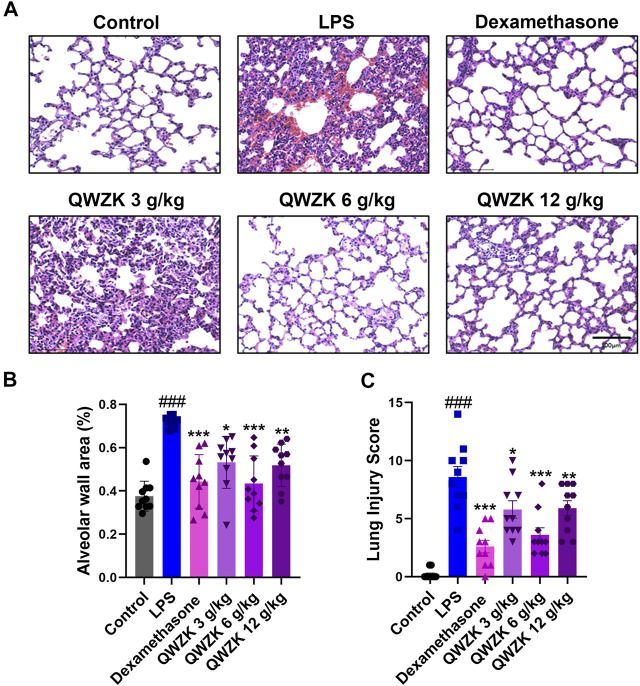
QWZK alleviated the pathological characteristics of lung in ALI rats induced by LPS. (A) The images of lung in different groups, which was stained with H&E. Images are representatives of independent experiments. The scale bar in the figures represents a distance of 100 μm. (B) Statistical results of alveolar wall percentage in different groups. Data were presented as the mean ± SEM, n = 10. (C) Statistical results of lung injury score in different groups. Data were presented as the median ± SEM, n = 10. # p < 0.05 vs. control group, ## p < 0.01 vs. control group, ### p < 0.001 vs. control group. *p < 0.05 vs. LPS group, **p < 0.01 vs. LPS group, ***p < 0.001 vs. LPS group.
FIGURE 4
FIGURE 4
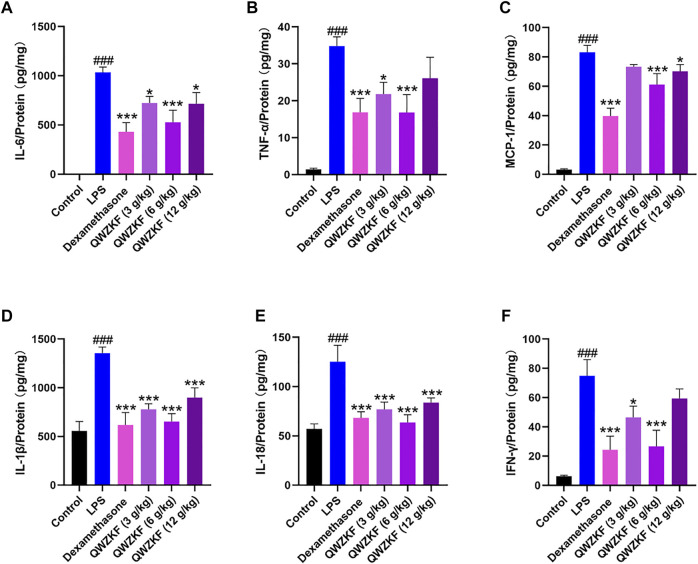
QWZK suppressed inflammatory cytokine levels in ALI rats induced by LPS. The level of (A) IL-6, (B) TNF-α, (C) MCP-1, (D) IL-1β, (E) IL-18, and (F) IFN-γ were detected by ELISA. Data were presented as the mean ± SEM, n ≥ 8. # p < 0.05 vs. control group, ## p < 0.01 vs. control group, ### p < 0.001 vs. control group. *p < 0.05 vs. LPS group, **p < 0.01 vs. LPS group, ***p < 0.001 vs. LPS group.
FIGURE 5
FIGURE 5
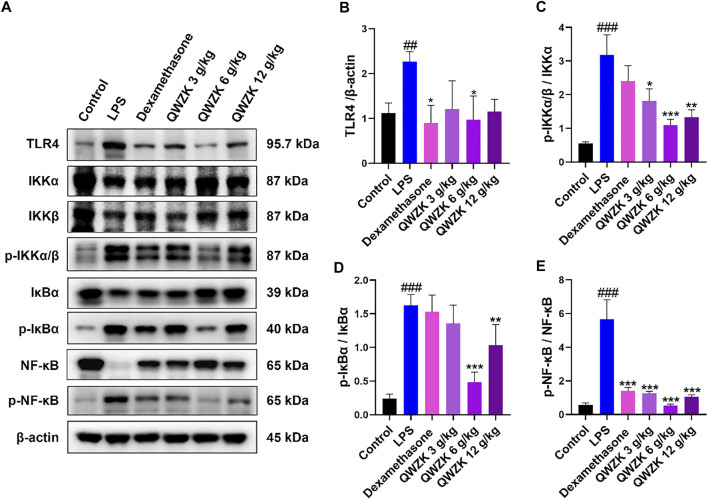
QWZK restrained TLR4/NF-κB pathway in ALI rats induced by LPS. (A) The protein expression levels of TLR4, p-IKKα/β, p-IκBα, p- NF-κB, IKKα/β, IκBα, NF-κB, and β-actin were tested by Western blots. (B–E) The intensity of proteins bands was quantified. Data were presented as the mean ± SEM, n = 8. # p < 0.05 vs. control group, ## p < 0.01 vs. control group, ### p < 0.001 vs. control group. *p < 0.05 vs. LPS group, **p < 0.01 vs. LPS group, ***p < 0.001 vs. LPS group.
FIGURE 6
FIGURE 6
QWZK inhibited NLRP3 inflammasome activation in ALI rats induced by LPS. (A) Western blot assay of NLRP3, pro-caspase-1, cleaved caspase-1, and ASC in different groups. (B–D) The protein expression was analyzed by gray scale. Data were presented as the mean ± SEM, n = 8. # p < 0.05 vs. control group, ## p < 0.01 vs. control group, ### p < 0.001 vs. control group. *p < 0.05 vs. LPS group, **p < 0.01 vs. LPS group, ***p < 0.001 vs. LPS group.
FIGURE 7
FIGURE 7
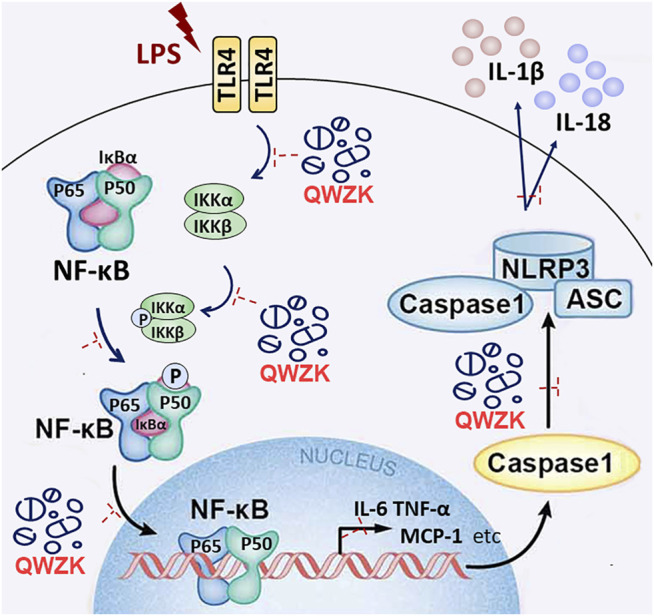
Schematic diagram shows that LPS, as a ligand of TLR4, can activate TLR4/NF-kB pathway and NLRP3 inflammasome and then upregulate the level of IL-6, TNF-α, MCP-1, IFN-γ, IL-1β, and IL-18, promoting lung damage. QWZK could protect LPS-induced ALI via downregulating the expression of IL-6, TNF-α, MCP-1, IFN-γ, IL-1β, and IL-18. Its mechanism of action might inhibit TLR4/NF-kB pathway and NLRP3 inflammasome activation.

References

    1. Afonina I. S., Zhong Z., Karin M., Beyaert R. (2017). Limiting Inflammation-The Negative Regulation of NF-Κb and the NLRP3 Inflammasome. Nat. Immunol. 18 (8), 861–869. 10.1038/ni.3772 - DOI - PubMed
    1. Blanchard O. L., Smoliga J. M. (2015). Translating Dosages from Animal Models to Human Clinical Trials-Rrevisiting Body Surface Area Scaling. FASEB J. 29 (5), 1629–1634. 10.1096/fj.14-269043 - DOI - PubMed
    1. Cheng Y., Peng S., Wang Y., Zisheng Y. (2019). Effects of Maxing Shigan Decoction on Pulmonary Function and Microscopic Indexes of Patients with Severe Pneumonia. World Chinese Medicine 14 (1), 140–148. 10.3969/j.issn.1673-7202.2019.01.028 - DOI
    1. Ciesielska A., Matyjek M., Kwiatkowska K. (2021). TLR4 and CD14 Trafficking and its Influence on LPS-Induced Pro-inflammatory Signaling. Cell Mol Life Sci 78 (4), 1233–1261. 10.1007/s00018-020-03656-y - DOI - PMC - PubMed
    1. Du Q., Huang W.-B., Zhao J., Zeng J., Zhang W., Huang X., et al. (2021). Lianhuaqingwen Capsule Inhibits Influenza-Induced Bacterial Adhesion to Respiratory Epithelial Cells Through Down-Regulation of Cell Adhesion Molecules. J. Ethnopharmacol. 280, 114128. 10.1016/j.jep.2021.114128 - DOI - PubMed