


Case Report: A Chinese Family of Woodhouse-Sakati Syndrome With Diabetes Mellitus, With a Novel Biallelic Deletion Mutation of the DCAF17 Gene
- PMID: 35002959
- PMCID: PMC8734028
- DOI: 10.3389/fendo.2021.770871
Case Report: A Chinese Family of Woodhouse-Sakati Syndrome With Diabetes Mellitus, With a Novel Biallelic Deletion Mutation of the DCAF17 Gene
Erratum in
-
Corrigendum: Case Report: A Chinese Family of Woodhouse-Sakati Syndrome With Diabetes Mellitus, With a Novel Biallelic Deletion Mutation of the DCAF17 Gene.Front Endocrinol (Lausanne). 2022 Feb 21;13:856002. doi: 10.3389/fendo.2022.856002. eCollection 2022. Front Endocrinol (Lausanne). 2022. PMID: 35265045 Free PMC article.
Abstract
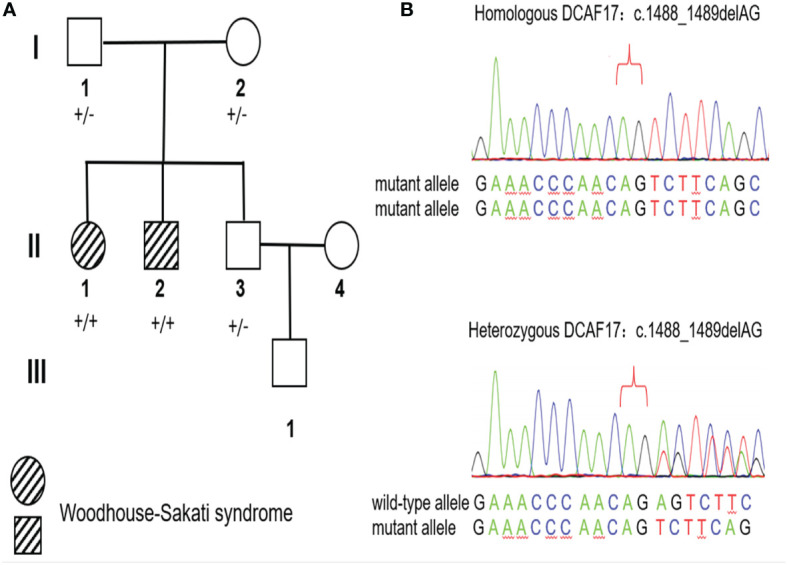
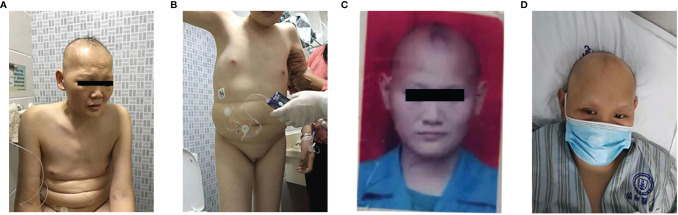
Woodhouse-Sakati syndrome (WSS) (OMIM#241080) is a rare multi-system autosomal recessive disease with homozygous mutation of the DCAF17 gene. The main features of WSS include diabetes, hypogonadism, alopecia, deafness, intellectual disability and progressive extrapyramidal syndrome. We identified a WSS family with a novel DCAF17 gene mutation type in China. Two unconsanguineous siblings from the Chinese Han family exhibiting signs and symptoms of Woodhouse-Sakati syndrome were presented for evaluation. Whole-exome sequencing revealed a homozygous deletion NM_025000.4:c.1488_1489delAG in the DCAF17 gene, which resulted in a frameshift mutation that led to stop codon formation. We found that the two patients exhibited low insulin and C-peptide release after glucose stimulation by insulin and C-peptide release tests. These findings indicate that the DCAF17 gene mutation may cause pancreatic β cell functional impairment and contribute to the development of diabetes.
Keywords: Woodhouse–Sakati syndrome; alopecia; diabetes; hypogonadism; intellectual disability.
Copyright © 2021 Zhou, Shi, Zheng, Chen, Wang, Xiao, Cui, Qiu, Zhu and Li.
Conflict of interest statement
The authors declare that the research was conducted in the absence of any commercial or financial relationships that could be construed as a potential conflict of interest.
Figures

References
-
- Bohlega SA, Abusrair A. Woodhouse-Sakati Syndrome. 2016 Aug 4 [Updated 2021 Jul 8]. In: Adam MP, Ardinger HH, Pagon RA, Wallace SE, Bean LJH, Mirzaa G, Amemiya A, editors. GeneReviews®. Seattle (WA: University of Washington, Seattle; (1993–2021). - PubMed
-
- Alazami AM, Al-Saif A, Al-Semari A, Bohlega S, Zlitni S, Alzahrani F, et al. Mutations in C2orf37, Encoding a Nucleolar Protein, Cause Hypogonadism, Alopecia, Diabetes Mellitus, Mental Retardation, and Extrapyramidal Syndrome. Am J Hum Genet (2008) 83(6):684–91. doi: 10.1016/j.ajhg.2008.10.018 - DOI - PMC - PubMed
Publication types
MeSH terms
Substances
Supplementary concepts
LinkOut - more resources
Full Text Sources
Medical
Research Materials
