. 2021 Dec 24:12:786146.
doi: 10.3389/fmicb.2021.786146. eCollection 2021.

Prevalence, Risk Factors, and Genetic Characterization of Extended-Spectrum Beta-Lactamase Escherichia coli Isolated From Healthy Pregnant Women in Madagascar

Affiliations

Prevalence, Risk Factors, and Genetic Characterization of Extended-Spectrum Beta-Lactamase Escherichia coli Isolated From Healthy Pregnant Women in Madagascar

Milen Milenkov et al. Front Microbiol. .

Abstract

Antimicrobial resistance is a major public health concern worldwide affecting humans, animals and the environment. However, data is lacking especially in developing countries. Thus, the World Health Organization developed a One-Health surveillance project called Tricycle focusing on the prevalence of ESBL-producing Escherichia coli in humans, animals, and the environment. Here we present the first results of the human community component of Tricycle in Madagascar. From July 2018 to April 2019, rectal swabs from 492 pregnant women from Antananarivo, Mahajanga, Ambatondrazaka, and Toamasina were tested for ESBL-E. coli carriage. Demographic, sociological and environmental risk factors were investigated, and E. coli isolates were characterized (antibiotic susceptibility, resistance and virulence genes, plasmids, and genomic diversity). ESBL-E. coli prevalence carriage in pregnant women was 34% varying from 12% (Toamasina) to 65% (Ambatondrazaka). The main risk factor associated with ESBL-E. coli carriage was the rainy season (OR = 2.9, 95% CI 1.3-5.6, p = 0.009). Whole genome sequencing was performed on 168 isolates from 144 participants. bla CTX-M-15 was the most frequent ESBL gene (86%). One isolate was resistant to carbapenems and carried the bla NDM-5 gene. Most isolates belonged to commensalism associated phylogenetic groups A, B1, and C (90%) and marginally to extra-intestinal virulence associated phylogenetic groups B2, D and F (10%). Multi locus sequence typing showed 67 different sequence types gathered in 17 clonal complexes (STc), the most frequent being STc10/phylogroup A (35%), followed distantly by the emerging STc155/phylogroup B1 (7%), STc38/phylogroup D (4%) and STc131/phylogroup B2 (3%). While a wide diversity of clones has been observed, SNP analysis revealed several genetically close isolates (n = 34/168) which suggests human-to-human transmissions. IncY plasmids were found with an unusual prevalence (23%), all carrying a bla CTX-M-15. Most of them (85%) showed substantial homology (≥85%) suggesting a dissemination of IncY ESBL plasmids in Madagascar. This large-scale study reveals a high prevalence of ESBL-E. coli among pregnant women in four cities in Madagascar associated with warmth and rainfall. It shows the great diversity of E. coli disseminating throughout the country but also transmission of specific clones and spread of plasmids. This highlights the urgent need of public-health interventions to control antibiotic resistance in the country.

Keywords: E. coli; Madagascar; digestive carriage; epidemiology; extended-spectrum beta-lactamase (ESBL); whole genome sequencing.


Conflict of interest statement

The authors declare that the research was conducted in the absence of any commercial or financial relationships that could be construed as a potential conflict of interest.

Figures
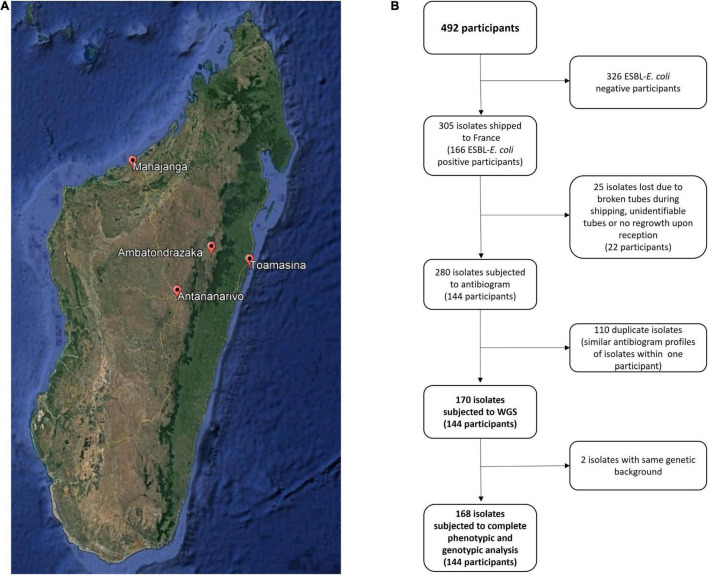
FIGURE 1
FIGURE 1
Study characteristics. (A) Geographical situation of cities involved in the project in Madagascar. (B) Flow chart representing the evolution of the number of isolates along study progress.
FIGURE 2
FIGURE 2
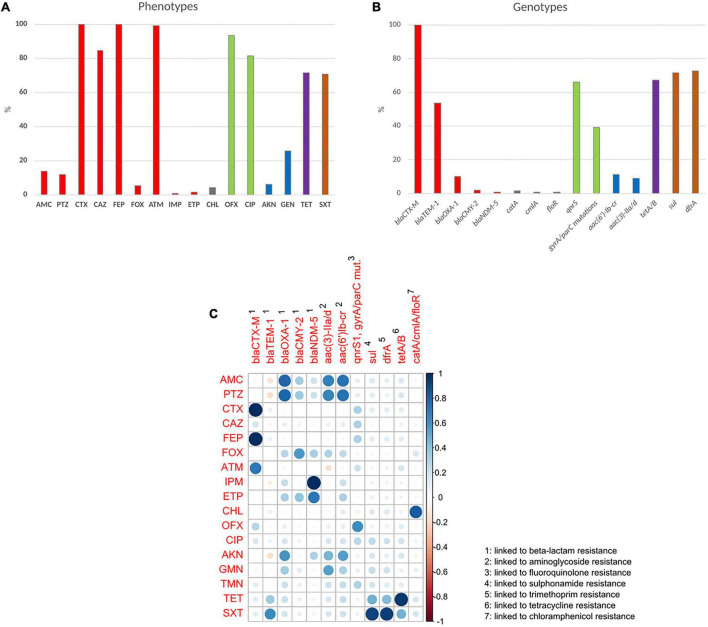
Prevalence of phenotypic antibiotic resistance and correlation to resistance genotype. (A) Prevalence of phenotypic antibiotic resistance. (B) Prevalence of antibiotic resistance genes. Percentages correspond to resistant and intermediately resistant isolates for each antibiotic. Red, beta-lactams; blue, aminoglycosides; green, fluoroquinolones; brown, folate synthesis inhibitors. (C) Correlation matrix between resistance phenotype and genotype. Blue circles represent significant positive correlations. Red circles represent significant negative correlations. Blank squares represent correlations without statistical significance. Circle size and color darkness represent the value of the correlation coefficient. AMC, amoxicillin/clavulanic acid; PTZ, piperacillin/tazobactam; CTX, cefotaxime; CAZ, ceftazidime; FEP, cefepime; FOX, cefoxitin; ATM, aztreonam; IMI, imipenem; ETP, ertapenem; CHL, chloramphenicol; OFX, ofloxacin; CIP, ciprofloxacin; AKN, amikacin; GEN, gentamicin; TET, tetracycline; SXT, sulfamethoxazole/Trimethoprim.
FIGURE 3
FIGURE 3
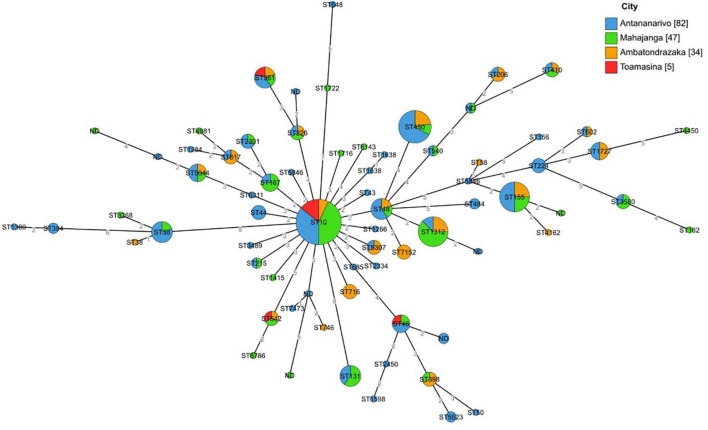
Minimum spanning tree based on MLST analysis of 168 sequenced isolates from pregnant women. Minimum spanning tree colors are coded by the geographical origin of the isolates. Labels indicate the sequence types. Distances are labeled as numbers on the branches.
FIGURE 4
FIGURE 4
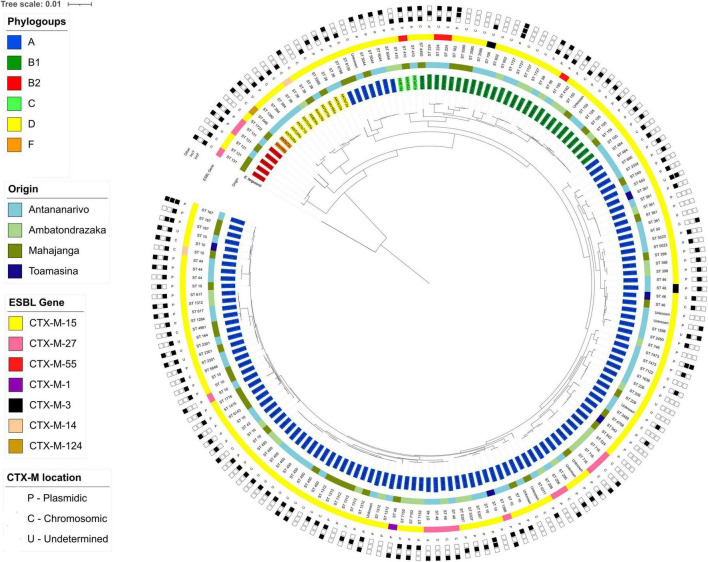
Phylogenetic tree based on core genome sequences of the 168 ESBL-E. coli isolates. The tree has been constructed with E. fergusonii used as the root. Isolates names are highlighted depending on their phylogenetic group (inner ring). Colored strips represent the geographical origin of the isolates (ring two) and the CTX-M enzyme detected (ring four). STs are given in the third ring. The penultimate ring represents the genomic location of the CTX-M gene. The outer ring represents the plasmid replicon detected in each isolate.
FIGURE 5
FIGURE 5
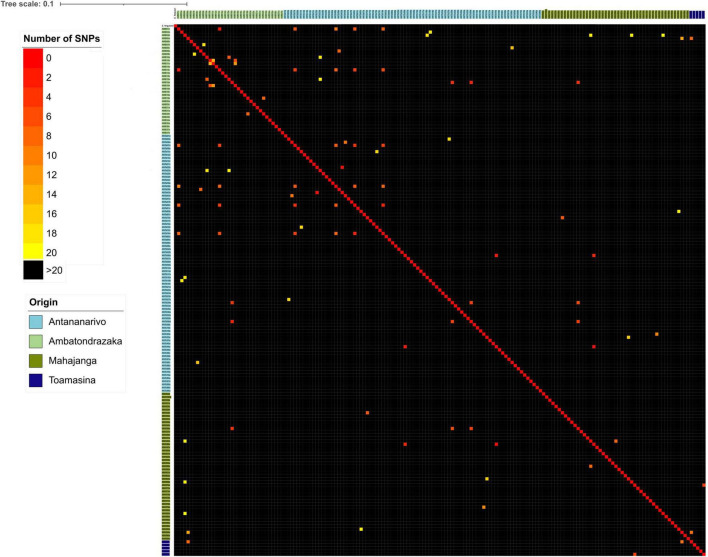
Heat map of SNP differences between ESBL-E. coli isolates grouped by geographical origin. Numbers of SNPs in the core genome between different sequenced isolates were interpreted as a distance matrix. Colors in the heat map represent SNP differences as shown in the legend at the top left. The colors of the isolate names indicate their geographical origin.
FIGURE 6
FIGURE 6
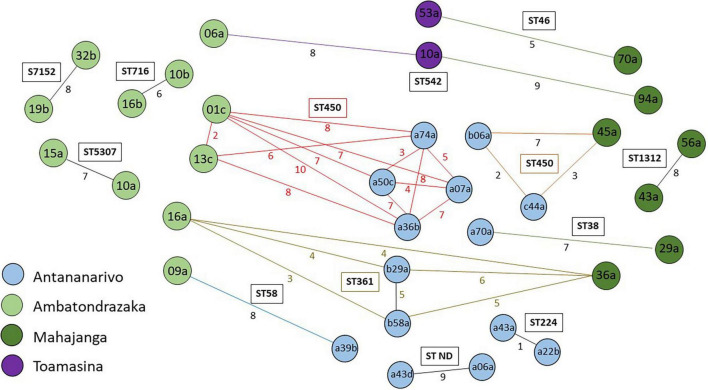
Wireframe diagram showing connections between isolates differing of less than 10 SNPs. The colors of the isolate names indicate their geographical origin. Inter-connections length is independent of the number of SNPs difference between isolates. Numbers on lines indicate the number of SNP differences. Colored lines and numbers indicate distances between closely related isolates from different sampling sites.
FIGURE 7
FIGURE 7
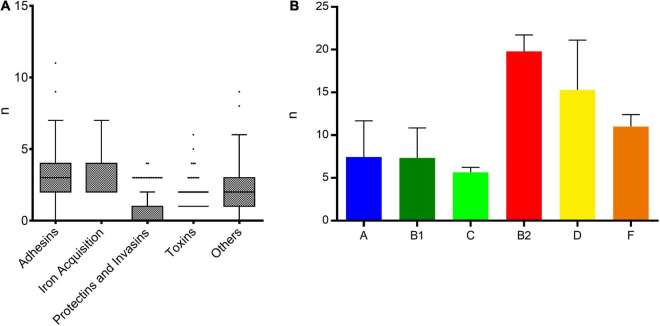
Distribution of virulence genes among ESBL-E. coli isolates. (A) Distribution of virulence genes per strain among the five main functional classes of virulence. (B) Mean number of virulence genes per isolate depending on the phylogenetic group.
FIGURE 8
FIGURE 8
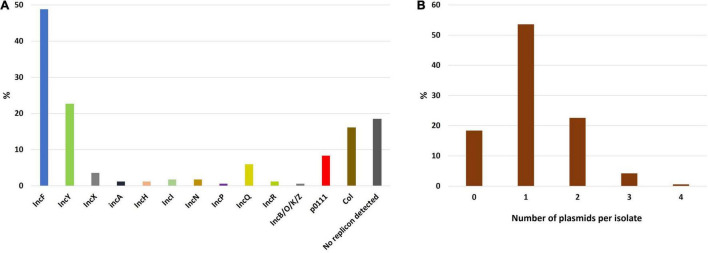
Prevalence of plasmid replicons detected in ESBL-E. coli isolates. The sum of the different plasmid replicon prevalence exceeds 100% as some isolates could carry multiple plasmids simultaneously. (A) Prevalence of plasmid replicons among the study isolates. (B) Histogram depicting the number of plasmids per isolate.
FIGURE 9
FIGURE 9
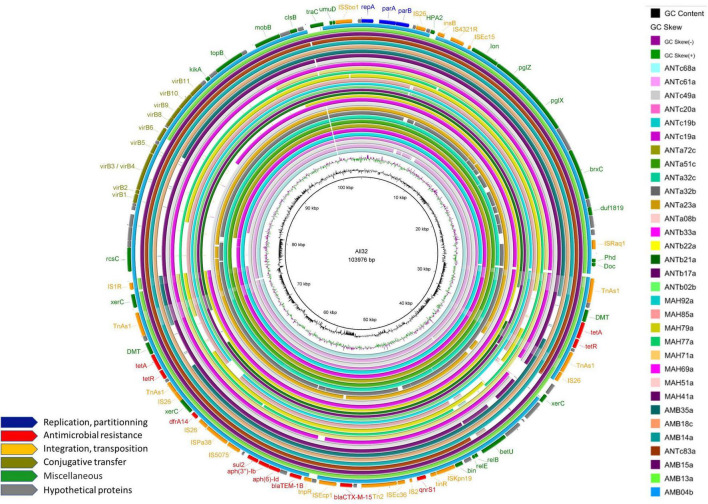
Alignment of the 32 IncY plasmid sequences with sequence homology of more than 85%. GC content and GC skew are depicted in the inner map with distance scale. Predicted coding sequences of the reference plasmid named within the circle are depicted in the outer ring with antimicrobial resistance genes highlighted in red.

References

    1. Alikhan N.-F., Petty N. K., Ben Zakour N. L., Beatson S. A. (2011). BLAST ring image generator (BRIG): simple prokaryote genome comparisons. BMC Genomics 12:402. 10.1186/1471-2164-12-402 - DOI - PMC - PubMed
    1. Beghain J., Bridier-Nahmias A., Le Nagard H., Denamur E., Clermont O. (2018). ClermonTyping: an easy-to-use and accurate in silico method for Escherichia genus strain phylotyping. Microb. Genomics 4:e000192. 10.1099/mgen.0.000192 - DOI - PMC - PubMed
    1. Bevan E. R., Jones A. M., Hawkey P. M. (2017). Global epidemiology of CTX-M β-lactamases: temporal and geographical shifts in genotype. J. Antimicrob. Chemother. 72 2145–2155. 10.1093/jac/dkx146 - DOI - PubMed
    1. Bezabih Y. M., Sabiiti W., Alamneh E., Bezabih A., Peterson G. M., Bezabhe W. M., et al. (2021). The global prevalence and trend of human intestinal carriage of ESBL-producing Escherichia coli in the community. J. Antimicrob. Chemother. 76 22–29. 10.1093/jac/dkaa399 - DOI - PubMed
    1. Bourrel A. S., Poirel L., Royer G., Darty M., Vuillemin X., Kieffer N., et al. (2019). Colistin resistance in Parisian inpatient faecal Escherichia coli as the result of two distinct evolutionary pathways. J. Antimicrob. Chemother. 74 1521–1530. 10.1093/jac/dkz090 - DOI - PubMed