


Blastocyst Morphology Based on Uniform Time-Point Assessments is Correlated With Mosaic Levels in Embryos
- PMID: 35003219
- PMCID: PMC8727871
- DOI: 10.3389/fgene.2021.783826
Blastocyst Morphology Based on Uniform Time-Point Assessments is Correlated With Mosaic Levels in Embryos
Abstract
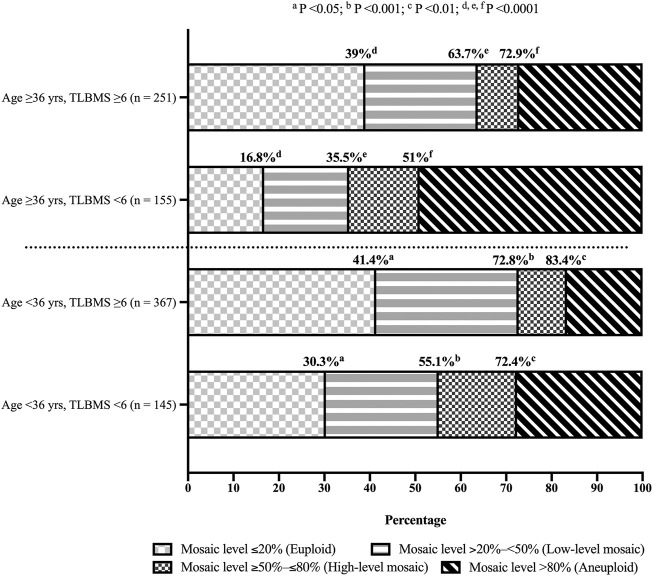
Avoiding aneuploid embryo transfers has been shown to improve pregnancy outcomes in patients with implantation failure and pregnancy loss. This retrospective cohort study aims to analyze the correlation of time-lapse (TL)-based variables and numeric blastocyst morphological scores (TLBMSs) with different mosaic levels. In total, 918 biopsied blastocysts with time-lapse assessments at a uniform time-point were subjected to next-generation sequencing-based preimplantation genetic testing for aneuploidy. In consideration of patient- and cycle-related confounding factors, all redefined blastocyst morphology components of low-grade blastocysts, that is, expansion levels (odds ratio [OR] = 0.388, 95% confidence interval [CI] = 0.217-0.695; OR = 0.328, 95% CI = 0.181-0.596; OR = 0.343, 95% CI = 0.179-0.657), inner cell mass grades (OR = 0.563, 95% CI = 0.333-0.962; OR = 0.35, 95% CI = 0.211-0.58; OR = 0.497, 95% CI = 0.274-0.9), and trophectoderm grades (OR = 0.29, 95% CI = 0.178-0.473; OR = 0.242, 95% CI = 0.143-0.411; OR = 0.3, 95% CI = 0.162-0.554), were less correlated with mosaic levels ≤20%, <50%, and ≤80% as compared with those of top-grade blastocysts (p < 0.05). After converting blastocyst morphology grades into scores, high TLBMSs were associated with greater probabilities of mosaic levels ≤20% (OR = 1.326, 95% CI = 1.187-1.481), <50% (OR = 1.425, 95% CI = 1.262-1.608), and ≤80% (OR = 1.351, 95% CI = 1.186-1.539) (p < 0.001). The prediction abilities of TLBMSs were similar for mosaic levels ≤20% (AUC = 0.604, 95% CI = 0.565-0.642), <50% (AUC = 0.634, 95% CI = 0.598-0.671), and ≤80% (AUC = 0.617, 95% CI = 0.576-0.658). In conclusion, detailed evaluation with TL monitoring at the specific time window reveals that redefined blastocyst morphology components and converted numeric TLBMSs are significantly correlated with all of the threshold levels of mosaicism. However, the performance of TLBMSs to differentiate blastocysts with aberrant ploidy risk remains perfectible.
Keywords: blastocyst morphology; high-resolution next-generation sequencing; mosaic levels; preimplantation genetic testing for aneuploidy; time-lapse monitoring.
Copyright © 2021 Chen, Lee, Huang, Chen, Ho, Cheng, Lin, Chen, Lee and Lee.
Conflict of interest statement
The authors declare that the research was conducted in the absence of any commercial or financial relationships that could be construed as a potential conflict of interest.
Figures
References
-
- Barash O. O., Ivani K. A., Willman S. P., Rosenbluth E. M., Wachs D. S., Hinckley M. D., et al. (2017). Association between Growth Dynamics, Morphological Parameters, the Chromosomal Status of the Blastocysts, and Clinical Outcomes in IVF PGS Cycles with Single Embryo Transfer. J. Assist. Reprod. Genet. 34, 1007–1016. 10.1007/s10815-017-0944-0 - DOI - PMC - PubMed
LinkOut - more resources
Full Text Sources
