


Standard spirometry to assess emphysema in patients with chronic obstructive pulmonary disease: the Emphysema Severity Index (ESI)
- PMID: 35003734
- PMCID: PMC8672489
- DOI: 10.4081/mrm.2021.805
Standard spirometry to assess emphysema in patients with chronic obstructive pulmonary disease: the Emphysema Severity Index (ESI)
Abstract
Background: Chronic obstructive pulmonary disease (COPD) is a generic term identifying a condition characterized by variable changes in peripheral airways and lung parenchyma. Standard spirometry cannot discriminate the relative role of conductive airways inflammatory changes from destructive parenchymal emphysema changes. The aim of this study was to quantify the emphysema component in COPD by a simple parameter (the Emphysema Severity Index - ESI), previously proved to reflect CT-assessed emphysema.
Methods: ESI was obtained by fitting the descending limb of MEFV curves by a fully automated procedure providing a 0 to 10 score of emphysema severity. ESI was computed in COPD patients enrolled in the CLIMA Study.
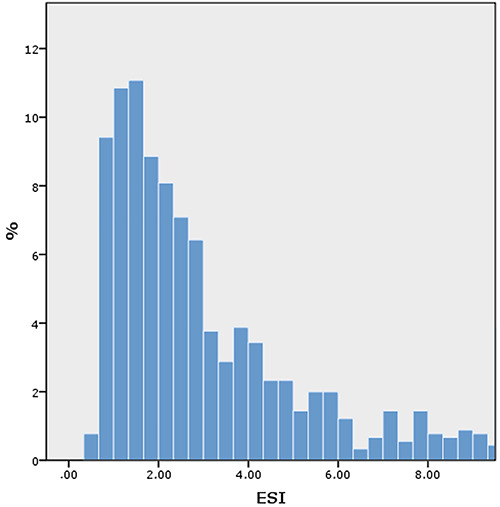
Results: The vast majority of ESI values ranged from 0 to 4, compatible with no-to-mild/moderate emphysema component. A limited proportion of patients showed ESI values >4, compatible with severe-to-very severe emphysema. ESI values were greatly dispersed within each GOLD class indicating that GOLD classification cannot discriminate emphysema and conductive airways changes in patients with similar airflow limitation. ESI and diffusing capacity (DLCO) were significantly correlated (p<0.001). However, the great dispersion in their correlation suggests that ESI and DLCO reflect partially different anatomo-functional determinants in COPD.
Conclusions: Airflow limitation has heterogenous determinants in COPD. Inflammatory and destructive changes may combine in CT densitometric alterations that cannot be detected by standard spirometry. ESI computation from spirometric data helps to define the prevailing pathogenetic mechanism underlying the measured airflow limitation. ESI could be a reliable advancement to select large samples of patients in clinical or epidemiological trials, and to compare different pharmacological treatments.
Keywords: COPD; ESI; Emphysema Severity Index; airflow limitation; phenotypes.
©Copyright: the Author(s).
Figures


References
-
- Burrows B, Fletcher CM, Heard BE, Jones NL, Wootliff JS he emphysematous and bronchial types of chronic airways obstruction. A cliniopathological study of patients in London and Chicago. Lancet 1966;87:830-35. - PubMed
-
- Pistolesi M, Camiciottoli G, Paoletti M, Marmai C, Lavorini F, Meoni E, et al. Identification of a predominant COPD phenotype of COPD in clinical practice. Respir Med 2008;102:367-76. - PubMed
-
- Camiciottoli G, Bigazzi F, Paoletti M, Cestelli L, Lavorini F, Pistolesi M. Pulmonary function and sputum characteristics predict computed tomography phenotype and severity of COPD. Eur Respir J 2013;42:626-35. - PubMed
-
- Ogawa E, Nakano Y, Ohara T, Muro S, Hirai T, Sato S, et al. Body mass index in male patients with COPD: correlation with low attenuation areas on CT. Thorax 2009;64:20-5. - PubMed
LinkOut - more resources
Full Text Sources