


Intravenous Metoclopramide to Improve the Success Rate of Blind Bedside Post-pyloric Placement of Feeding Tube in Critically Ill Children: A Randomized, Double-Blind, Placebo-Controlled Study
- PMID: 35004534
- PMCID: PMC8727866
- DOI: 10.3389/fped.2021.739247
Intravenous Metoclopramide to Improve the Success Rate of Blind Bedside Post-pyloric Placement of Feeding Tube in Critically Ill Children: A Randomized, Double-Blind, Placebo-Controlled Study
Abstract
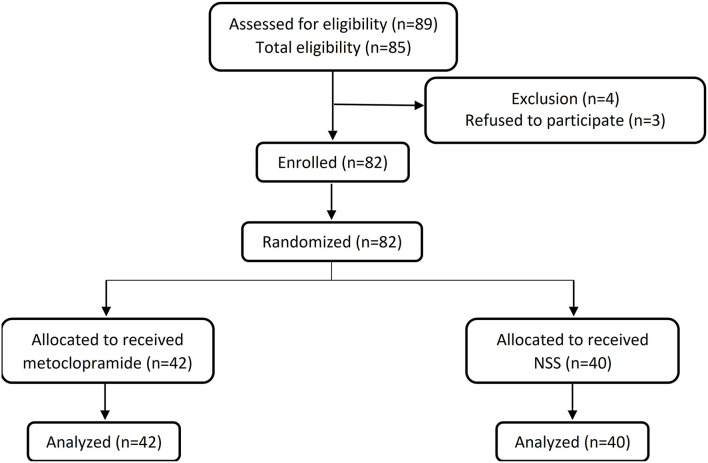
Objective: Impaired gastric emptying is a common cause of delayed feeding in critically ill children. Post-pyloric feeding may help improve feeding intolerance and nutritional status and, hence, contribute to a better outcome. However, post-pyloric feeding tube insertion is usually delayed due to a technical difficulty. Therefore, prokinetic agents have been used to facilitate blind bedside post-pyloric feeding tube insertion. Metoclopramide is a potent prokinetic agent that has also been used to improve motility in adults and children admitted to intensive care units. The objective of this study was to determine the efficacy of intravenous metoclopramide in promoting the success rate of blind bedside post-pyloric feeding tube placement in critically ill children. Design: The design of this study is randomized, double blind, placebo controlled. Setting: The setting of the study is a single-center pediatric intensive care unit. Patients: Children aged 1 month-18 years admitted to the pediatric intensive care unit with severe illness or feeding intolerance were enrolled in this study. Intervention: Patients were randomly selected to receive intravenous metoclopramide or 0.9% normal saline solution (the placebo) prior to the tube insertion. The study outcome was the success rate of post-pyloric feeding tube placement confirmed by an abdominal radiography 6-8 h after the insertion. Measurements and Main Results: We found that patients receiving metoclopramide had a higher success rate (37/42, 88%) of post-pyloric feeding tube placement than the placebo (28/40, 70%) (p = 0.04). Patients who received sedative drug or narcotic agent showed a tendency of higher success rate (p = 0.08). Conclusion: Intravenous metoclopramide improves the success rate of blind bedside post-pyloric placement of feeding tube in critically ill children. Trial Registration: Thai Clinical Trial Registry TCTR20190821002. Registered 15th August 2019.
Keywords: blind bedside placement; critically ill children; metoclopramide; nasojejunal feeding; post-pyloric feeding.
Copyright © 2021 Ketsuwan, Tanpowpong, Ruangwattanapaisarn, Phaopant, Suppalarkbunlue, Kooanantkul, Anantasit and Vaewpanich.
Conflict of interest statement
The authors declare that the research was conducted in the absence of any commercial or financial relationships that could be construed as a potential conflict of interest.
References
-
- Mehta NM, Skillman HE, Irving SY, Coss-Bu JA, Vermilyea S, Farrington EA, et al. Guidelines for the provision and assessment of nutrition support therapy in the pediatric critically ill patient: society of critical care medicine and American society for parenteral and enteral nutrition. Pediatr Crit Care Med. (2017) 18:675–715. 10.1097/PCC.0000000000001134 - DOI - PubMed
-
- Russell M, Stieber M, Brantley S, Freeman A, Lefton J, Malone A, et al. American Society for Parenteral and Enteral Nutrition (ASPEN) and American Dietetic Association (ADA): standards of practice and standards of professional performance for registered dietitians (generalist, specialty, and advanced) in nutrition support. Nutr Clin Pract. (2007) 22:558–86. 10.1177/0115426507022005558 - DOI - PubMed
-
- Wan B, Fu H, Yin J. Early jejunal feeding by bedside placement of a nasointestinal tube significantly improves nutritional status and reduces complications in critically ill patients versus enteral nutrition by a nasogastric tube. Asia Pac J Clin Nutr. (2015) 24:51–7. 10.6133/apjcn.2015.24.1.03 - DOI - PubMed
LinkOut - more resources
Full Text Sources
