Review
. 2021 Dec 23:8:764232.
doi: 10.3389/fsurg.2021.764232. eCollection 2021.

Management of Pilon Fractures-Current Concepts

Affiliations
Review

Management of Pilon Fractures-Current Concepts

Olivia Mair et al. Front Surg. .

Abstract

Tibial pilon fractures were first described by Étienne Destot in 1911. He used the French word "pilon" (i.e., pestle), to describe the mechanical function of the distal tibia in the ankle joint. This term has further been used to portray the mechanism involved in tibial pilon fractures in which the distal tibia acts as a pestle with heavy axial forces over the talus basically causing the tibia to burst. Many different classification systems exist so far, with the AO Classification being the most commonly used classification in the clinical setting. Especially Type C fractures are extremely difficult to manage as the high energy involved in developing this type of injury frequently damages the soft tissue surrounding the fracture zone severely. Therefore, long -term outcome is often poor and correct initial management crucial. In the early years of this century treatment has evolved to a two-staged protocol, which nowadays is the gold standard of care. Additional methods of treating the soft tissue envelope are currently being investigated and have shown promising results for the future. The aim of this review is therefore to summarize protocols in managing these difficult fractures, review the literature on recent developments and therefore give surgeons a better understanding and ability to handle tibial pilon fractures.

Keywords: ankle fractures; distal tibial fractures; soft tissue management; tibial pilon fractures; tibia–injuries.


Conflict of interest statement

The authors declare that the research was conducted in the absence of any commercial or financial relationships that could be construed as a potential conflict of interest.

Figures
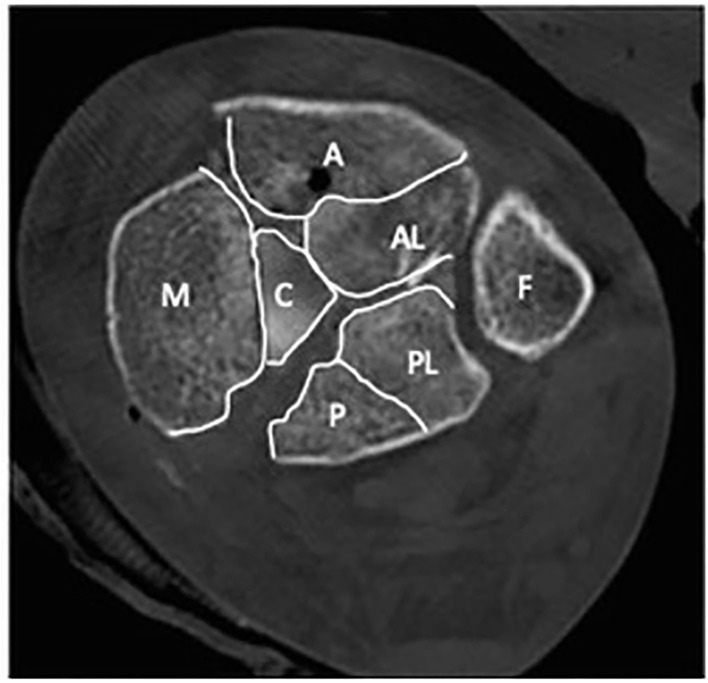
Figure 1
Figure 1
An axial CT of the distal tibia showing the typical six fracture fragments. A, anterior fragment; AL, anterolateral fragment; P, posterior fragment; PL, posterolateral fragment; C, central die-punch fragment; M, medial fragment; F, fibula.
Figure 2
Figure 2
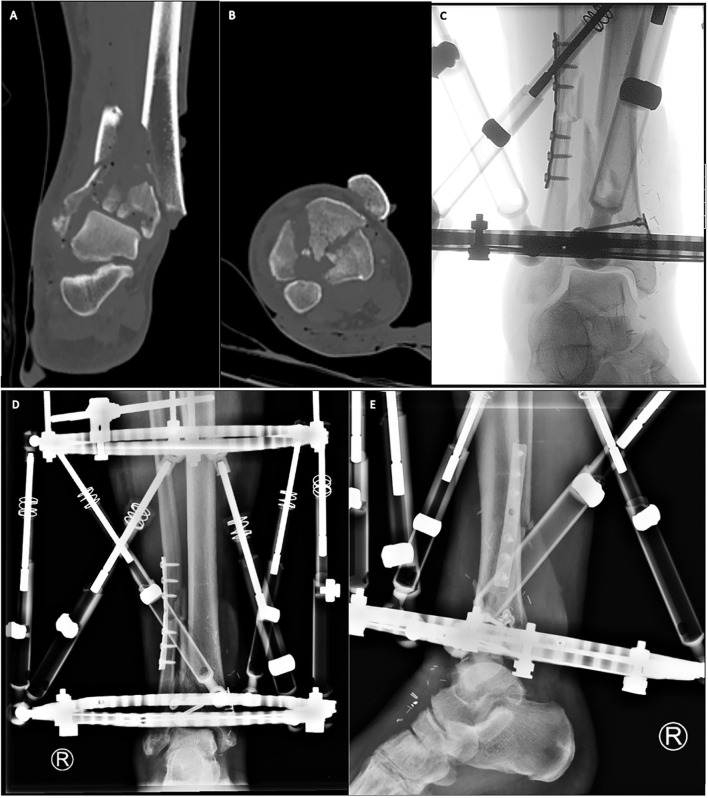
Primary Hybrid external fixation in combination with plate and lag screw osteosynthesis in a °II open tibial pilon fracture. We present a 55-year-old male, with a °II open tibial pilon fracture AO type 43-C3, who presented via the trauma room. After emergency preoperative CT scans [(A) coronal plane, (B) axial plane] temporary fixation and soft tissue conditioning was performed. The extensive soft tissue defect on the anteromedial side was covered with an arteria radialis microvascular free flap. Afterwards the comminuted fibula was restored in length and rotation and the articular surface of the tibial pilon was reconstructed using minimally invasive plating and lag screws [(C) Intraoperative fluoroscopy]. Finally, we stabilized the tibial pilon fracture using a hybrid circular frame with tensioned K-wires in the distal fragments and Schanz-screws in the proximal tibia [(D) Post-operative a.p. X-ray, (E) Post-operative lat. X-Ray].
Figure 3
Figure 3
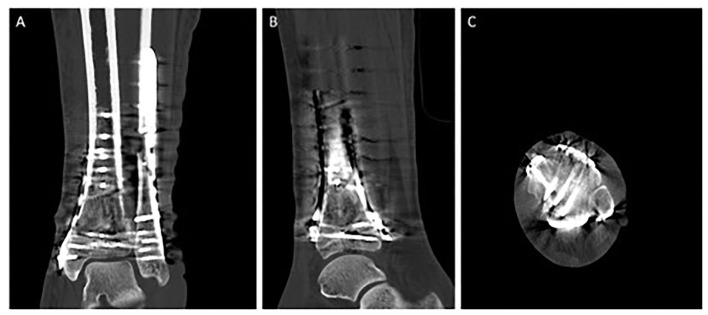
Triple plate ORIF of a tibial pilon fracture AO type 43-C3. Postoperative CT scans [(A) coronal plane, (B) sagittal plane, (C) axial plane] of a 49-year-old female patient following operative treatment of an AO type 43-C3 tibial pilon fracture, resulting from a hiking accident. As a first step, fracture reconstruction was started with a posterolateral approach to address the dorsal tibial component with a buttress plate. The comminuted fibula was restored in length and rotation afterwards. As a second step, the extensile approach was used to address the anterior and the anteromedial component with two angular stable plates.

References

    1. Luo TD, Eady JM, Aneja A, Miller AN. Classifications in brief: ruedi-allgower classification of tibial plafond fractures. Clin Orthop Relat Res. (2017) 475:1923–8. 10.1007/s11999-016-5219-z - DOI - PMC - PubMed
    1. Chen H, Cui X, Ma B, Rui Y, Li H. Staged procedure protocol based on the four-column concept in the treatment of AO/OTA type 43-C3.3 pilon fractures. J Int Med Res. (2019) 47:2045–55. 10.1177/0300060519836512 - DOI - PMC - PubMed
    1. Mauffrey C, Vasario G, Battiston B, Lewis C, Beazley J, Seligson D. Tibial pilon fractures: a review of incidence, diagnosis, treatment, and complications. Acta Orthop Belg. (2011) 77:432–40. - PubMed
    1. Cutillas-Ybarra MB, Lizaur-Utrilla A, Lopez-Prats FA. Prognostic factors of health-related quality of life in patients after tibial plafond fracture. A pilot study injury. Injury. (2015) 46:2253–7. 10.1016/j.injury.2015.06.025 - DOI - PubMed
    1. Bartonícek J, Mittlmeier T, Rammelt S. [Anatomy, biomechanics and pathomechanics of the tibial pilon]. Ful Sprunggelenk. (2012) 10:3–11. 10.1016/j.fuspru.2012.01.017 - DOI

LinkOut - more resources