


Daily activity relates to not only femoral bone mineral density, but also hip structural analysis parameters: A cross-sectional observational study
- PMID: 35005248
- PMCID: PMC8714472
- DOI: 10.1016/j.afos.2021.10.001
Daily activity relates to not only femoral bone mineral density, but also hip structural analysis parameters: A cross-sectional observational study
Abstract
Objectives: Physical activity to maintain bone mass and strength is important for hip fracture prevention. We aim to investigate the relationship between physical performance/activity status and bone mineral density (BMD)/hip structural analysis (HSA) parameters among postmenopausal women in Japan.
Methods: Sixty-two postmenopausal women diagnosed with osteoporosis (mean age: 72.61 ± 7.43 years) were enrolled in this cross-sectional observational study. They were evaluated for BMD and HSA in the proximal femur by dual-energy X-ray absorptiometry and underwent several physical performance tests, the Geriatric Locomotive Function Scale of 25 questions (GLFS-25). Principal component analysis (PCA) was used to summarize data on the BMD/HSA parameters. Partial correlation analysis, multiple regression analysis, and structural equation modeling (SEM) were performed to investigate the relationship between physical performance/activity status and BMD/HSA parameters of the proximal femur.
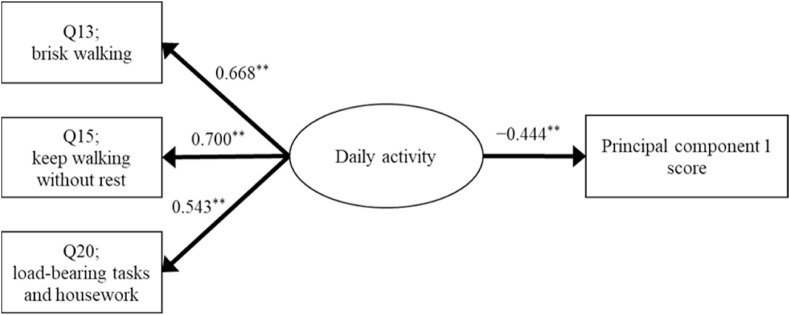
Results: In a partial correlation analysis adjusted for age and body mass index (BMI), GLFS-25 scores were correlated with HSA parameter (|r| = 0.260-0.396, P < 0.05). Principal component 1 (PC1) calculated by PCA was interpreted as more reflective of bone strength based on the value of BMD/HSA parameters. The SEM results showed that the model created by the 3 questions (Q13, brisk walking; Q15, keep walking without rest; Q20, load-bearing tasks and housework) of the GLFS-25 had the best fit and was associated with the PC1 score (β = -0.444, P = 0.001).
Conclusions: The GLFS-25 score was associated with the BMD/HSA parameter, which may reflect the bone strength of the proximal femur as calculated by PCA.
Keywords: Bone mineral density; Geriatric locomotive function scale of 25 questions; Hip structural analysis; Locomotive syndrome; Osteoporosis.
© 2021 The Korean Society of Osteoporosis. Publishing services by Elsevier B.V.
Conflict of interest statement
Nobukazu Okimoto has received consulting fees from Teijin Pharma Ltd and Asahi-Kasei Pharmaceutical Co., Ltd. Nobukazu Okimoto has received payments for lectures, such as speakers’ bureau fees, from Astellas Pharma Inc.; Asahi-Kasei Pharmaceutical Co., Ltd.; Eli Lilly Japan K·K.; Chugai Pharmaceutical Co.; Amgen Astellas BioPharma K·K.; Daiichi-Sankyo Co. Ltd.; Eisai Co., Ltd.; Teijin Pharma Ltd.; Pfizer Japan Inc.; Ono Pharmaceutical Co.; and Mitsubishi-Tanabe Pharma Corp. There are no conflicts of interest for all other authors.
Figures
References
-
- Penrod J.D., Litke A., Hawkes W.G., Magaziner J., Koval K.J., Doucette J.T., et al. Heterogeneity in hip fracture patients: age, functional status, and comorbidity. J Am Geriatr Soc. 2007;55:407–413. - PubMed
-
- Cooper C., Campion G., Melton L.J. Hip fractures in the elderly: a world-wide projection. Osteoporos Int. 1992;2:285–289. - PubMed
-
- Armbrecht G., Belavý D.L., Backström M., Beller G., Alexandre C., Rizzoli R., et al. Trabecular and cortical bone density and architecture in women after 60 days of bed rest using high-resolution pQCT: wise 2005. J Bone Miner Res. 2011;26:2399–2410. - PubMed
LinkOut - more resources
Full Text Sources
Research Materials
Miscellaneous
