


Comparison of bone mineral density and vertebral fracture assessment in postmenopausal women with and without distal radius fractures
- PMID: 35005249
- PMCID: PMC8714471
- DOI: 10.1016/j.afos.2021.11.004
Comparison of bone mineral density and vertebral fracture assessment in postmenopausal women with and without distal radius fractures
Abstract
Objectives: To compare bone mineral density (BMD) in Thai postmenopausal women with and without distal radius fracture, and to investigate the role of vertebral fracture assessment (VFA) in diagnosing osteoporosis after distal radius fracture.
Methods: A cross-sectional study was conducted in Thai postmenopausal women with and without distal radius fracture. BMDs of the femoral neck (FN), total hip (TH), lumbar spine (LS), and VFA were obtained within 2 weeks of injury. BMD were compared between groups. Participants were classified into osteoporosis, osteopenia or normal using BMD alone, and BMD plus VFA, where a mere presence of vertebral compression fracture indicated osteoporosis.
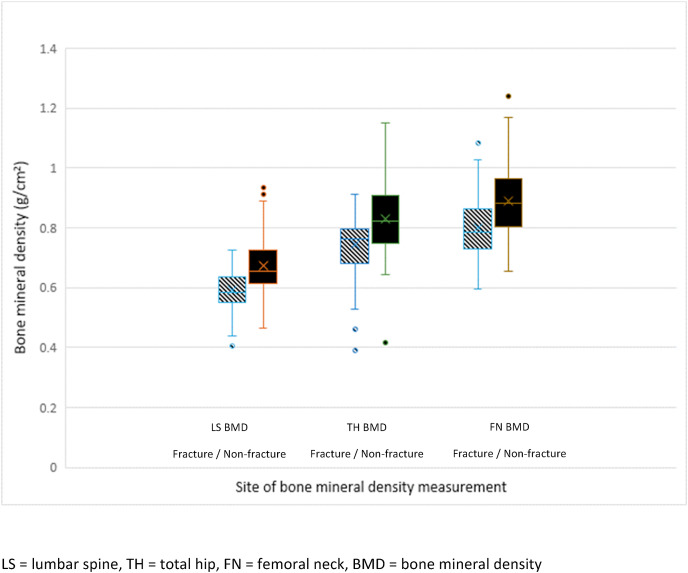
Results: Fifty postmenopausal women with distal radius fractures and 111 non-fracture postmenopausal women participated. The mean BMD was significantly lower at all sites in the fracture group (FN BMD 0.590 ± 0.075 vs 0.671 ± 0.090, p = 0.007; TH BMD 0.742 ± 0.103 vs 0.828 ± 0.116, P = 0.009; LS BMD 0.799 ± 0.107 vs 0.890 ± 0.111, P = 0.009 in the fracture vs non-fracture group respectively). VFA increased the prevalence of osteoporosis from 16 (32%) to 23 (46%) in the fracture group, and 7 (6.31%) to 17 (16.22%) in the non-fracture group, with a number needed to treat 9.
Conclusions: Postmenopausal women with distal radius fractures had lower BMD. Incorporating VFA into diagnosis of osteoporosis increased the prevalence of osteoporosis in both fracture and non-fracture groups. Postmenopausal women aged 50 years or older with distal radius fracture are a good target for the investigation of osteoporosis.
Keywords: Bone mineral density; Distal radius fracture; Osteoporosis; Vertebral compression fracture; Vertebral fracture assessment.
© 2021 The Korean Society of Osteoporosis. Publishing services by Elsevier B.V.
Conflict of interest statement
The authors declare no competing interests.
Figures
References
-
- Kanis J.A. Assessment of fracture risk and its application to screening for postmenopausal osteoporosis: synopsis of a WHO report. WHO Study Group. Osteoporos Int. 1994;4:368–381. - PubMed
-
- Mallmin H., Ljunghall S., Persson I., Naessén T., Krusemo U.B., Bergström R. Fracture of the distal forearm as a forecaster of subsequent hip fracture: a population-based cohort study with 24 years of follow-up. Calcif Tissue Int. 1993;52:269–272. - PubMed
-
- Sornay-Rendu E., Munoz F., Garnero P., Duboeuf F., Delmas P.D. Identification of osteopenic women at high risk of fracture: the OFELY study. J Bone Miner Res. 2005;20:1813–1819. - PubMed
-
- Bozkurt H.H., Atik O., Tokgöz M.A. Can distal radius or vertebra fractures due to low-energy trauma be a harbinger of a hip fracture? Eklem Hastalik Cerrahisi. 2018;29:100–103. - PubMed
LinkOut - more resources
Full Text Sources
Miscellaneous
