Prediction of End-Stage Kidney Disease Using Estimated Glomerular Filtration Rate With and Without Race : A Prospective Cohort Study
- PMID: 35007146
- PMCID: PMC9083829
- DOI: 10.7326/M21-2928
Prediction of End-Stage Kidney Disease Using Estimated Glomerular Filtration Rate With and Without Race : A Prospective Cohort Study
Abstract
Background: New estimated glomerular filtration rate (eGFR) equations removed race adjustment, but the impact of its removal on prediction of end-stage kidney disease (ESKD) is unknown.
Objective: To compare the ESKD prediction performance of different eGFR equations.
Design: Observational, prospective cohort study.
Setting: 7 U.S. clinical centers.
Participants: 3873 participants with chronic kidney disease (CKD) from the CRIC (Chronic Renal Insufficiency Cohort) Study contributing 13 902 two-year risk periods.
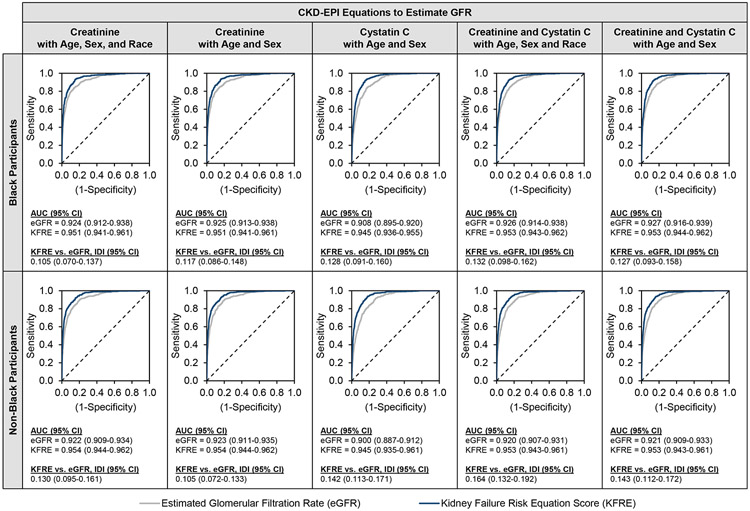
Measurements: ESKD was defined as initiation of dialysis or transplantation. eGFR was calculated using 5 Chronic Kidney Disease Epidemiology Collaboration (CKD-EPI) equations based on serum creatinine and/or cystatin C, with or without race adjustment. The predicted 2-year risk for ESKD was calculated using the 4-variable Kidney Failure Risk Equation (KFRE). We evaluated the prediction performance of eGFR equations and the KFRE score using discrimination and calibration analyses.
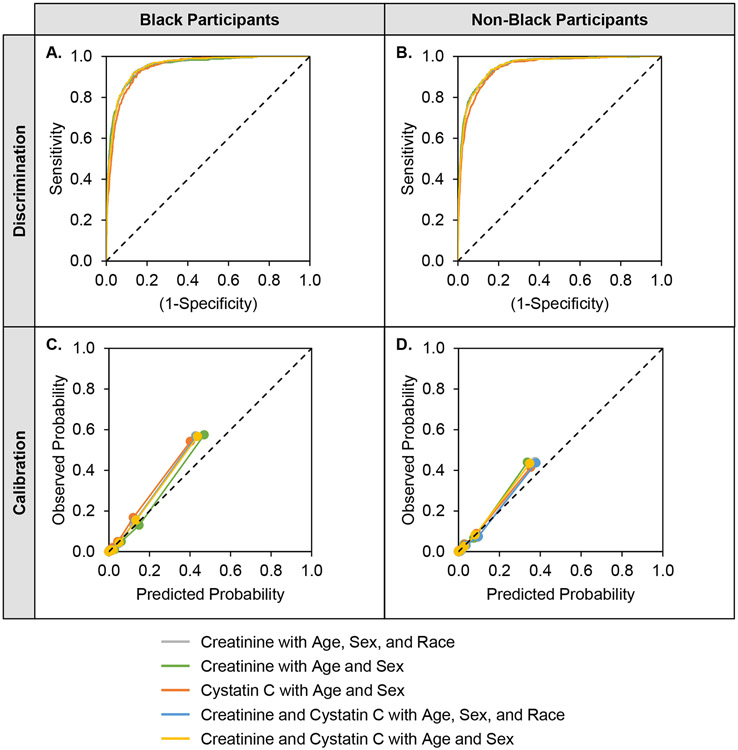
Results: During a maximum 16 years of follow-up, 856 participants developed ESKD. Across all eGFR equations, the KFRE score was superior for predicting 2-year incidence of ESKD compared with eGFR alone (area under the curve ranges, 0.945 to 0.954 vs. 0.900 to 0.927). Prediction performance of KFRE scores using different eGFR equations was similar, but the creatinine equation without race adjustment improved calibration among Black participants. Among all participants, compared with an eGFR less than 20 mL/min/1.73 m2, a KFRE score greater than 20% had similar specificity for predicting 2-year ESKD risk (ranges, 0.94 to 0.97 vs. 0.95 to 0.98) but higher sensitivity (ranges, 0.68 to 0.78 vs. 0.42 to 0.66).
Limitation: Data are solely from the United States.
Conclusion: The KFRE score better predicts 2-year risk for ESKD compared with eGFR alone, regardless of race adjustment. The creatinine equation with age and sex may improve calibration among Black patients. A KFRE score greater than 20% showed high specificity and sensitivity for predicting 2-year risk for ESKD.
Primary funding source: National Institutes of Health.
Figures
Comment in
-
Eliminating Racial Inequities in Kidney Health: Much More Than Revising Estimating Equations.Ann Intern Med. 2022 Mar;175(3):446-447. doi: 10.7326/M21-4875. Epub 2022 Jan 11. Ann Intern Med. 2022. PMID: 35007150 No abstract available.
-
In CKD, the Kidney Failure Risk Equation predicted 2-y risk for ESKD better than eGFR alone.Ann Intern Med. 2022 May;175(5):JC59. doi: 10.7326/J22-0022. Epub 2022 May 3. Ann Intern Med. 2022. PMID: 35500267
References
Publication types
MeSH terms
Substances
Grants and funding
- UL1 TR002548/TR/NCATS NIH HHS/United States
- U01 DK060963/DK/NIDDK NIH HHS/United States
- U01 DK061022/DK/NIDDK NIH HHS/United States
- R01 DK119199/DK/NIDDK NIH HHS/United States
- UL1 TR000003/TR/NCATS NIH HHS/United States
- UL1 TR000439/TR/NCATS NIH HHS/United States
- U01 DK060990/DK/NIDDK NIH HHS/United States
- UL1 RR029879/RR/NCRR NIH HHS/United States
- UL1 TR003098/TR/NCATS NIH HHS/United States
- U01 DK061028/DK/NIDDK NIH HHS/United States
- UL1 TR000433/TR/NCATS NIH HHS/United States
- U01 DK060984/DK/NIDDK NIH HHS/United States
- U01 DK061021/DK/NIDDK NIH HHS/United States
- U24 DK060990/DK/NIDDK NIH HHS/United States
- U01 DK060980/DK/NIDDK NIH HHS/United States
- UL1 RR024131/RR/NCRR NIH HHS/United States
- K12 HD043451/HD/NICHD NIH HHS/United States
- K12 AR084224/AR/NIAMS NIH HHS/United States
- UL1 TR000424/TR/NCATS NIH HHS/United States
- M01 RR016500/RR/NCRR NIH HHS/United States
- P20 GM109036/GM/NIGMS NIH HHS/United States
- U01 DK060902/DK/NIDDK NIH HHS/United States
LinkOut - more resources
Full Text Sources
Medical
Research Materials
Miscellaneous