. 2022 Mar 7;61(11):e202112572.
doi: 10.1002/anie.202112572. Epub 2022 Jan 27.

A Plausible Prebiotic One-Pot Synthesis of Orotate and Pyruvate Suggestive of Common Protometabolic Pathways

Affiliations

A Plausible Prebiotic One-Pot Synthesis of Orotate and Pyruvate Suggestive of Common Protometabolic Pathways

Alyssa P Clay et al. Angew Chem Int Ed Engl. .

Abstract

A reaction between two prebiotically plausible building blocks, hydantoin and glyoxylate, generates both the nucleobase orotate, a precursor of biological pyrimidines, and pyruvate, a core metabolite in the citric acid cycle and amino acid biosynthesis. The reaction proceeds in water to provide significant yields of the two widely divergent chemical motifs. Additionally, the reaction of thiohydantoin and glyoxylate produces thioorotate in high yield under neutral aqueous conditions. The use of an open-chain thiohydantoin derivative also enables the potential pre-positioning of a nucleosidic bond prior to the synthesis of an orotate nucleoside. The observation that diverse building blocks of modern metabolism can be produced in a single reaction pot, from common reactants under mild conditions, supports the plausibility of orthogonal chemistries operating at the origins of chemical evolution.

Keywords: Prebiotic Chemistry; Pyrimidine Synthesis; Pyruvate Synthesis.


Conflict of interest statement

The authors declare no conflict of interest.

Figures
Scheme 1
Scheme 1
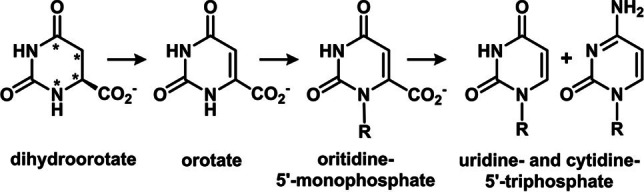
The biosynthesis of pyrimidine nucleotides proceeds through an orotate intermediate that is subsequently ribosylated and decarboxylated to produce the canonical uridine and cytidine nucleotides. The original aspartate skeleton within dihydroorotate is starred.
Scheme 2
Scheme 2
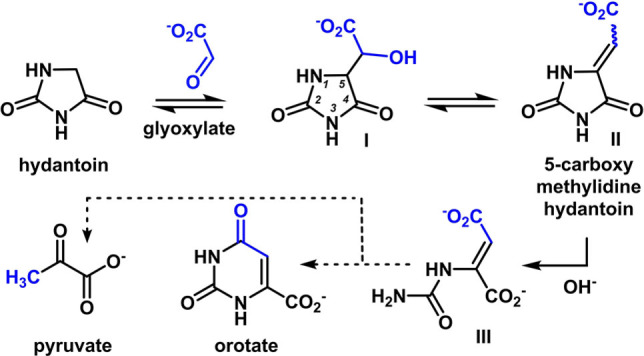
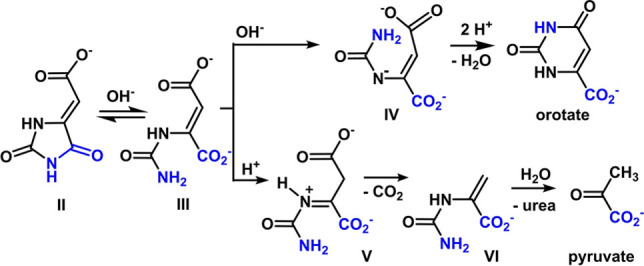
The reaction pathway from hydantoin and glyoxylate proceeds through the hydrolysis of 5‐carboxymethylidinehydantoin (II) to intermediate III. Attack of the liberated N3 on the carboxylate (C7) produces orotate. Tautomerization and hydrolysis of III yields pyruvate. The numbering system maintains consistency from hydantoin, and the blue color tracks the glyoxylate skeleton.
Figure 1
Figure 1
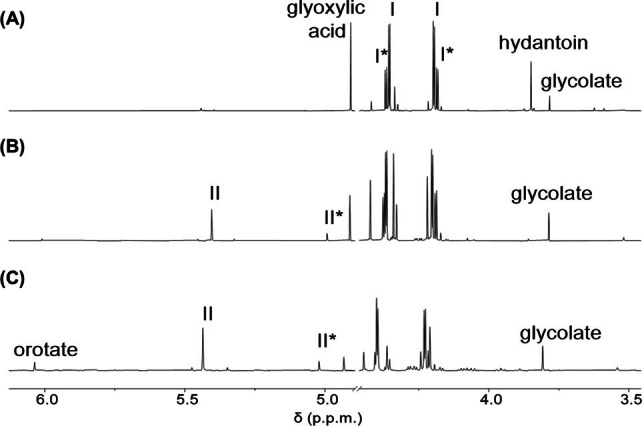
The proposed pathway from hydantoin to orotate. 1H NMR (in D2O) of a reaction aliquot from 90 mM hydantoin with 1.5 eq. of glyoxylic acid in pH 8.2 1.0 M NaHCO3 buffer stirred at 60 °C for 1 hour (A), for 24 hours (B), and for 96 hours (C).
Figure 2
Figure 2
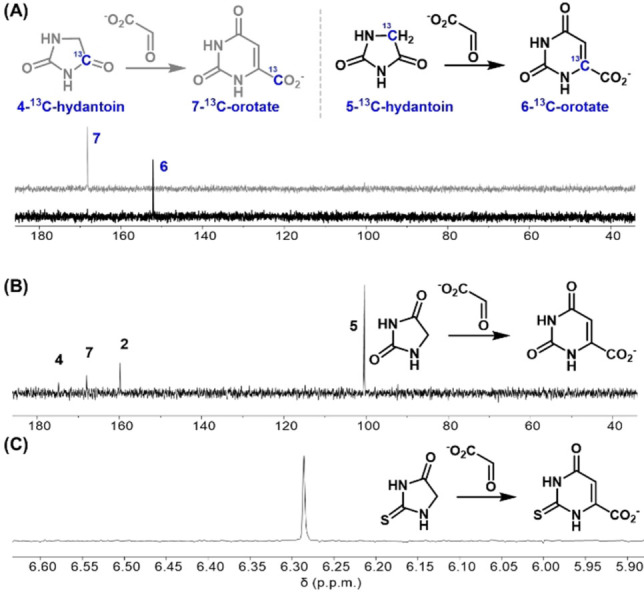
13C NMR (in D2O) showing A) (7‐13C)orotate and (6‐13C)orotate produced from C4‐ and C5‐13C‐hydantoins, respectively, B) in comparison to a non isotopically‐labeled orotate. C) 1H NMR (in D2O) of a reaction aliquot from 50 mM 2‐thiohydantoin with 1.5 eq. of glyoxylic acid in a pH 7 0.5 M NaH2PO4 buffer stirred at 60 °C to produce 2‐thioorotate.
Figure 3
Figure 3
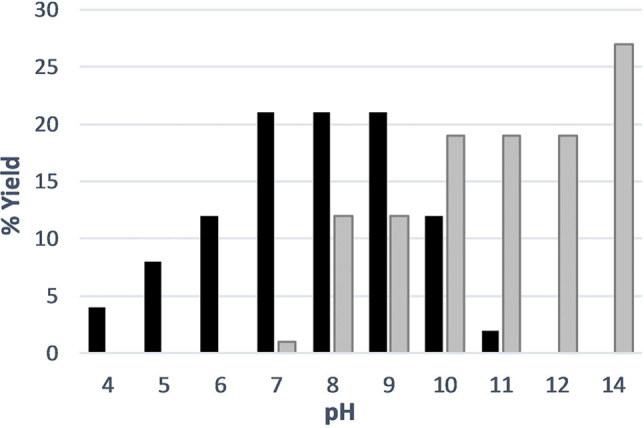
pH dependence of pyruvate (black) and orotate (shaded) production from 90 mM hydantoin with 1.5 eq. of glyoxylic acid, heated at 80 °C for 96 h in phosphate buffer (pH 4–7, 11–12), bicarbonate buffer (pH 8–10), or 2.0 M KOH (pH 14).
Figure 4
Figure 4
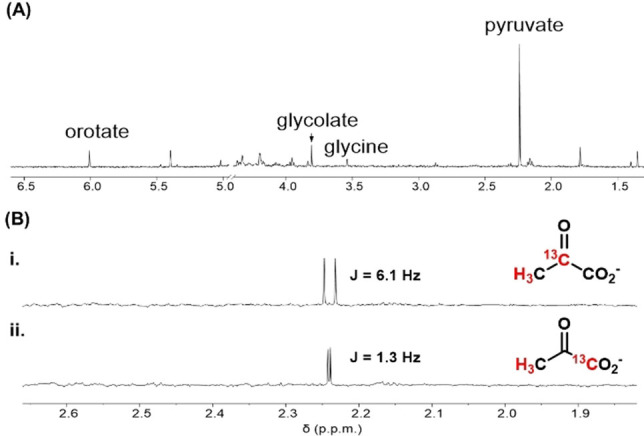
A) Synthesis of pyruvate in 1.0 M NaHCO3, pH 8.2, 60 °C for 96 h. B) Pyruvate produced from i) (5‐13C)hydantoin and ii) (4‐13C)hydantoin in 1.0 M NaHCO3 pH 8.2, with 1.5 eq. of glyoxylic acid heated at 60 °C for 72 h. C−H couplings are consistent with expected values for i. two‐bond and ii. three‐bond proton‐carbon couplings.
Scheme 3
Scheme 3
Bifurcation of the mechanistic pathway to orotate and pyruvate from 5‐carboxymethylidinehydantoin (II).
Figure 5
Figure 5
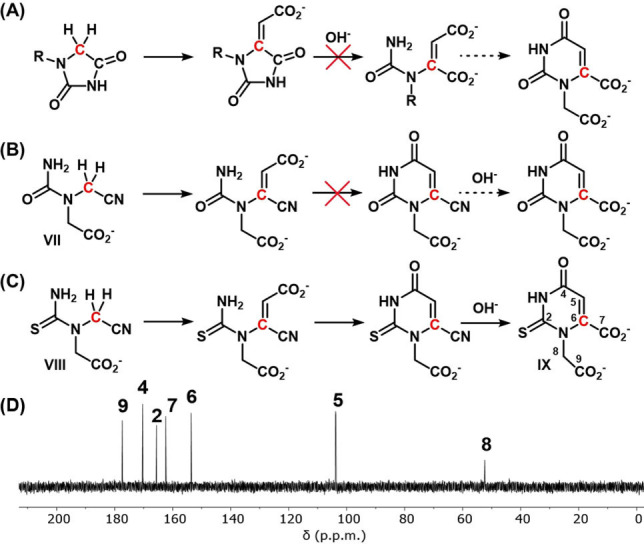
Nucleosidation of hydantoin analogues. Attempts to synthesize orotate nucleosides with 1.5 equiv. of glyoxylate in 1 M NaHCO3 at 80 °C were unsuccessful starting from: A) N1‐alkylated hydantoins, and B) open‐chain hydantoin analogues (VII). C) However, an open‐chain thiohydantoin analogue (VIII) was successfully transformed into a carboxymethylthiorotate nucleoside (IX), as shown by its 13C NMR (D).

References

    1. Wu L.-F., Sutherland J. D., Emerg. Top. Life Sci. 2019, 3, 459–468. - PMC - PubMed
    1. Sutherland J. D., Angew. Chem. Int. Ed. 2016, 55, 104–121; - PubMed
    2. Angew. Chem. 2016, 128, 108–126.
    1. Lazcano A., Miller S. L., Cell 1996, 85, 793–798. - PubMed
    1. Patel B. H., Percivalle C., Ritson D. J., Duffy C. D., Sutherland J. D., Nat. Chem. 2015, 7, 301–307. - PMC - PubMed
    1. Springsteen G., Yerabolu J. R., Nelson J., Rhea C. J., Krishnamurthy R., Nat. Commun. 2018, 9, 91. - PMC - PubMed

Publication types

LinkOut - more resources