


Skeletal muscle myosin promotes coagulation by binding factor XI via its A3 domain and enhancing thrombin-induced factor XI activation
- PMID: 35007530
- PMCID: PMC8856988
- DOI: 10.1016/j.jbc.2022.101567
Skeletal muscle myosin promotes coagulation by binding factor XI via its A3 domain and enhancing thrombin-induced factor XI activation
Abstract
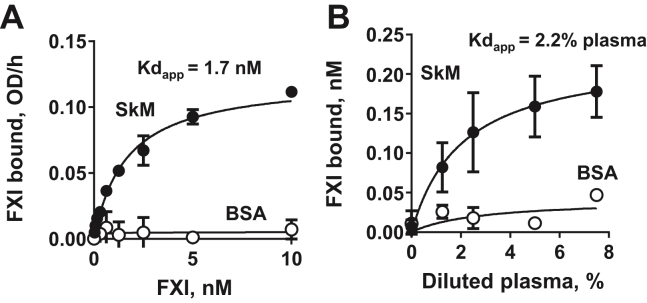
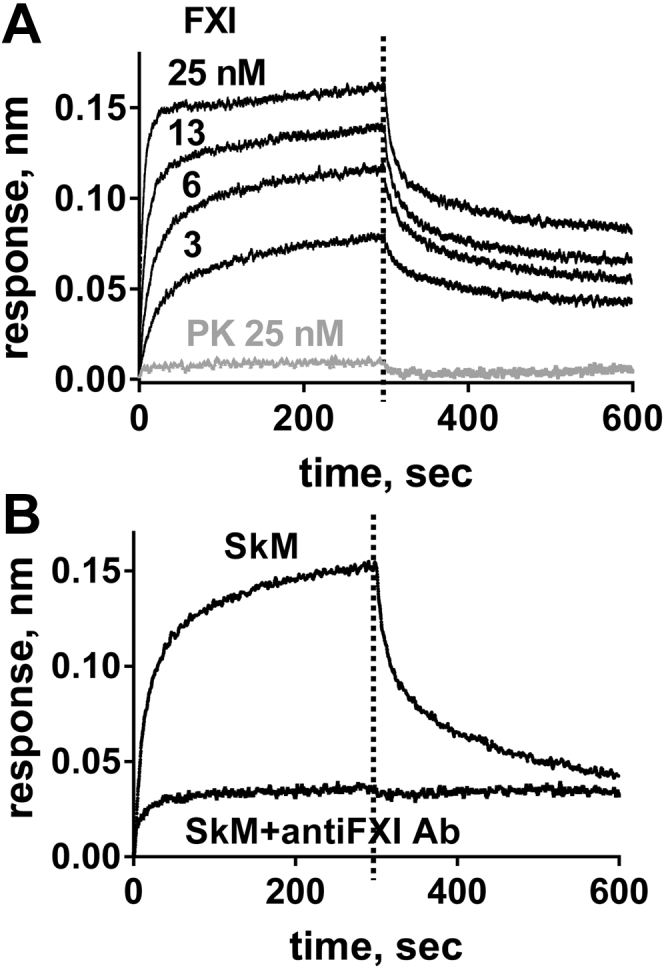
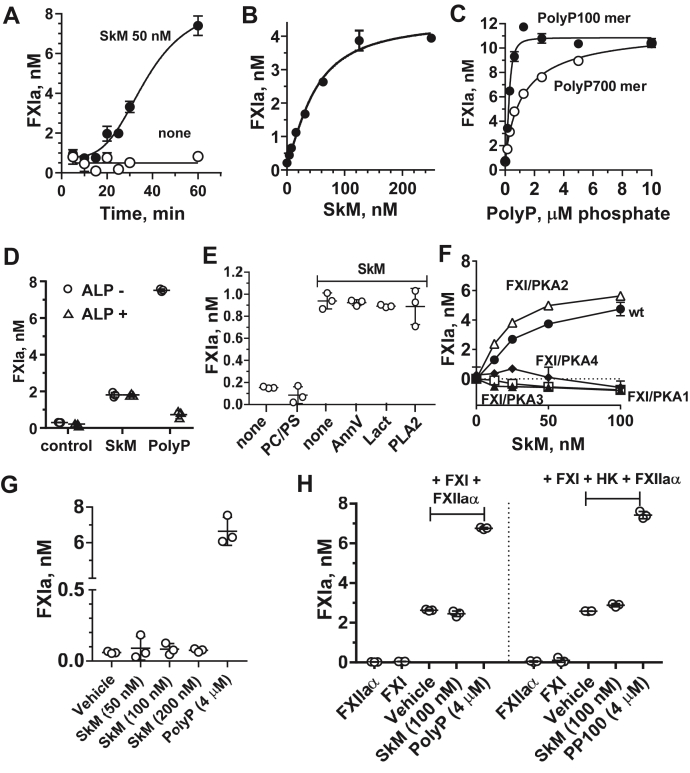
Skeletal muscle myosin (SkM) has been shown to possess procoagulant activity; however, the mechanisms of this coagulation-enhancing activity involving plasma coagulation pathways and factors are incompletely understood. Here, we discovered direct interactions between immobilized SkM and coagulation factor XI (FXI) using biolayer interferometry (Kd = 0.2 nM). In contrast, we show that prekallikrein, a FXI homolog, did not bind to SkM, reflecting the specificity of SkM for FXI binding. We also found that the anti-FXI monoclonal antibody, mAb 1A6, which recognizes the Apple (A) 3 domain of FXI, potently inhibited binding of FXI to immobilized SkM, implying that SkM binds FXI A3 domain. In addition, we show that SkM enhanced FXI activation by thrombin in a concentration-dependent manner. We further used recombinant FXI chimeric proteins in which each of the four A domains of the heavy chain (designated A1 through A4) was individually replaced with the corresponding A domain from prekallikrein to investigate SkM-mediated enhancement of thrombin-induced FXI activation. These results indicated that activation of two FXI chimeras with substitutions of either the A3 domains or A4 domains was not enhanced by SkM, whereas substitution of the A2 domain did not reduce the thrombin-induced activation compared with wildtype FXI. These data strongly suggest that functional interaction sites on FXI for SkM involve the A3 and A4 domains. Thus, this study is the first to reveal and support the novel intrinsic blood coagulation pathway concept that the procoagulant mechanisms of SkM include FXI binding and enhancement of FXI activation by thrombin.
Keywords: coagulation factor; factor XI; myosin; skeletal muscle myosin; thrombin.
Copyright © 2022 The Authors. Published by Elsevier Inc. All rights reserved.
Conflict of interest statement
Conflict of interest The authors declare that they have no conflicts of interest with the contents of this article.
Figures
References
-
- Erlacher P., Lercher A., Falkensammer J., Nassonov E.L., Samsonov M.I., Shtutman V.Z., Puschendorf B., Mair J. Cardiac troponin and beta-type myosin heavy chain concentrations in patients with polymyositis or dermatomyositis. Clin. Chim. Acta. 2001;306:27–33. - PubMed
-
- Lofberg M., Tahtela R., Harkonen M., Somer H. Myosin heavy-chain fragments and cardiac troponins in the serum in rhabdomyolysis. Diagnostic specificity of new biochemical markers. Arch. Neurol. 1995;52:1210–1214. - PubMed
Publication types
MeSH terms
Substances
Grants and funding
LinkOut - more resources
Full Text Sources
