Clofarabine with topotecan, vinorelbine, and thiotepa reinduction regimen for children and young adults with relapsed AML
- PMID: 35008101
- PMCID: PMC9043926
- DOI: 10.1182/bloodadvances.2021005753
Clofarabine with topotecan, vinorelbine, and thiotepa reinduction regimen for children and young adults with relapsed AML
Abstract
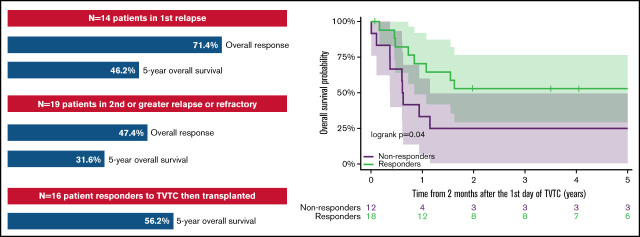
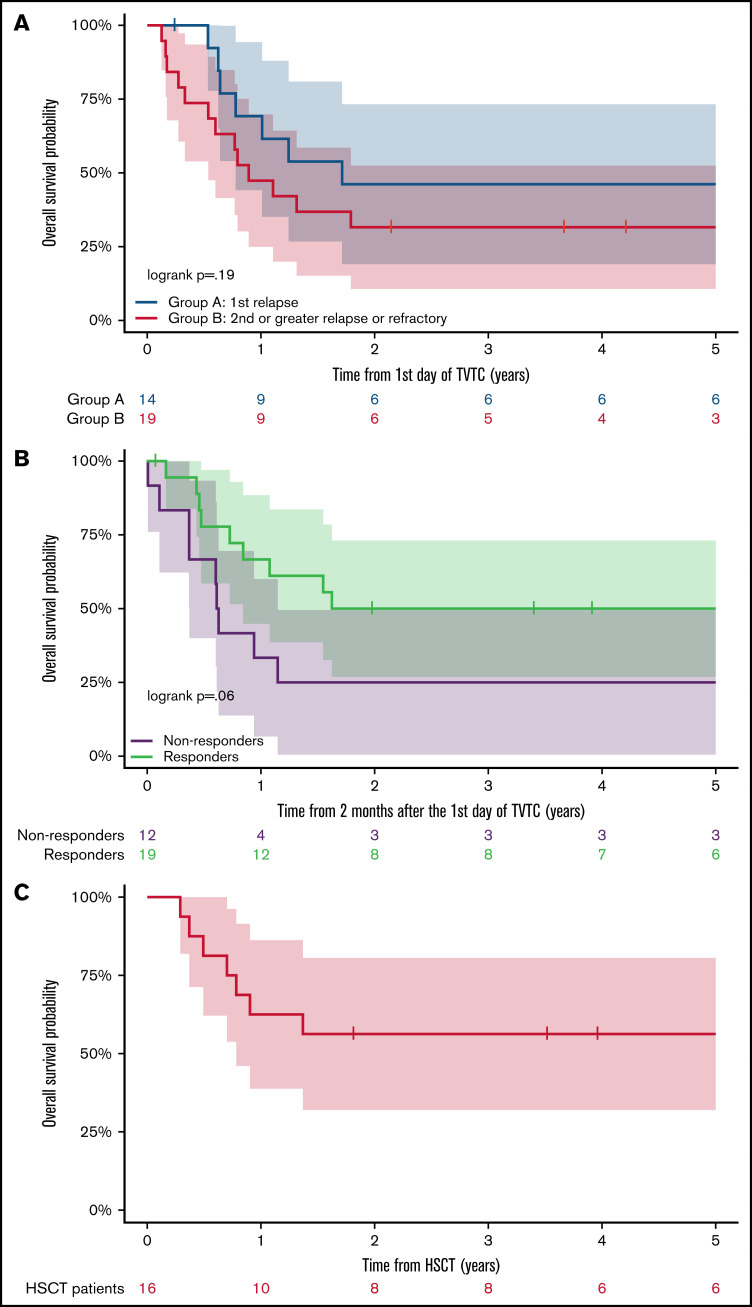
Effective reinduction regimens are needed for children with relapsed and refractory acute myeloid leukemia (AML), as outcomes remain poor. Therapeutic options are limited in this heavily pretreated patient population, many of whom have reached lifetime recommended doses of anthracycline chemotherapy. The development of effective non-anthracycline-based salvage regimens is crucial to these patients who are at significant risk of life-threatening cardiotoxicity. We previously reported results of a phase 2 trial of a clofarabine-based regimen with topotecan, vinorelbine, and thiotepa (TVTC) in patients with relapsed acute leukemias. Here we report on an expanded bicenter cohort of 33 patients, <25 years of age, with relapsed/refractory AML treated with up to 2 cycles of the TVTC reinduction regimen from 2007 to 2018. The overall response rate, defined as complete remission or complete remission with partial recovery of platelet count, was 71.4% (95% confidence interval [CI], 41.9-91.6) for those patients in first relapse (n = 14) and 47.4% (95% CI, 24.4-71.1) for patients in second or greater relapse or with refractory disease. Responses were seen across multiple high-risk cytogenetic and molecular subtypes, with 84% of responders successfully bridged to allogeneic stem cell transplantation. The 5-year overall survival for patients in first relapse was 46.2% (95% CI, 19.1-73.3) and 50.0% (95% CI, 26.9-73.1) for patients who responded to TVTC. For pediatric and young adult patients with relapsed/refractory AML, TVTC reinduction compares favorably with currently used salvage regimens and warrants further exploration.
© 2022 by The American Society of Hematology. Licensed under Creative Commons Attribution-NonCommercial-NoDerivatives 4.0 International (CC BY-NC-ND 4.0), permitting only noncommercial, nonderivative use with attribution. All other rights reserved.
Figures
References
-
- Gibson BE, Webb DK, Howman AJ, De Graaf SS, Harrison CJ, Wheatley K; United Kingdom Childhood Leukaemia Working Group and the Dutch Childhood Oncology Group . Results of a randomized trial in children with acute myeloid leukaemia: medical research council AML12 trial. Br J Haematol. 2011;155(3):366-376. - PubMed
-
- Gamis AS, Alonzo TA, Meshinchi S, et al. Gemtuzumab ozogamicin in children and adolescents with de novo acute myeloid leukemia improves event-free survival by reducing relapse risk: results from the randomized phase III Children’s Oncology Group trial AAML0531. J Clin Oncol. 2014;32(27):3021-3032. - PMC - PubMed
-
- Creutzig U, Zimmermann M, Bourquin JP, et al. Randomized trial comparing liposomal daunorubicin with idarubicin as induction for pediatric acute myeloid leukemia: results from Study AML-BFM 2004. Blood. 2013;122(1):37-43. - PubMed
-
- Wells RJ, Adams MT, Alonzo TA, et al. ; Children’s Cancer Group Study 2951 . Mitoxantrone and cytarabine induction, high-dose cytarabine, and etoposide intensification for pediatric patients with relapsed or refractory acute myeloid leukemia: Children’s Cancer Group Study 2951. J Clin Oncol. 2003;21(15):2940-2947. - PubMed