Review
. 2021 Dec 21;23(1):14.
doi: 10.3390/ijms23010014.

Neuroinflammation in Cerebral Ischemia and Ischemia/Reperfusion Injuries: From Pathophysiology to Therapeutic Strategies

Affiliations
Review

Neuroinflammation in Cerebral Ischemia and Ischemia/Reperfusion Injuries: From Pathophysiology to Therapeutic Strategies

Anamaria Jurcau et al. Int J Mol Sci. .

Abstract

Its increasing incidence has led stroke to be the second leading cause of death worldwide. Despite significant advances in recanalization strategies, patients are still at risk for ischemia/reperfusion injuries in this pathophysiology, in which neuroinflammation is significantly involved. Research has shown that in the acute phase, neuroinflammatory cascades lead to apoptosis, disruption of the blood-brain barrier, cerebral edema, and hemorrhagic transformation, while in later stages, these pathways support tissue repair and functional recovery. The present review discusses the various cell types and the mechanisms through which neuroinflammation contributes to parenchymal injury and tissue repair, as well as therapeutic attempts made in vitro, in animal experiments, and in clinical trials which target neuroinflammation, highlighting future therapeutic perspectives.

Keywords: astrocytes; chemokines; cytokines; ischemic stroke; microglia; neuroinflammation; stem cells.


Conflict of interest statement

The authors declare no conflict of interest.

Figures
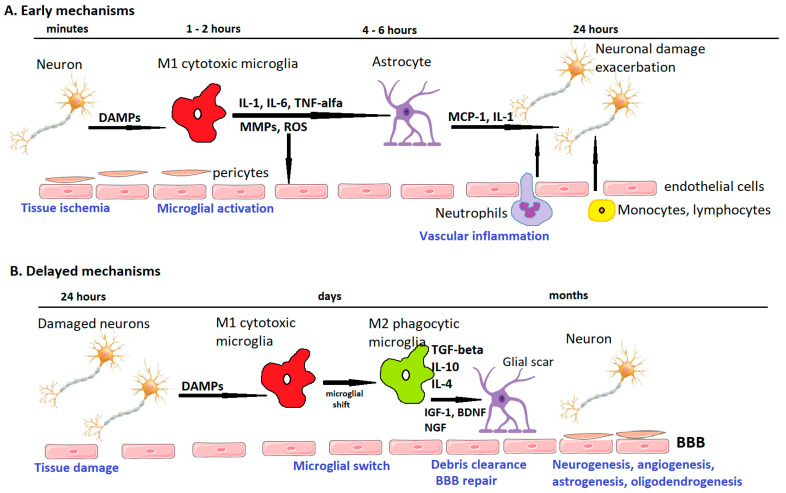
Figure 2
Figure 2
Temporal profile of post-stroke ischemic pathways. Immediately after ischemic stroke, neurons release damage-associated molecular patterns (DAMPs) which lead to microglial and endothelial activation. M1-polarized microglia release pro-inflammatory interleukins (IL-1, IL-6, tumor necrosis factor-alpha), as well as matrix metalloproteinases (MMPs) and reactive oxygen species (ROS), which weaken the blood–brain barrier (BBB). Pericytes and astrocytic endfeet are lifted from the basement membranes. A “leaky” BBB allows leukocytes to infiltrate the cerebral parenchyma, where they produce pro-inflammatory factors (IL-1, monocyte chemotactic protein 1 (MCP-1)) and exacerbate tissue injury. In the delayed subacute phase, microglial switch to an M2 phenotype leads to tissular debris clearance, and, by expressing anti-inflammatory mediators and neurotrophic factors such as insulin-like growth factor 1 (IGF-1), brain-derived neurotrophic factor (BDNF), or nerve growth factor (NGF), promotes glial scar formation as well as BBB repair, neurogenesis, astrogenesis, oligodendrogenesis, and angiogenesis. Adapted from Rajkovic et al. [204].
Figure 1
Figure 1
Leukocyte diapedesis. Leukocytes interact with endothelial cells expressing P-selectins through P-selectin glycoprotein 1 (PSGL-1), leading to their “rolling” on the endothelial surface. Interaction of leukocyte integrins CD11a/CD18 and CD11b/CD18 with intercellular adhesion molecule 1 (ICAM-1) leads to firm adherence and aggregation of leukocytes. Diapedesis of leukocytes is facilitated by the expression of platelet endothelial cell adhesion molecule 1 (PECAM-1) by endothelial cells. Adapted from Collard and Gelman [96].

References

    1. Katan M., Luft A. Global burden of stroke. Semin. Neurol. 2018;38:208–211. doi: 10.1055/s-0038-1649503. - DOI - PubMed
    1. Li L., Scott C.A., Rothwell P.M., on behalf of the Oxford Vascular Study Trends in stroke incidence in high-income countries in the 21st century. Population-based study and systematic review. Stroke. 2020;51:1372–1380. doi: 10.1161/STROKEAHA.119.028484. - DOI - PMC - PubMed
    1. Danaei G., Finucane M.M., Lu Y., Singh G.M., Cowan M.J., Paciorek C.J., Lin J.K., Farzadfar F., Khang Y.H., Stevens G.A., et al. National, regional, and global trends in fasting plasma glucose and diabetes prevalence since 1980s: Systematic analysis of health examination surveys and epidemiological studies with 370 country-years and 2.7 million participants. Lancet. 2011;378:31–40. doi: 10.1016/S0140-6736(11)60679-X. - DOI - PubMed
    1. NCD Risk Factor Collaboration (NCD-RisC) Trends in adult body mass index in 200 countries from 1975 to 2014: A pooled analysis of 1698 population-based measurement studies with 19.2 million participants. Lancet. 2016;387:1377–1396. doi: 10.1016/S0140-6736(16)30054-X. - DOI - PMC - PubMed
    1. Hacke W., Kaste M., Bluhmki E., Brozman M., Dávalos A., Guidetti D., Larrue V., Lees K.R., Medeghri Z., Machnig T., et al. Thrombolysis with alteplase 3 to 4.5 h after acute ischemic stroke. N. Engl. J. Med. 2008;359:1317–1329. doi: 10.1056/NEJMoa0804656. - DOI - PubMed

LinkOut - more resources
