Review
. 2022 Jan 4;23(1):546.
doi: 10.3390/ijms23010546.

Epigenetic Mechanisms in Parenchymal Lung Diseases: Bystanders or Therapeutic Targets?

Affiliations
Review

Epigenetic Mechanisms in Parenchymal Lung Diseases: Bystanders or Therapeutic Targets?

Edibe Avci et al. Int J Mol Sci. .

Abstract

Epigenetic responses due to environmental changes alter chromatin structure, which in turn modifies the phenotype, gene expression profile, and activity of each cell type that has a role in the pathophysiology of a disease. Pulmonary diseases are one of the major causes of death in the world, including lung cancer, idiopathic pulmonary fibrosis (IPF), chronic obstructive pulmonary disease (COPD), pulmonary hypertension (PH), lung tuberculosis, pulmonary embolism, and asthma. Several lines of evidence indicate that epigenetic modifications may be one of the main factors to explain the increasing incidence and prevalence of lung diseases including IPF and COPD. Interestingly, isolated fibroblasts and smooth muscle cells from patients with pulmonary diseases such as IPF and PH that were cultured ex vivo maintained the disease phenotype. The cells often show a hyper-proliferative, apoptosis-resistant phenotype with increased expression of extracellular matrix (ECM) and activated focal adhesions suggesting the presence of an epigenetically imprinted phenotype. Moreover, many abnormalities observed in molecular processes in IPF patients are shown to be epigenetically regulated, such as innate immunity, cellular senescence, and apoptotic cell death. DNA methylation, histone modification, and microRNA regulation constitute the most common epigenetic modification mechanisms.

Keywords: COPD; DNA methylation; IPF; epigenetic editing; gene transfer; histone modifications; microRNA.


Conflict of interest statement

The authors declare no conflict of interest.

Figures
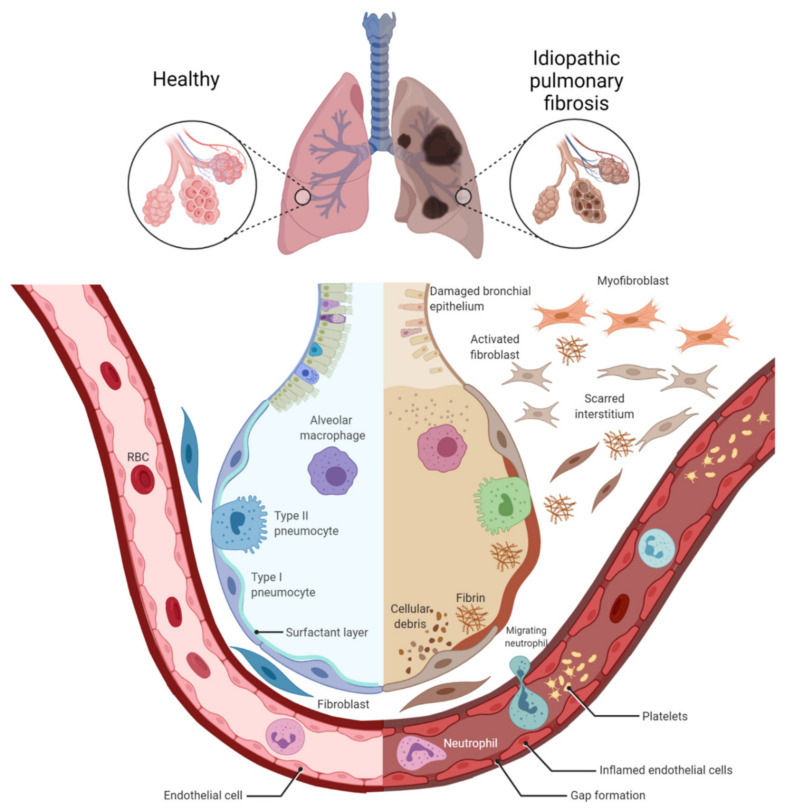
Figure 1
Figure 1
Alveolar damage, dysfunction of inflammatory cells, and scarred interstitium in idiopathic pulmonary fibrosis. Idiopathic pulmonary fibrosis results in dilatation of the bronchi, inflammation, alveolar remodeling, and parenchymal fibrosis (fibroblast–myofibroblast differentiation), which results in impaired gas exchange. Figure created using BioRENDER.com. Accessed on 5 December 2021.
Figure 2
Figure 2
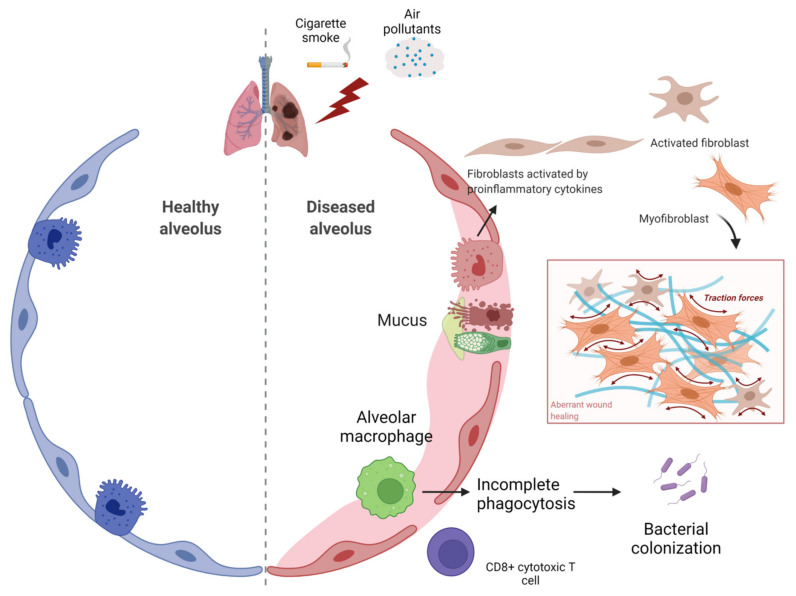
Airway obstruction and inflammatory cells involved in COPD. In chronic obstructive pulmonary disease (COPD), decline in lung function and airflow obstruction due to cigarette smoke and various air pollutants results in disruption of alveolar wall attachments as a result of emphysema formation and airway luminal occlusion by mucus hypersecretion. Both inflammation and fibrosis lead to narrowing of small airways via thickening of the bronchiolar wall. Figure created using BioRENDER.com. Accessed on 18 November 2021.
Figure 3
Figure 3
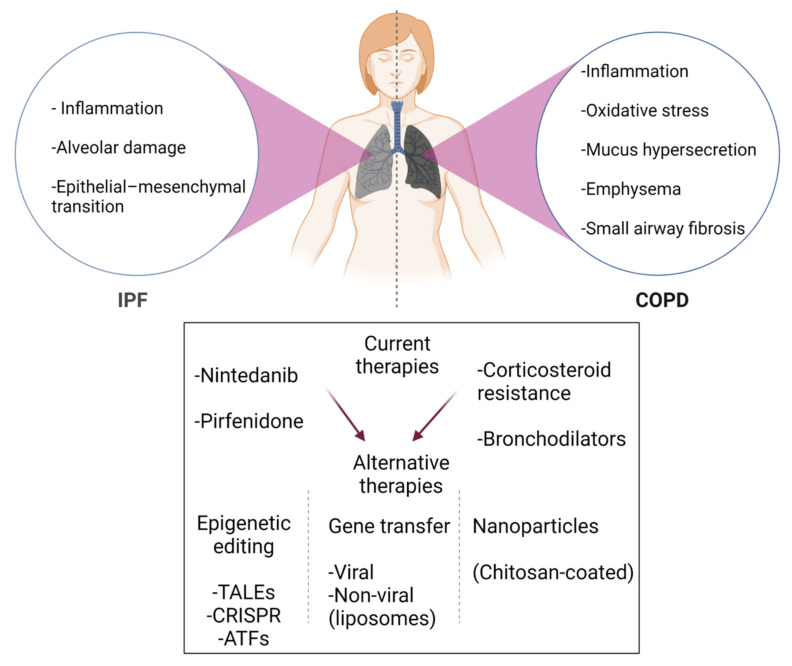
Brief schematic summary of current medications and new strategies for IPF and COPD treatment. Since current drugs and therapies do not show curative effects, new approaches for patients (depicted by red arrows) are required. In addition, large numbers of COPD patients are resistant to corticosteroids. To improve the current therapeutic options in IPF and COPD, a considerable shift in efforts towards epigenetic editing, gene transfer, and nanoparticles in the research field. Figure created using BioRENDER.com. Accessed on 18 November 2021.

References

    1. Marcon A., Schievano E., Fedeli U. Mortality Associated with Idiopathic Pulmonary Fibrosis in Northeastern Italy, 2008–2020: A Multiple Cause of Death Analysis. Int. J. Environ. Res. Public Health. 2021;18:7249. doi: 10.3390/ijerph18147249. - DOI - PMC - PubMed
    1. Raghu G., Chen S.-Y., Yeh W.-S., Maroni B., Li Q., Lee Y.-C., Collard H.R. Idiopathic pulmonary fibrosis in US Medicare beneficiaries aged 65 years and older: Incidence, prevalence, and survival, 2001–2011. Lancet Respir. Med. 2014;2:566–572. doi: 10.1016/s2213-2600(14)70101-8. - DOI - PubMed
    1. Richeldi L., Collard H.R., Jones M.G. Idiopathic pulmonary fibrosis. Lancet. 2017;389:1941–1952. doi: 10.1016/S0140-6736(17)30866-8. - DOI - PubMed
    1. Sgalla G., Iovene B., Calvello M., Ori M., Varone F., Richeldi L. Idiopathic pulmonary fibrosis: Pathogenesis and management. Respir. Res. 2018;19:1–18. doi: 10.1186/s12931-018-0730-2. - DOI - PMC - PubMed
    1. Birch J., Barnes P.J., Passos J.F. Mitochondria, telomeres and cell senescence: Implications for lung ageing and disease. Pharmacol. Ther. 2017;183:34–49. doi: 10.1016/j.pharmthera.2017.10.005. - DOI - PubMed

MeSH terms