


A Review: Laser Welding of Dissimilar Materials (Al/Fe, Al/Ti, Al/Cu)-Methods and Techniques, Microstructure and Properties
- PMID: 35009268
- PMCID: PMC8746029
- DOI: 10.3390/ma15010122
A Review: Laser Welding of Dissimilar Materials (Al/Fe, Al/Ti, Al/Cu)-Methods and Techniques, Microstructure and Properties
Abstract
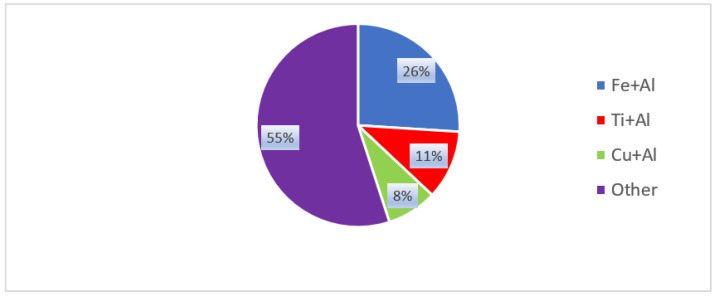
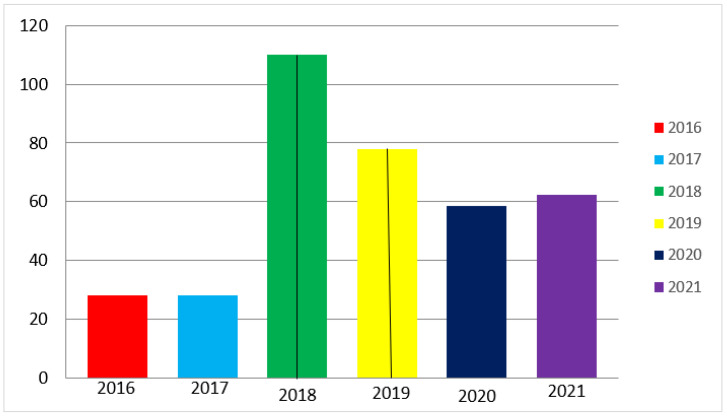
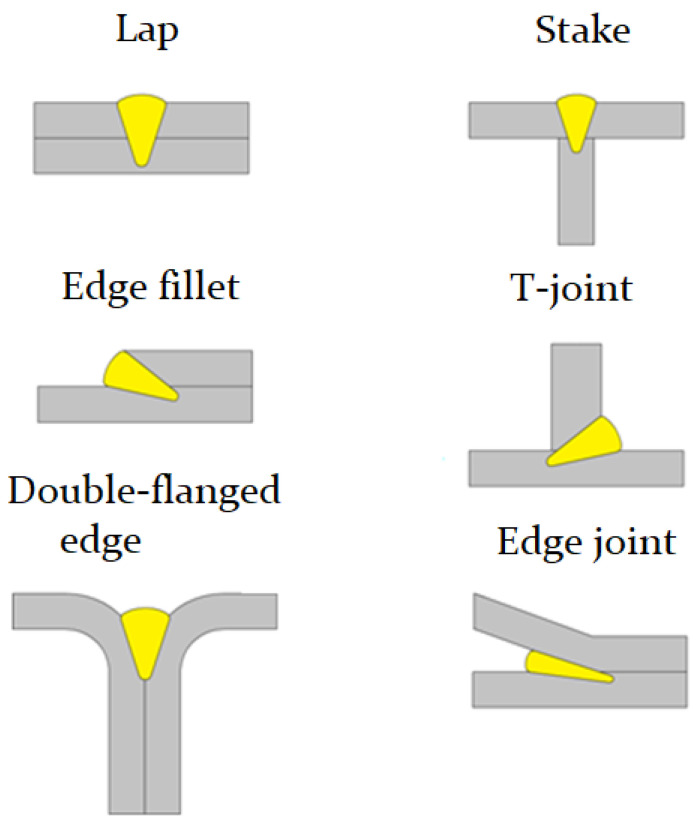
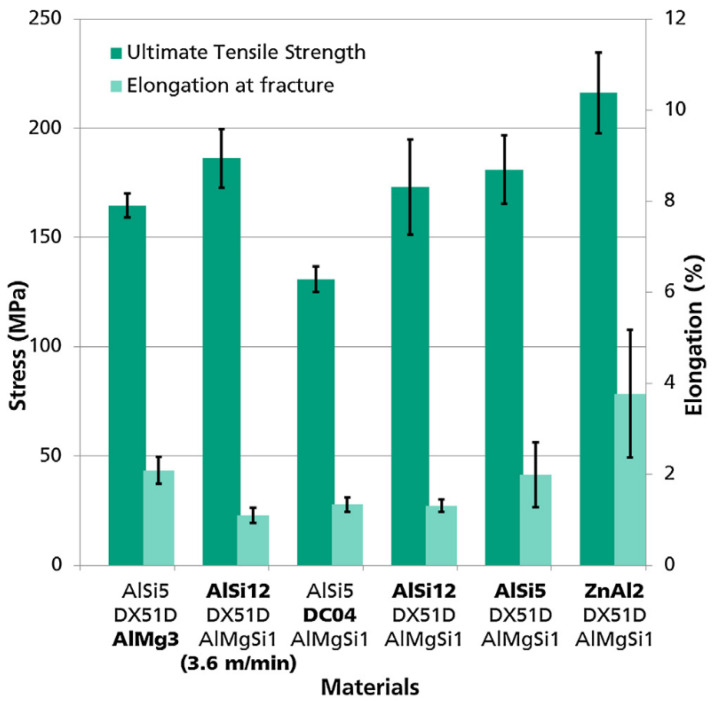
Modern structural engineering is impossible without the use of materials and structures with high strength and low specific weight. This work carries out a quantitative and qualitative analysis of articles for 2016-2021 on the topic of welding of dissimilar alloys. It is found that laser welding is most widely used for such metal pairs as Al/Fe, Al/Ti, and Al/Cu. The paper analyzes the influence of the basic techniques, methods, and means of laser welding of Al/Fe, Al/Ti, and Al/Cu on the mechanical properties and thickness of the intermetallic compound (IMC). When welding the lap joint or spike T-joint configuration of Al/Fe, it is preferable to melt the steel, which will be heated or melted, by the laser beam, and through thermal conduction, it will heat the aluminum. When welding the butt-welded joint of Al/Fe, the most preferable is to melt the aluminum by the laser beam (150-160 MPa). When welding the butt-welded joint of Al/Ti, it is possible to obtain the minimum IMC and maximum mechanical properties by offsetting the laser beam to aluminum. Whereas when the laser beam is offset to a titanium alloy, the mechanical properties are 40-50% lower than when the laser beam is offset to an aluminum alloy. When lap welding the Al/Cu joint, under the impact of the laser beam on the aluminum, using defocusing or wobbling (oscillation) of a laser beam, it is possible to increase the contact area of electrical conductivity with the tensile shear strength of 95-128 MPa.
Keywords: dissimilar metals; intermetallic layer; laser welding; mechanical properties; microstructure; weldability.
Conflict of interest statement
The author declares no conflict of interest.
Figures

References
-
- Martinsen K., Hu S.J., Carlson B.E. Joining of dissimilar materials. CIRP Ann. 2015;64:679–699. doi: 10.1016/j.cirp.2015.05.006. - DOI
-
- Seffer O., Pfeifer R., Springer A., Kaierle S. Investigations on laser beam welding of different dissimilar joints of steel and aluminum alloys for automotive lightweight construction. Phys. Procedia. 2016;83:383–395. doi: 10.1016/j.phpro.2016.08.040. - DOI
-
- Wiley C.P. In: Handbook of Lightweight Engineering Materials. 1st ed. Degischer H.P., editor. Wiley-VCH; Weinheim, Germany: 2017. p. 450.
-
- Sakundarini N., Taha Z., Abdul-Rashid S.H., Ghazila R.A.R. Optimal multi-material selection for lightweight design of automotive body assembly incorporating recyclability. Mater. Des. 2013;50:846–857. doi: 10.1016/j.matdes.2013.03.085. - DOI
-
- Schwartz M. Soldering–Understanding the Basics. ASM International; New York, NY, USA: 2014.
Publication types
LinkOut - more resources
Full Text Sources
Research Materials
