Review
. 2021 Dec 28;19(1):282.
doi: 10.3390/ijerph19010282.

The Microbiota-Bone-Allergy Interplay

Affiliations
Review

The Microbiota-Bone-Allergy Interplay

Maria Maddalena Sirufo et al. Int J Environ Res Public Health. .

Abstract

Emerging knowledge suggests an increasing importance of gut microbiota in health and disease. Allergy and bone metabolism are closely interconnected, and the possible negative effects of common therapies are not the only aspects of this relationship. The immune system is influenced by the microbiota-host interactions, and several pieces of evidence suggest the existence of an interplay between microbiota, bone metabolism, and allergies. Understanding these inter-relationships is essential for the development of new potential strategies of treatment and prevention targeting microbiota. A wide range of substances and germs, prebiotics and probiotics, are capable of influencing and modifying the microbiota. Prebiotics and probiotics have been shown in several studies to have different actions based on various factors such as sex, hormonal status, and age. In this review, we summarize the latest knowledge on the topic, and we discuss practical implications and the need for further studies.

Keywords: allergy; bone metabolism; food allergy; gut microbiota; inflammation; microbiota; osteoimmunology; osteoporosis; skeletal health.


Conflict of interest statement

The authors declare no conflict of interest.

Figures
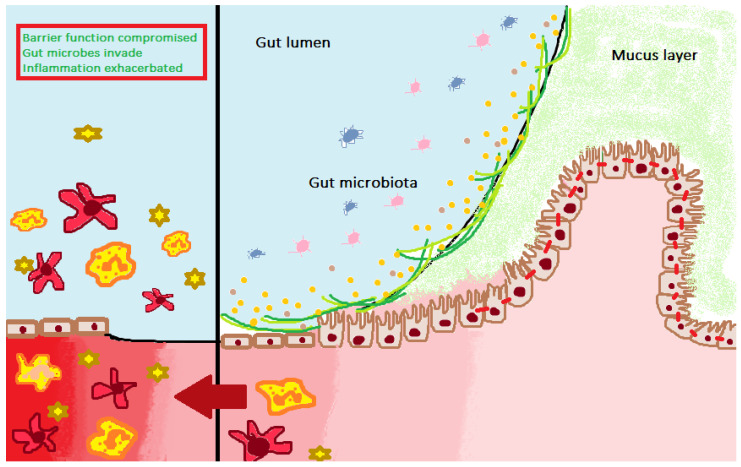
Figure 1
Figure 1
The human gastrointestinal tract is colonized by about 1013–1014 microorganisms, of which 15,000 different bacterial strains are located mainly in the colon in a symbiotic relationship with the host. In normal conditions, the microbiota is characterized by the predominance of obligate anaerobic members of Firmicutes and Bacteriodetes phyla, which guarantee intestinal and general health, while the loss of homeostasis, dysbiosis, linked to the proliferation of some bacterial populations such as the Enterobacteriaceae or the absence of important commensal bacteria helps to create a more favorable environment for the growth of pathogens, predisposing the organism to pathological conditions.
Figure 2
Figure 2
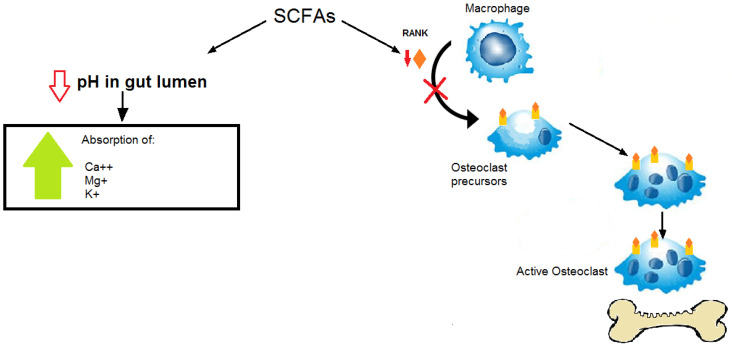
SCFAs play a very important role in bone formation and mineralization by acting on the osteoprotegerin pathway, reducing osteoclastogenesis by suppressing the RANKL pathway, and reducing the pH of the intestinal tract by subsequently increasing the absorption of minerals.
Figure 3
Figure 3
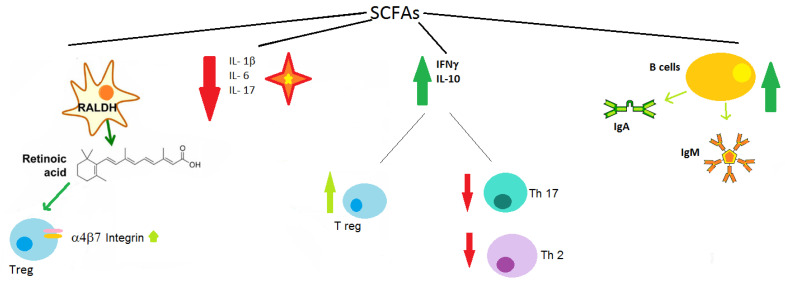
SCFAs effects in immunological tolerance: induce gut dendritic cells (DC) to express retinal aldehyde dehydrogenase (RALDH), with result in the production of retinoic acid that upregulates expression of the gut-homing integrins α4β7 on peripheral regulatory T cells (Treg); promote immune tolerance, regulate the antibody response through the production of IgA and IgM; stimulate the production of anti-inflammatory mediators such as IFNγ and IL-10, which induce the expansion of Treg cells and the suppression of proinflammatory T helper 17 (Th17) and Th2 cells; reduce the production of proinflammatory cytokines including IL-1β, IL-6, and IL-17.

References

    1. Nance C.L., Deniskin R., Diaz V.C., Paul M., Anvari S., Anagnostou A. The Role of the Microbiome in Food Allergy: A Review. Children. 2020;7:50. doi: 10.3390/children7060050. - DOI - PMC - PubMed
    1. Yoo J.Y., Groer M., Dutra S.V.O., Sarkar A., McSkimming D.I. Gut Microbiota and Immune System Interactions. Microorganisms. 2020;8:1587. doi: 10.3390/microorganisms8101587. - DOI - PMC - PubMed
    1. Lee K.H., Song Y., Wu W., Yu K., Zhang G. The gut microbiota, environmental factors, and links to the development of food allergy. Clin. Mol. Allergy. 2020;18:5. doi: 10.1186/s12948-020-00120-x. - DOI - PMC - PubMed
    1. Kim S., Jazwinski S.M. The Gut Microbiota and Healthy Aging: A Mini-Review. Gerontology. 2018;64:513–520. doi: 10.1159/000490615. - DOI - PMC - PubMed
    1. Miqdady M., Al Mistarihi J., Azaz A., Rawat D. Prebiotics in the Infant Microbiome: The Past, Present, and Future. Pediatr. Gastroenterol. Hepatol. Nutr. 2020;23:1–14. doi: 10.5223/pghn.2020.23.1.1. - DOI - PMC - PubMed