


Strategies to Prevent Sarcopenia in the Aging Process: Role of Protein Intake and Exercise
- PMID: 35010928
- PMCID: PMC8746908
- DOI: 10.3390/nu14010052
Strategies to Prevent Sarcopenia in the Aging Process: Role of Protein Intake and Exercise
Abstract
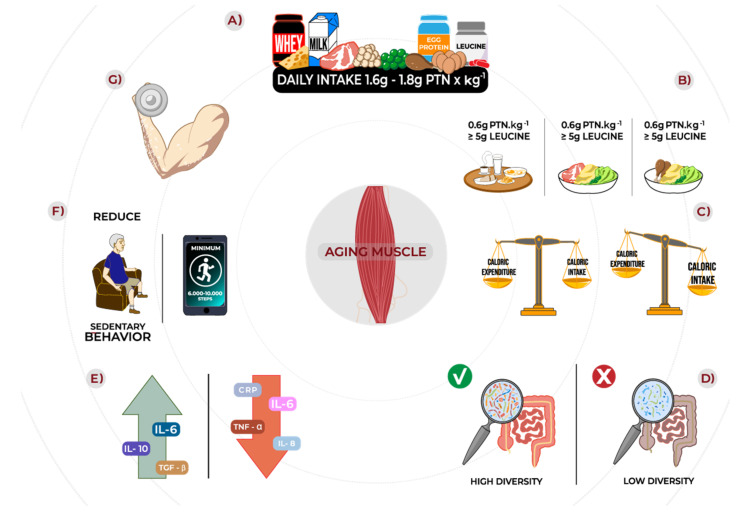
Sarcopenia is one of the main issues associated with the process of aging. Characterized by muscle mass loss, it is triggered by several conditions, including sedentary habits and negative net protein balance. According to World Health Organization, it is expected a 38% increase in older individuals by 2025. Therefore, it is noteworthy to establish recommendations to prevent sarcopenia and several events and comorbidities associated with this health issue condition. In this review, we discuss the role of these factors, prevention strategies, and recommendations, with a focus on protein intake and exercise.
Keywords: aging; exercise; metabolism; nutrition; protein.
Conflict of interest statement
The authors declare no conflict of interest.
Figures
References
-
- World Health Organization Multisectoral Action for a Life Course Approach to Healthy Ageing: Draft Global Strategy and Plan of Action on Ageing and Health. WHO; Geneva, Switzerland: 2016.
-
- Fielding R.A., Vellas B., Evans W.J., Bhasin S., Morley J.E., Newman A.B., Abellan van Kan G., Andrieu S., Bauer J., Breuille D., et al. Sarcopenia: An Undiagnosed Condition in Older Adults. Current Consensus Definition: Prevalence, Etiology, and Consequences. International Working Group on Sarcopenia. J. Am. Med. Dir. Assoc. 2011;12:249–256. doi: 10.1016/j.jamda.2011.01.003. - DOI - PMC - PubMed
-
- Valenzuela R.E.R., Ponce J.A., Morales-Figueroa G.G., Muro K.A., Carreón V.R., Alemán-Mateo H. Insufficient Amounts and Inadequate Distribution of Dietary Protein Intake in Apparently Healthy Older Adults in a Developing Country: Implications for Dietary Strategies to Prevent Sarcopenia. Clin. Interv. Aging. 2013;8:1143–1148. doi: 10.2147/CIA.S49810. - DOI - PMC - PubMed
Publication types
MeSH terms
Substances
Grants and funding
LinkOut - more resources
Full Text Sources
Medical
