Review
. 2021 Dec 27;14(1):101.
doi: 10.3390/nu14010101.

Age-Dependent Decline of NAD+-Universal Truth or Confounded Consensus?

Affiliations
Review

Age-Dependent Decline of NAD+-Universal Truth or Confounded Consensus?

Augusto Peluso et al. Nutrients. .

Abstract

Nicotinamide adenine dinucleotide (NAD+) is an essential molecule involved in various metabolic reactions, acting as an electron donor in the electron transport chain and as a co-factor for NAD+-dependent enzymes. In the early 2000s, reports that NAD+ declines with aging introduced the notion that NAD+ metabolism is globally and progressively impaired with age. Since then, NAD+ became an attractive target for potential pharmacological therapies aiming to increase NAD+ levels to promote vitality and protect against age-related diseases. This review summarizes and discusses a collection of studies that report the levels of NAD+ with aging in different species (i.e., yeast, C. elegans, rat, mouse, monkey, and human), to determine whether the notion that overall NAD+ levels decrease with aging stands true. We find that, despite systematic claims of overall changes in NAD+ levels with aging, the evidence to support such claims is very limited and often restricted to a single tissue or cell type. This is particularly true in humans, where the development of NAD+ levels during aging is still poorly characterized. There is a need for much larger, preferably longitudinal, studies to assess how NAD+ levels develop with aging in various tissues. This will strengthen our conclusions on NAD metabolism during aging and should provide a foundation for better pharmacological targeting of relevant tissues.

Keywords: C. elegans; NAD+; aging; human; monkey; mouse; rat; yeast.


Conflict of interest statement

The authors declare no conflict of interest.

Figures
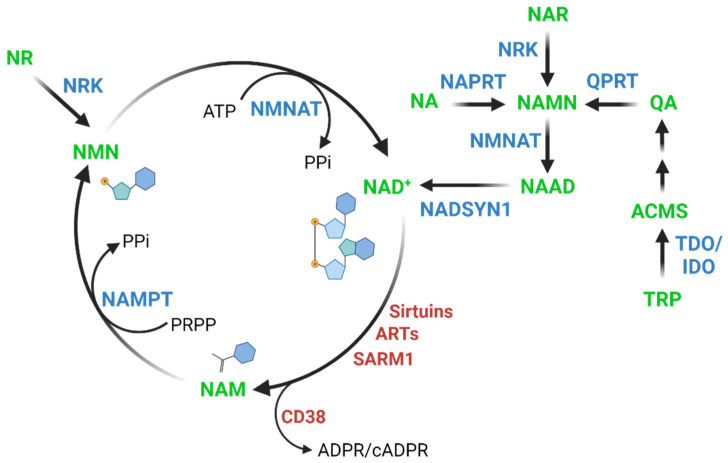
Figure 1
Figure 1
NAD+ biosynthesis pathways in mammalian cells. ACMS: 2-amino-3-carboxymuconate, NA: nicotinic acid, NAD+: nicotinamide adenine dinucleotide, NAM: nicotinamide, NAMN: nicotinic acid mononucleotide, NAR: nicotinic acid riboside, NMN: nicotinamide mononucleotide, NAAD: nicotinic acid adenine dinucleotide, NR: nicotinamide riboside, QA: quinolinic acid, TRP: tryptophan, IDO: indoleamine-2,3-dioxygenase, NADSYN1: NAD synthetase, NAMPT: nicotinamide phosphoribosyltransferase, NAPRT: nicotinic acid phosphoribosyltransferase, NMNAT: nicotinamide mononucleotide adenylyl transferase, NRK: NR Kinase, QPRT: quinolinic acid phosphoribosyltransferase, TDO: tryptophan-2,3-dioxygenase, ARTs: ADP-ribosyltransferases, CD38: ADP-ribosyl cyclase/cyclic ADP-ribose hydrolase 1, SARM1: NAD+ hydroxylase SARM1, ATP: adenosine triphosphate, PPi: inorganic pyrophosphate, PRPP: 5-phosphoribosyl-1-pyrophosphate.
Figure 2
Figure 2
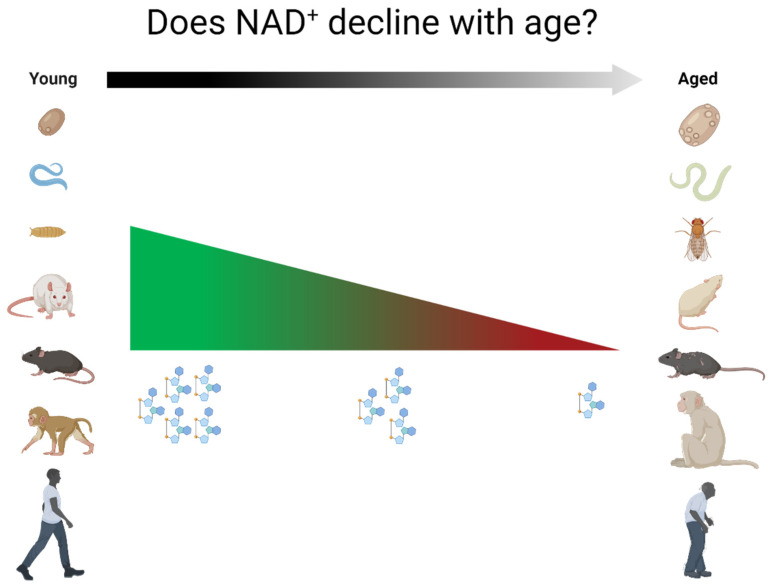
This review discusses the scientific robustness of the claim that NAD+ levels decline with age.

References

    1. Bogan K.L., Brenner C. Nicotinic Acid, Nicotinamide, and Nicotinamide Riboside: A Molecular Evaluation of NAD+ Precursor Vitamins in Human Nutrition. Annu. Rev. Nutr. 2008;28:115–130. doi: 10.1146/annurev.nutr.28.061807.155443. - DOI - PubMed
    1. Wilk A., Hayat F., Cunningham R., Li J., Garavaglia S., Zamani L., Ferraris D.M., Sykora P., Andrews J., Clark J., et al. Extracellular NAD+ Enhances PARP-Dependent DNA Repair Capacity Independently of CD73 Activity. Sci. Rep. 2020;10:651. doi: 10.1038/s41598-020-57506-9. - DOI - PMC - PubMed
    1. Schultz M.B., Sinclair D.A. Why NAD+ Declines during Aging: It’s Destroyed. Cell Metab. 2016;23:965–966. doi: 10.1016/j.cmet.2016.05.022. - DOI - PMC - PubMed
    1. Lautrup S., Sinclair D.A., Mattson M.P., Fang E.F. NAD+ in Brain Aging and Neurodegenerative Disorders. Cell Metab. 2019;30:630–655. doi: 10.1016/j.cmet.2019.09.001. - DOI - PMC - PubMed
    1. Zhang H., Ryu D., Wu Y., Gariani K., Wang X., Luan P., D’Amico D., Ropelle E.R., Lutolf M.P., Aebersold R., et al. NAD+ Repletion Improves Mitochondrial and Stem Cell Function and Enhances Life Span in Mice. Science. 2016;352:1436–1443. doi: 10.1126/science.aaf2693. - DOI - PubMed

LinkOut - more resources