Review
. 2022 Jan 3;27(1):276.
doi: 10.3390/molecules27010276.

Development of Phenothiazine Hybrids with Potential Medicinal Interest: A Review

Affiliations
Review

Development of Phenothiazine Hybrids with Potential Medicinal Interest: A Review

Marina C Posso et al. Molecules. .

Abstract

The molecular hybridization approach has been used to develop compounds with improved efficacy by combining two or more pharmacophores of bioactive scaffolds. In this context, hybridization of various relevant pharmacophores with phenothiazine derivatives has resulted in pertinent compounds with diverse biological activities, interacting with specific or multiple targets. In fact, the development of new drugs or drug candidates based on phenothiazine system has been a promising approach due to the diverse activities associated with this tricyclic system, traditionally present in compounds with antipsychotic, antihistaminic and antimuscarinic effects. Actually, the pharmacological actions of phenothiazine hybrids include promising antibacterial, antifungal, anticancer, anti-inflammatory, antimalarial, analgesic and multi-drug resistance reversal properties. The present review summarizes the progress in the development of phenothiazine hybrids and their biological activity.

Keywords: anti-Alzheimer; antimicrobial; antitumor; molecular hybridization; pharmacophore; phenothiazine.


Conflict of interest statement

The authors declare no conflict of interest.

Figures

Figure 1
Figure 1
Three successfully marketed hybrid molecules.
Figure 2
Figure 2
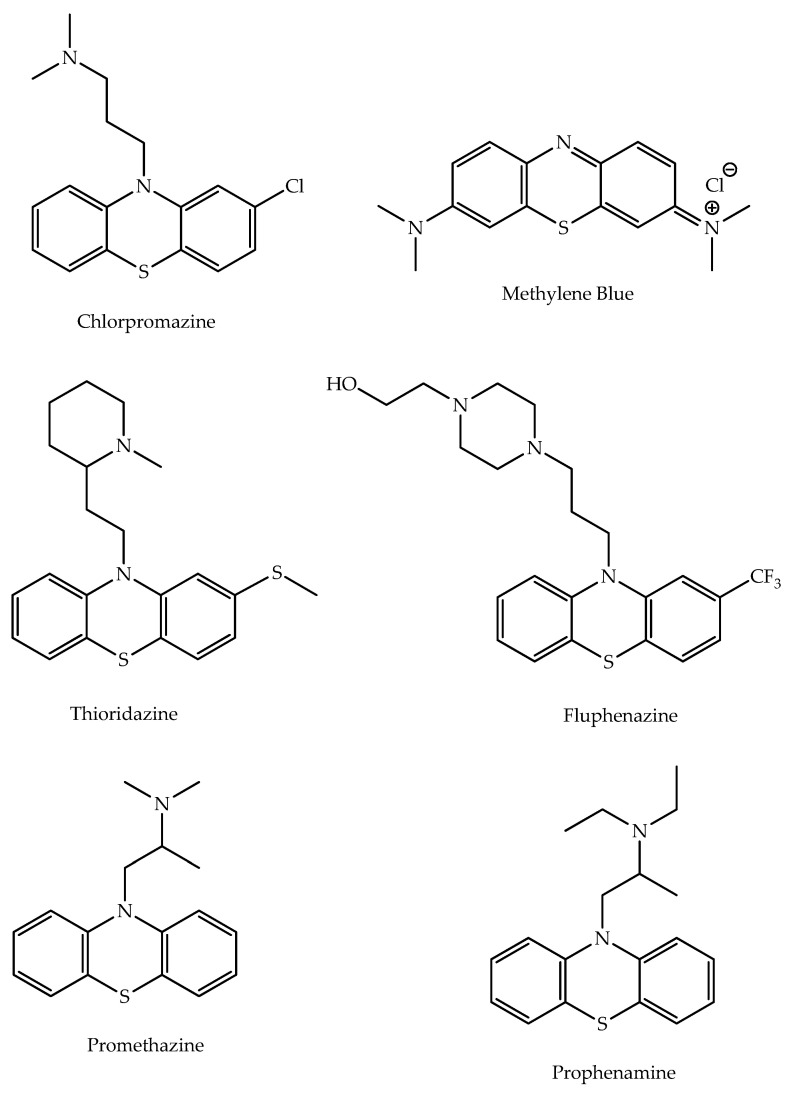
Examples of drug molecules containing phenothiazines scaffold: Methylene Blue, Chlorpromazine; Thioridazine, Fluphenazine, Promethazine, and Prophenamine [8].
Figure 3
Figure 3
Chemical structure of 3-([1,2,4]triazolo[4,3-a]pyridin-3-yl)-10-ethyl-7-phenyl-10H-phenothiazine (1), an antitumor hybrid.
Figure 4
Figure 4
Chemical structures of the most active phenothiazine-1,2,3 triazole hybrids with antiproliferative activity.
Figure 5
Figure 5
Chemical structures of 1,2,3-triazole and diazaphenothiazine hybrids with antiproliferative effects.
Figure 6
Figure 6
Chemical structures of N-(2-hydroxybutyl)-2-aminophenothiazines bound to 4-methoxyphenyltetrazole with P-glycoprotein inhibitory activity.
Figure 7
Figure 7
Chemical structures of hybrids bearing the phenothiazine core and N-acylated 1,2,3-triazole with antitumor interest.
Figure 8
Figure 8
Chemical structures of phenothiazine-indolizine derivatives with antiproliferative activity.
Figure 9
Figure 9
Chemical structures of the most active pyrazolo-phenothiazine and similar compounds with FTase inhibitor activity.
Figure 10
Figure 10
Chemical structures of amino acid-phenothiazine with FTase inhibitory activity. The most promising FTase inhibitor was 16d.
Figure 11
Figure 11
Chemical structures of chalcone-phenothiazine hybrids with antitumor interest.
Figure 12
Figure 12
Chemical structure of the most potent antiproliferative compound synthesized by Brem et al. (2017): 2-(naphthalen-1-yl)-10-methyl-10H-thiazolo[5,4-b]-phenothiazine [38].
Figure 13
Figure 13
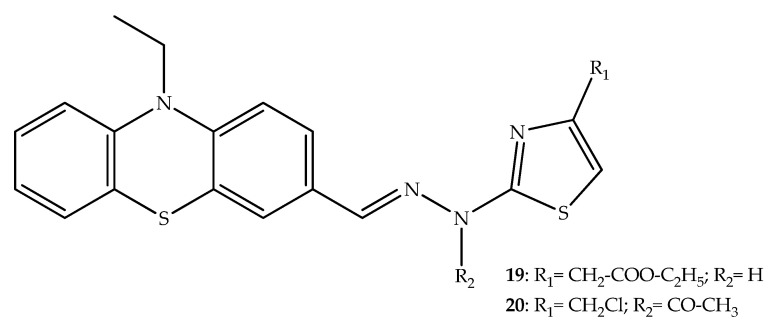
Chemical structure of the most active phenothiazinyl-thiazolyl-hydrazine derivatives with cytotoxic effects.
Figure 14
Figure 14
Chemical structure of phenothiazine-based hybrids linked with analogs of phenstatin [42,46].
Figure 15
Figure 15
Chemical structure of phenothiazine-dithiocarbamate (23) hybrid with potent anticancer activity.
Figure 16
Figure 16
Chemical structure of the most potent phenothiazinyldihydropyridine dicarboxamides hybrids as antiproliferative agents.
Figure 17
Figure 17
Chemical structure of the most potent phenothiazinyldihydropyridine hybrids as antitumor compounds.
Figure 18
Figure 18
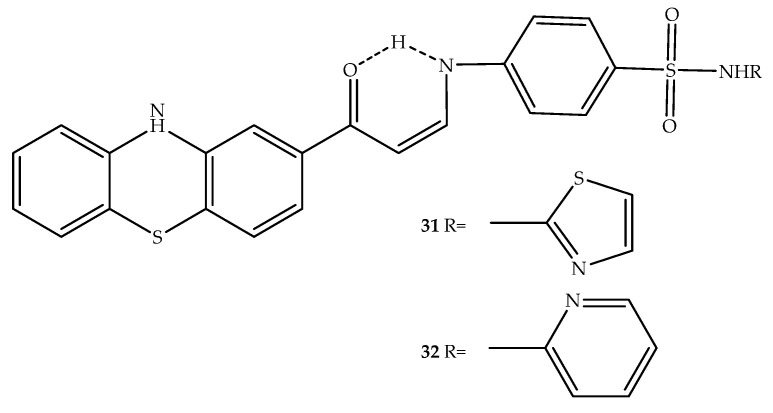
Chemical structure of the most potent hybrids with sulfonamide moiety with anticancer activity.
Figure 19
Figure 19
The chemical structure of phenothiazine-sphingolipid hybrid 33.
Figure 20
Figure 20
Chemical structure of the three most potent tacrine-phenothiazine hybrids with interest in Alzheimer’s disease.
Figure 21
Figure 21
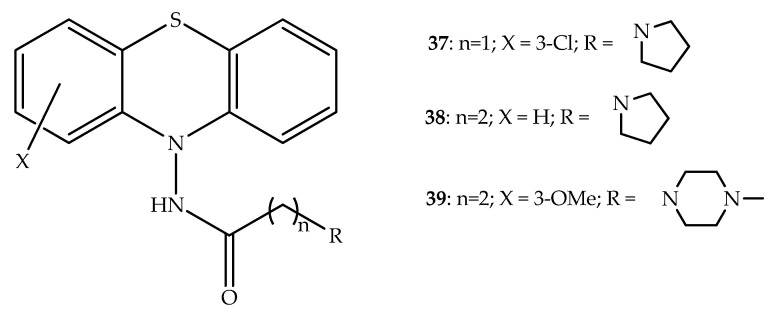
General chemical structure of N-acylaminophenothiazine hybrids with interest in neurodegenerative diseases.
Figure 22
Figure 22
Chemical structures of N-carbonyl compounds butyrylcholinesterase inhibitors with no neurotransmitter receptor interactions.
Figure 23
Figure 23
Chemical structure of hybrid 42 designed by Kubota et al. (2009) with antihistaminic activity [63].
Figure 24
Figure 24
Chemical structure of phenothiazine hybrids with EPIs INF55 (43 and 44) and INF271 (45).
Figure 25
Figure 25
Chemical structure of isoxazole–phenothiazine hybrids with antibacterial effects.
Figure 26
Figure 26
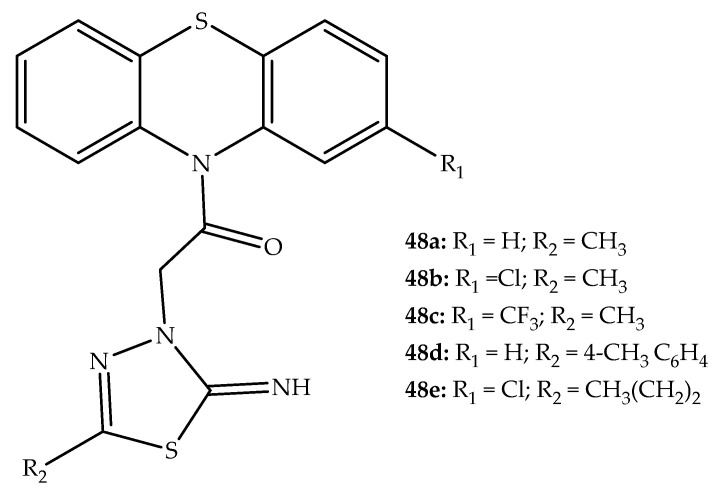
Chemical structure of the most potent phenothiazine-1,3,4-thiadiazoles developed by Ramprasad et al. (2015) [73].
Figure 27
Figure 27
Chemical structure of phenothiazine triazole-based antitubercular agents.
Figure 28
Figure 28
Chemical structure of verapamil phenothiazine hybrids with antitubercular interest.
Figure 29
Figure 29
Chemical structure of a phenothiazines alkyltriphenylphosphonium hybrid (54) with activity against M. tuberculosis.
Figure 30
Figure 30
Chemical structures of phenothiazine linked with-chalcones, pyrazolines and isoxazolines demonstrating antitubercular activity.
Figure 31
Figure 31
Chemical structures of phenothiazine-triazole hybrids with potent antitubercular activity.
Figure 32
Figure 32
Chemical structure of compound 61, an antimalarial that acts synergistically with chloroquine.
Figure 33
Figure 33
Chemical structure of compound 62 with antifungal activity.
Figure 34
Figure 34
Chemical structure of the most active phenothiazine-CB1-antagonist hybrids.
Figure 35
Figure 35
Chemical structures of compounds with antiplatelet and analgesic effects synthesized by Silva et al. (2004) [89].

References

    1. Ramos R., Olden K. Gene-Environment Interactions in the Development of Complex Disease Phenotypes. Int. J. Environ. Res. Public Health. 2008;5:4–11. doi: 10.3390/ijerph5010004. - DOI - PMC - PubMed
    1. Makhoba X.H., Viegas C., Jr., Mosa R.A., Viegas F.P.D., Pooe O.J. Potential Impact of the Multi-Target Drug Approach in the Treatment of Some Complex Diseases. Drug Des. Devel. Ther. 2020;14:3235–3249. doi: 10.2147/DDDT.S257494. - DOI - PMC - PubMed
    1. He B., Lu C., Zheng G., He X., Wang M., Chen G., Zhang G., Lu A. Combination Therapeutics in Complex Diseases. J. Cell. Mol. Med. 2016;20:2231–2240. doi: 10.1111/jcmm.12930. - DOI - PMC - PubMed
    1. Choudhary S., Singh P.K., Verma H., Singh H., Silakari O. Success Stories of Natural Product-based Hybrid Molecules for Multi-factorial Diseases. Eur. J. Med. Chem. 2018;151:62–97. doi: 10.1016/j.ejmech.2018.03.057. - DOI - PubMed
    1. Fink D.M., Palermo M.G., Bores G.M., Huger F.P., Kurys B.E., Merriman M.C., Olsen G.E., Petko W., O’Malley G.J. Imino 1,2,3,4-tetrahydrocyclopent[b]indole carbamates as Dual Inhibitors of Acetylcholinesterase and Monoamine Oxidase. Bioorg. Med. Chem. Lett. 1996;6:625–630. doi: 10.1016/0960-894X(96)00072-8. - DOI

LinkOut - more resources