Review
. 2021 Dec 23;11(1):34.
doi: 10.3390/cells11010034.

Genetic Control of MAP3K1 in Eye Development and Sex Differentiation

Affiliations
Review

Genetic Control of MAP3K1 in Eye Development and Sex Differentiation

Jingjing Wang et al. Cells. .

Abstract

The MAP3K1 is responsible for transmitting signals to activate specific MAP2K-MAPK cascades. Following the initial biochemical characterization, genetic mouse models have taken center stage to elucidate how MAP3K1 regulates biological functions. To that end, mice were generated with the ablation of the entire Map3k1 gene, the kinase domain coding sequences, or ubiquitin ligase domain mutations. Analyses of the mutants identify diverse roles that MAP3K1 plays in embryonic survival, maturation of T/B cells, and development of sensory organs, including eye and ear. Specifically in eye development, Map3k1 loss-of-function was found to be autosomal recessive for congenital eye abnormalities, but became autosomal dominant in combination with Jnk and RhoA mutations. Additionally, Map3k1 mutation increased eye defects with an exposure to environmental agents such as dioxin. Data from eye developmental models reveal the nexus role of MAP3K1 in integrating genetic and environmental signals to control developmental activities. Here, we focus the discussions on recent advances in understanding the signaling mechanisms of MAP3K1 in eye development in mice and in sex differentiation from human genomics findings. The research works featured here lead to a deeper understanding of the in vivo signaling network, the mechanisms of gene-environment interactions, and the relevance of this multifaceted protein kinase in disease etiology and pathogenesis.

Keywords: JNK; MAP3K1; dioxin; embryonic eyelid closure; gene-environment interactions; genetic crosstalks; sex development and differentiation.


Conflict of interest statement

The authors declare no conflict of interest.

Figures
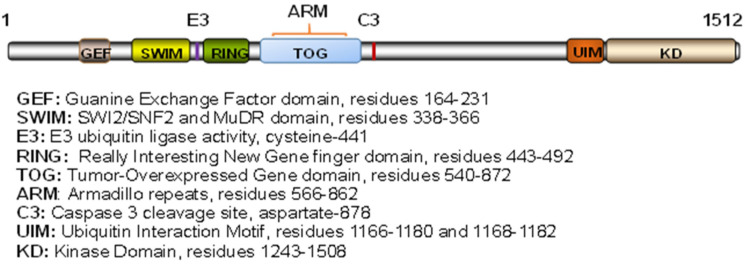
Figure 1
Figure 1
Schematic structure of MAP3K1. Illustration of the functional domains and the relative domain locations of human MAP3K1.
Figure 2
Figure 2
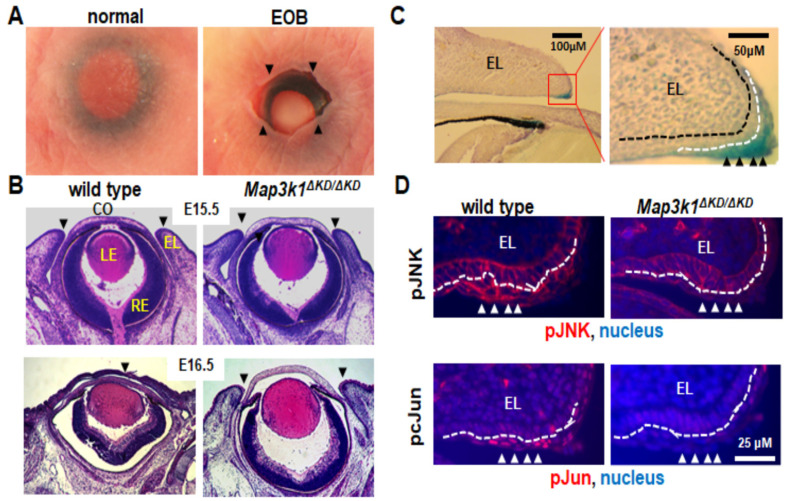
Mouse embryonic eyelid development and closure. (A) Photographs of eyes of the newborn pups. Mice are normally born with eyelids closed, but those with defective embryonic eyelid closures are born with an EOB phenotype. Arrowheads point at the eyelid opening margins in EOB mice. (B) Histological analyses of the embryonic eyes at E15.5 and E16.5. At E15.5, the wild-type and Map3k1ΔKD/ΔKD embryos have the same eye structures, with the upper and lower eyelids separated. At E16.5, the eyelids were fused in the wild-type, but remained separated in the Map3k1ΔKD/ΔKD fetuses. Arrowheads point at the leading edge or fusion junction of the upper and lower eyelids. (C) Eye sections of the whole-mount X-gal stained Map3k1+/ΔKD E15.5 embryos were photographed at 10× (left panel), the red box in the left panel was shown at 40× magnifications (right panel). Abundant β-gal positive, i.e., MAP3K1-expressing cells were detected in the eyelid epithelium, particularly in the inferior periderm near the eyelid tip. (D) Immunohistochemistry analyses with antibodies for the pJNK (upper panels) and p-cJun (lower panels) of the E15.5 eyes. The pJNK and pJun were detected in the inferior periderm near the eyelid tip in wild-type but not Map3k1ΔKD/ΔKD embryos. Nuclei were stained with DAPI (blue). EL: eyelid, CO: cornea, LE: lens, RE: retina. Black dotted lines mark the basement membrane; white dotted lines mark the boundary between the basal epithelium and periderm. Arrowheads point at the MAP3K1-expressing periderm.
Figure 3
Figure 3
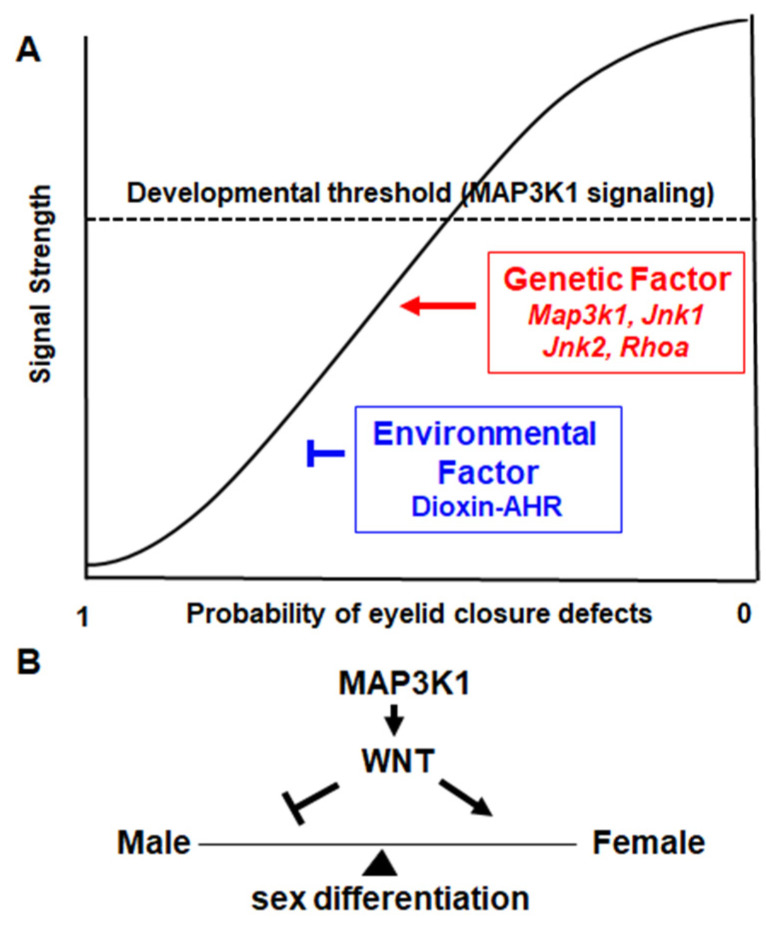
Summary and perspectives. (A) MAP3K1 signaling serves as a developmental threshold. Different genes and environmental factors distinctly affect the strength of MAP3K1 signaling; when the signaling strength reduces to levels below the critical threshold eyelid closure abnormalities occur. (B). The hypothetical roles of the MAP3K1–WNT axis in maintaining the balance of male–female sex differentiation.

References

    1. Widmann C., Gibson S., Jarpe M.B., Johnson G.L. Mitogen-activated protein kinase: Conservation of a three-kinase module from yeast to human. Physiol. Rev. 1999;79:143–180. doi: 10.1152/physrev.1999.79.1.143. - DOI - PubMed
    1. Uhlik M.T., Abell A.N., Cuevas B.D., Nakamura K., Johnson G.L. Wiring diagrams of MAPK regulation by MEKK1, 2, and 3. Biochem. Cell Biol. 2004;82:658–663. doi: 10.1139/o04-114. - DOI - PubMed
    1. Xu S., Robbins D., Frost J., Dang A., Lange-Carter C., Cobb M.H. MEKK1 phosphorylates MEK1 and MEK2 but does not cause activation of mitogen-activated protein kinase. Proc. Natl. Acad. Sci. USA. 1995;92:6808–6812. doi: 10.1073/pnas.92.15.6808. - DOI - PMC - PubMed
    1. Pham T.T., Angus S.P., Johnson G.L. MAP3K1: Genomic Alterations in Cancer and Function in Promoting Cell Survival or Apoptosis. Genes Cancer. 2013;4:419–426. doi: 10.1177/1947601913513950. - DOI - PMC - PubMed
    1. Xia Y., Wu Z., Su B., Murray B., Karin M. JNKK1 organizes a MAP kinase module through specific and sequential interactions with upstream and downstream components mediated by its amino-terminal extension. Genes Dev. 1998;12:3369–3381. doi: 10.1101/gad.12.21.3369. - DOI - PMC - PubMed

Publication types

Substances