


Channels and Transporters of the Pulmonary Lamellar Body in Health and Disease
- PMID: 35011607
- PMCID: PMC8750383
- DOI: 10.3390/cells11010045
Channels and Transporters of the Pulmonary Lamellar Body in Health and Disease
Abstract
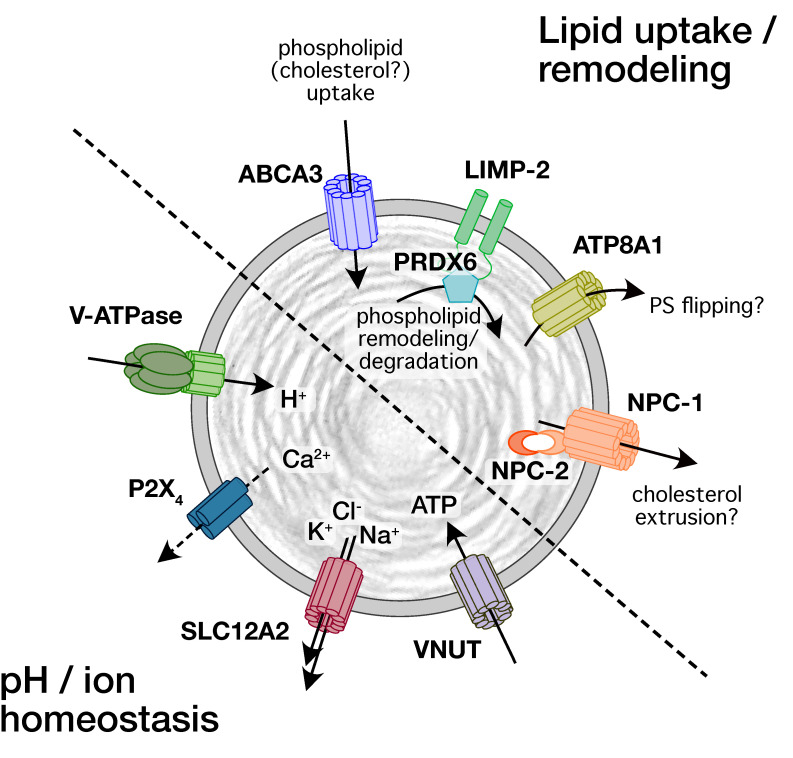
The lamellar body (LB) of the alveolar type II (ATII) cell is a lysosome-related organelle (LRO) that contains surfactant, a complex mix of mainly lipids and specific surfactant proteins. The major function of surfactant in the lung is the reduction of surface tension and stabilization of alveoli during respiration. Its lack or deficiency may cause various forms of respiratory distress syndrome (RDS). Surfactant is also part of the innate immune system in the lung, defending the organism against air-borne pathogens. The limiting (organelle) membrane that encloses the LB contains various transporters that are in part responsible for translocating lipids and other organic material into the LB. On the other hand, this membrane contains ion transporters and channels that maintain a specific internal ion composition including the acidic pH of about 5. Furthermore, P2X4 receptors, ligand gated ion channels of the danger signal ATP, are expressed in the limiting LB membrane. They play a role in boosting surfactant secretion and fluid clearance. In this review, we discuss the functions of these transporting pathways of the LB, including possible roles in disease and as therapeutic targets, including viral infections such as SARS-CoV-2.
Keywords: alveolus; ambroxol; exocytosis; ivermectin; lysosome related organelle (LRO); purinergic signaling; surfactant.
Conflict of interest statement
The authors declare no conflict of interest.
Figures
References
Publication types
MeSH terms
Substances
Grants and funding
LinkOut - more resources
Full Text Sources
Medical
Miscellaneous
