


Association of COVID-19 with Intracranial Hemorrhage during Extracorporeal Membrane Oxygenation for Acute Respiratory Distress Syndrome: A 10-Year Retrospective Observational Study
- PMID: 35011769
- PMCID: PMC8745037
- DOI: 10.3390/jcm11010028
Association of COVID-19 with Intracranial Hemorrhage during Extracorporeal Membrane Oxygenation for Acute Respiratory Distress Syndrome: A 10-Year Retrospective Observational Study
Abstract
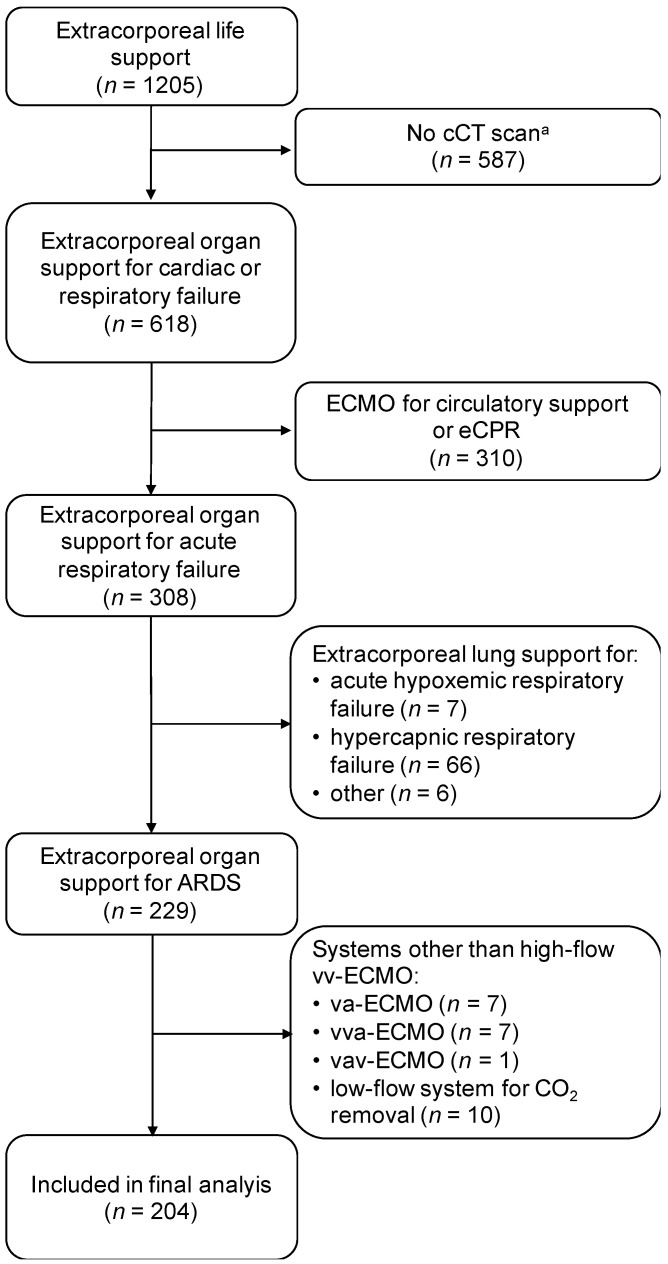
Extracorporeal membrane oxygenation (ECMO) is potentially lifesaving for patients with acute respiratory distress syndrome (ARDS) but may be accompanied by serious adverse events, including intracranial hemorrhage (ICRH). We hypothesized that ICRH occurs more frequently in patients with COVID-19 than in patients with ARDS of other etiologies. We performed a single-center retrospective analysis of adult patients treated with venovenous (vv-) ECMO for ARDS between January 2011 and April 2021. Patients were included if they had received a cranial computed tomography (cCT) scan during vv-ECMO support or within 72 h after ECMO removal. Cox regression analysis was used to identify factors associated with ICRH. During the study period, we identified 204 patients with vv-ECMO for ARDS, for whom a cCT scan was available. We observed ICRH in 35.4% (n = 17/48) of patients with COVID-19 and in 16.7% (n = 26/156) of patients with ARDS attributable to factors other than COVID-19. COVID-19 (HR: 2.945; 95%; CI: 1.079-8.038; p = 0.035) and carboxyhemoglobin (HR: 0.330; 95%; CI: 0.135-0.806; p = 0.015) were associated with ICRH during vv-ECMO. In patients receiving vv-ECMO, the incidence of ICRH is doubled in patients with COVID-19 compared to patients suffering from ARDS attributable to other causes. More studies on the association between COVID-19 and ICRH during vv-ECMO are urgently needed to identify risk patterns and targets for potential therapeutic interventions.
Keywords: COVID-19; acute respiratory distress syndrome; extracorporeal membrane oxygenation; hemorrhagic stroke; intracerebral hemorrhage; neurologic complications.
Conflict of interest statement
The authors declare no conflict of interest.
Figures

References
-
- Karagiannidis C., Mostert C., Hentschker C., Voshaar T., Malzahn J., Schillinger G., Klauber J., Janssens U., Marx G., Weber-Carstens S., et al. Case characteristics, resource use, and outcomes of 10,021 patients with COVID-19 admitted to 920 German hospitals: An observational study. Lancet Respir. Med. 2020;8:853–862. doi: 10.1016/S2213-2600(20)30316-7. - DOI - PMC - PubMed
-
- Badulak J., Antonini M.V., Stead C.M., Shekerdemian L., Raman L., Paden M.L., Agerstrand C., Bartlett R.H., Barrett N., Combes A., et al. Extracorporeal Membrane Oxygenation for COVID-19: Updated 2021 Guidelines from the Extracorporeal Life Support Organization. Asaio J. 2021;67:485–495. doi: 10.1097/MAT.0000000000001422. - DOI - PMC - PubMed
-
- Tonna J.E., Abrams D., Brodie D., Greenwood J.C., Rubio Mateo-Sidron J.A., Usman A., Fan E. Management of Adult Patients Supported with Venovenous Extracorporeal Membrane Oxygenation (VV ECMO): Guideline from the Extracorporeal Life Support Organization (ELSO) Asaio J. 2021;67:601–610. doi: 10.1097/MAT.0000000000001432. - DOI - PMC - PubMed
Grants and funding
LinkOut - more resources
Full Text Sources
Miscellaneous
