


Newborn Hearing Screening Benefits Children, but Global Disparities Persist
- PMID: 35012010
- PMCID: PMC8746089
- DOI: 10.3390/jcm11010271
Newborn Hearing Screening Benefits Children, but Global Disparities Persist
Abstract
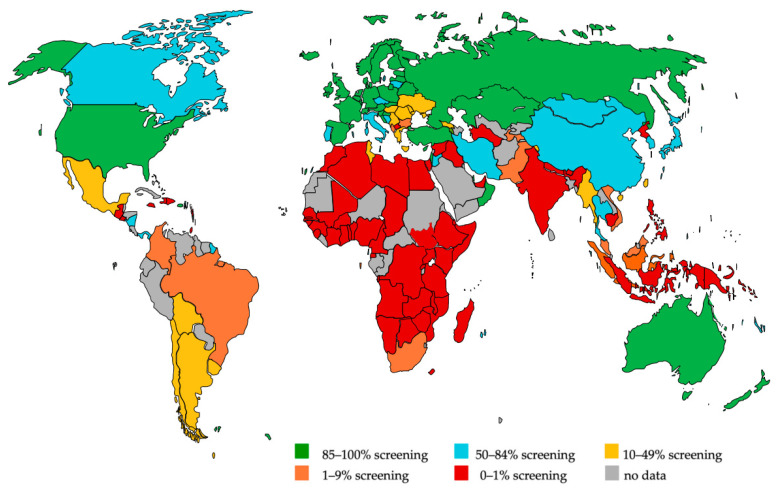
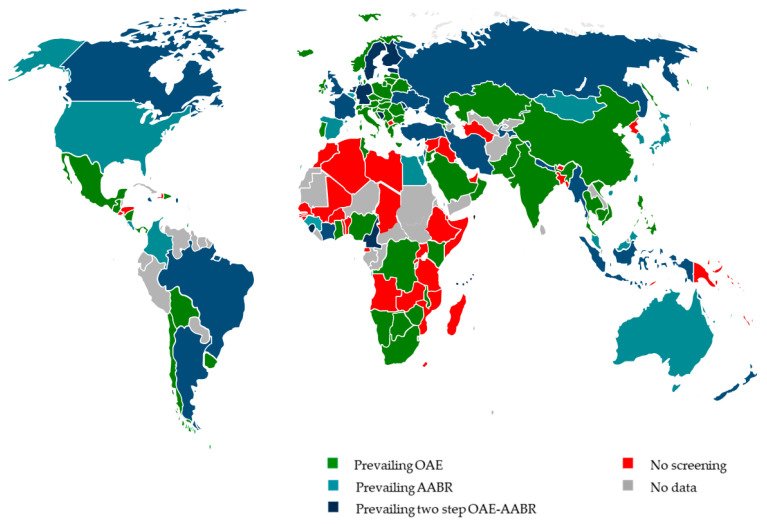
There is substantial evidence that newborn hearing screening (NHS) reduces the negative sequelae of permanent childhood hearing loss (PCHL) if performed in programs that aim to screen all newborns in a region or nation (often referred to as Universal Newborn Hearing Screening or UNHS). The World Health Organization (WHO) has called in two resolutions for the implementation of such programs and for the collection of large-scale data. To assess the global status of NHS programs we surveyed individuals potentially involved with newborn and infant hearing screening (NIHS) in 196 countries/territories (in the following text referred to as countries). Replies were returned from 158 countries. The results indicated that 38% of the world's newborns and infants had no or minimal hearing screening and 33% screened at least 85% of the babies (hereafter referred to as UNHS). Hearing screening programs varied considerably in quality, data acquisition, and accessibility of services for children with PCHL. In this article, we summarize the main results of the survey in the context of several recent WHO publications, particularly the World Report on Hearing, which defined advances in the implementation of NHS programs in the Member States as one of three key indicators of worldwide progress in ear and hearing care (EHC).
Keywords: NHS; WHO; hearing; hearing loss; infant; neonatal; newborn; screening; universal; world report on hearing.
Conflict of interest statement
The authors declare no conflict of interest.
Figures
References
-
- World Health Organization . Hearing Screening: Considerations for Implementation. World Health Organization; Geneva, Switzerland: 2021. [(accessed on 27 November 2021)]. Licence: CC BY-NC-SA 3.0 IGO. Available online: https://www.who.int/publications/i/item/9789240032767.
-
- World Health Organization . World Report on Hearing. World Health Organization; Geneva, Switzerland: 2021. [(accessed on 27 November 2021)]. Available online: https://www.who.int/publications/i/item/world-report-on-hearing.
-
- World Health Organization Childhood Hearing Loss: Strategies for Prevention and Care. 2016. [(accessed on 27 November 2021)]. Available online: http://apps.who.int/iris/bitstream/10665/204632/1/9789241510325_eng.pdf?....
Publication types
Grants and funding
LinkOut - more resources
Full Text Sources
