. 2022 Feb 22;13(1):e0344721.
doi: 10.1128/mbio.03447-21. Epub 2022 Jan 11.

Systematic Genetic Interaction Analysis Identifies a Transcription Factor Circuit Required for Oropharyngeal Candidiasis

Affiliations

Systematic Genetic Interaction Analysis Identifies a Transcription Factor Circuit Required for Oropharyngeal Candidiasis

Norma V Solis et al. mBio. .

Abstract

Oropharyngeal candidiasis (OPC) is a common infection that complicates a wide range of medical conditions and can cause either mild or severe disease depending on the patient. The pathobiology of OPC shares many features with candidal biofilms of abiotic surfaces. The transcriptional regulation of C. albicans biofilm formation on abiotic surfaces has been extensively characterized and involves six key transcription factors (Efg1, Ndt80, Rob1, Bcr1, Brg1, and Tec1). To determine if the in vitro biofilm transcriptional regulatory network also plays a role in OPC, we carried out a systematic genetic interaction analysis in a mouse model of C. albicans OPC. Whereas each of the six transcription factors are required for in vitro biofilm formation, only three homozygous deletion mutants (tec1ΔΔ, bcr1ΔΔ, and rob1ΔΔ) and one heterozygous mutant (tec1Δ/TEC1) have reduced infectivity in the mouse model of OPC. Although single mutants (heterozygous or homozygous) of BRG1 and EFG1 have no effect on fungal burden, double heterozygous and homozygous mutants have dramatically reduced infectivity, indicating a critical genetic interaction between these two transcription factors during OPC. Using epistasis analysis, we have formulated a genetic circuit, [EFG1+BRG1]→TEC1BCR1, that is required for OPC infectivity and oral epithelial cell endocytosis. Surprisingly, we also found transcription factor mutants with in vitro defects in filamentation, such as efg1ΔΔ, rob1ΔΔ, and brg1ΔΔ filament, during oral infection and that reduced filamentation does not correlate with infectivity. Taken together, these data indicate that key in vitro biofilm transcription factors are involved in OPC but that the network characteristics and functional connections during infection are distinct from those observed in vivo. IMPORTANCE The pathology of oral candidiasis has features of biofilm formation, a well-studied process in vitro. Based on that analogy, we hypothesized that the network of transcription factors that regulates in vitro biofilm formation has similarities and differences during oral infection. To test this, we employed the first systematic genetic interaction analysis of C. albicans in a mouse model of oropharyngeal infection. This revealed that the six regulators involved in in vitro biofilm formation played roles in vivo but that the functional connections between factors were quite distinct. Surprisingly, we also found that while many of the factors are required for filamentation in vitro, none of the transcription factor deletion mutants was deficient for this key virulence trait in vivo. These observations clearly demonstrate that C. albicans regulates key aspects of its biology differently in vitro and in vivo.

Keywords: Candida albicans; biofilms; complex haploinsufficiency; oropharyngeal candidiasis.


Conflict of interest statement

The authors declare no conflict of interest.

Figures
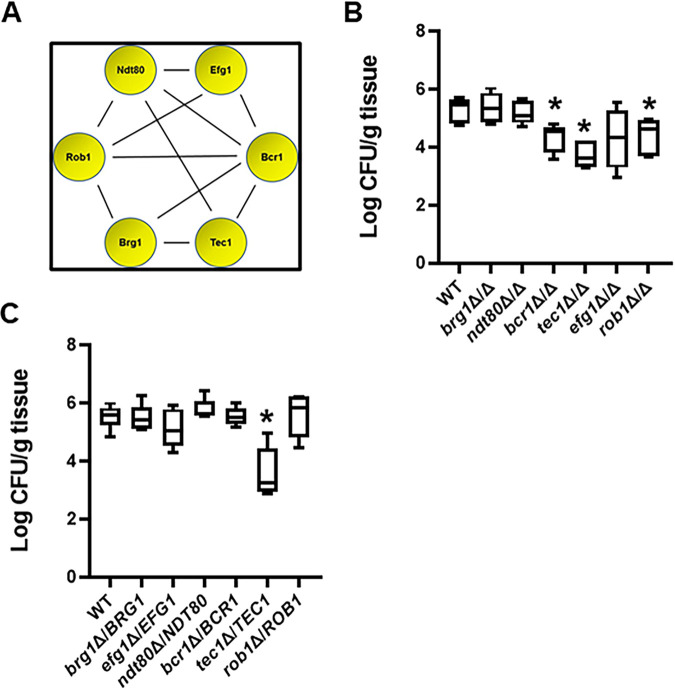
FIG 1
FIG 1
Effect of in vitro biofilm transcription factors in a mouse model of oropharyngeal candidiasis. (A) The functional genetic interaction network of six transcription factors required for C. albicans biofilm formation in vitro (11). (B and C) The fungal burden 5 days postinfection for animals infected with the indicated deletion mutants in the SN background. Medians and standard deviations are shown for 4 to 5 animals per group. The log10-transformed fungal burden data for each experiment was analyzed by one-way ANOVA followed by post hoc Student's t test to identify statistically significant differences between individual strains (P < 0.05). Strains that were statistically different from the WT are indicated with an asterisk.
FIG 2
FIG 2
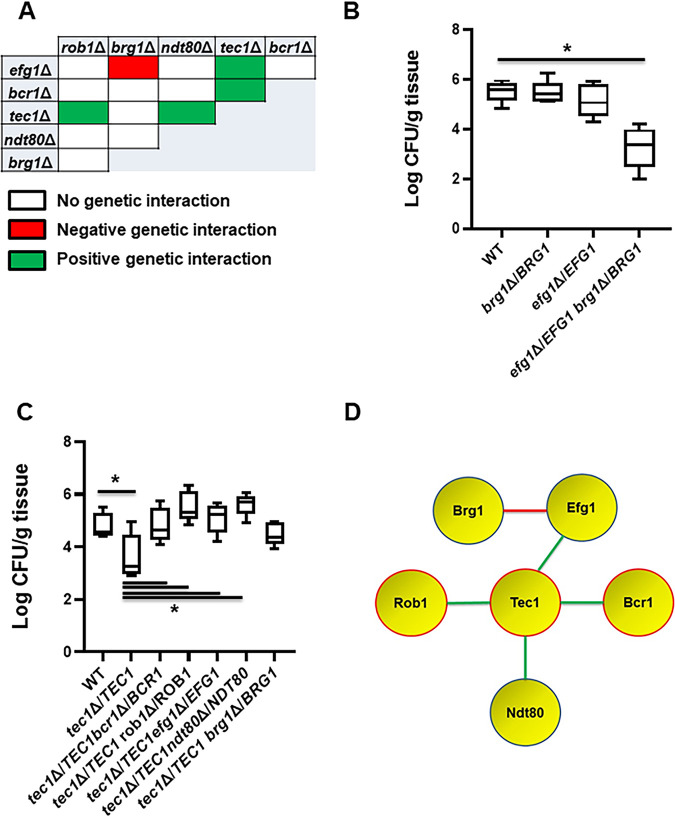
Genetic interaction analysis of transcription factors in a mouse model of oropharyngeal candidiasis identifies a functional network. (A) The set of all possible double heterozygous transcription factor deletion mutants was screened for genetic interactions relative to the individual heterozygotes. The interaction map summarizes these interactions with negative interactions indicated in red, positive interactions indicated by green, and no interaction indicated by white. (B) The double heterozygous efg1Δ/EFG1 brg1Δ/BRG1 mutant shows complex haploinsufficiency in the oropharyngeal candidiasis model. The log10-transformed fungal burden data, means and standard deviations, for each experiment were analyzed by one-way ANOVA followed by post hoc Student's t test to identify statistically significant differences between individual strains (P < 0.05). Strains that were statistically different from the WT are indicated with an asterisk. (C) BCR1, ROB1, NDT80, and EFG1 show positive genetic interactions with tec1Δ/TEC1. (D) The functional interaction network based on genetic interactions shown by the indicated transcription factors. Deletion mutants of genes highlighted in red have reduced infectivity. Red lines indicate a negative genetic interaction, while green lines indicate a positive genetic interaction.
FIG 3
FIG 3
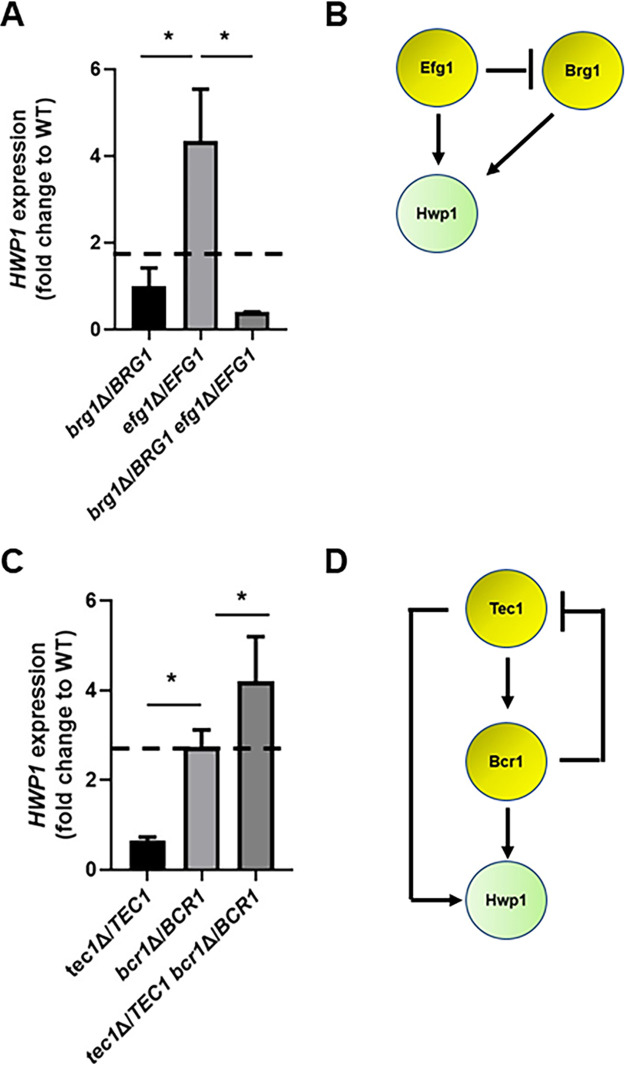
HWP1 expression in double heterozygous deletion strains showing negative and positive genetic interactions. The expression of HWP1 in the indicated strains in 48-h in vitro biofilms was assessed by RT-PCR as described in Materials and Methods. The dashed line indicates the fold change in HWP1 expression if the two TFs functioned independently and thus displayed no genetic interaction. (A) The brg1Δ/BRG1 efg1Δ/BRG1 strain shows a negative genetic interaction during OPC infection and a negative genetic interaction with respect to biofilm HWP1 expression. (B) Regulatory circuit consistent with the effect of TEC1 and BCR1 mutations on HWP1 expression. Arrows indicate activating interaction; cross bar indicates deactivating interaction. (C) The tec1Δ/TEC1 brg1Δ/BRG1 strain shows a positive genetic interaction during OPC infection and a positive genetic interaction with respect to HWP1 expression. (D) Regulatory circuit consistent with the effect of BRG1 and EFG1 mutations on HWP1 expression. The data are presented as the means of 3 to 4 independent replicates performed in triplicate with standard errors of the means. Differences between mutants were analyzed by one-way ANOVA followed by Student's t test to assess significance of individual group differences (P < 0.05).
FIG 4
FIG 4
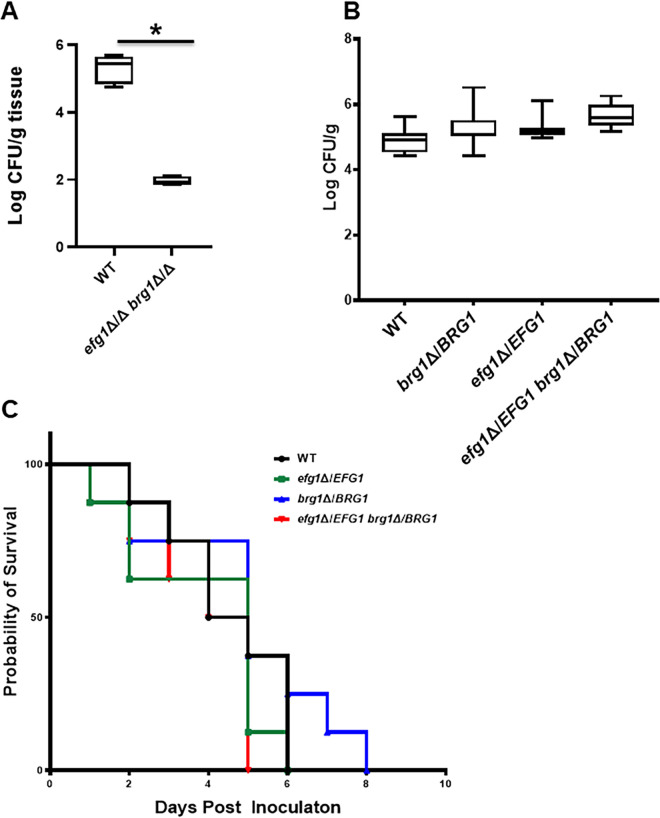
Genetic interaction of EFG1 and BRG1 is not observed in a model of disseminated candidiasis. (A) The double homozygous brg1ΔΔ efg1ΔΔ shows a dramatic reduction in fungal burden relative to the wild type in a mouse model of oropharyngeal candidiasis. The log10-transformed fungal burden data (means and standard deviations) for each experiment were analyzed by one-way ANOVA followed by post hoc Student's t test to identify statistically significant differences between individual strains (P < 0.05). Strains that were statistically different from the WT are indicated with an asterisk. (B) The double heterozygous efg1Δ/EFG1 brg1Δ/BRG1 mutant does not have a reduced kidney fungal burden relative to the WT or single heterozygous mutants in a mouse model of disseminated candidiasis. (C) The double heterozygous efg1Δ/EFG1 brg1Δ/BRG1 mutant is as virulent as the WT and the single mutants in a mouse model of disseminated candidiasis based on Kaplan-Meier analysis of the disease progression curve shown.
FIG 5
FIG 5
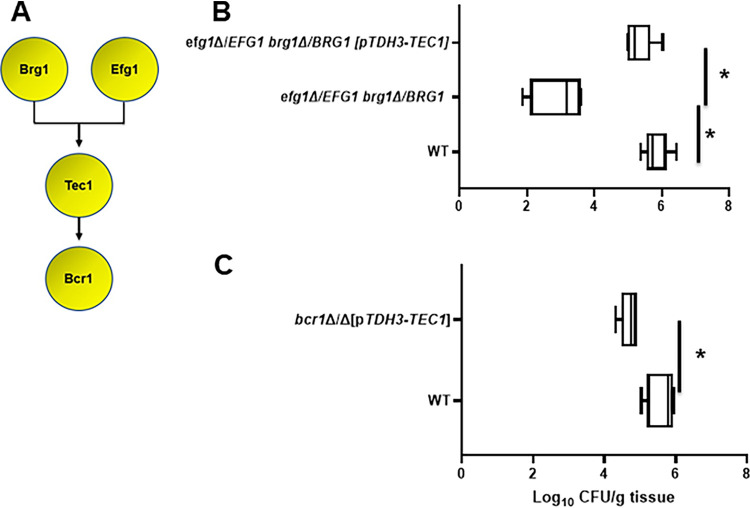
Epistasis analysis provides genetic support for a transcriptional circuit regulating infectivity in a mouse model of oropharyngeal candidiasis. (A) Diagram of proposed regulatory circuit based on in vivo genetic interaction data and known binding interactions in vitro. (B) Expression of TEC1 from the TDH3 promoter in the double heterozygous efg1Δ/EFG1 brg1Δ/BRG1 mutant restores its infectivity in a mouse model of oropharyngeal candidiasis. The log10-transformed fungal burden data (means and standard deviation) for each experiment were analyzed by one-way ANOVA followed by post hoc Student's t test to identify statistically significant differences between individual strains (P < 0.05). (C) Expression of TEC1 from the TDH3 promoter in the homozygous bcr1ΔΔ mutant does not restore its infectivity in a mouse model of oropharyngeal candidiasis. NS, not significant.
FIG 6
FIG 6
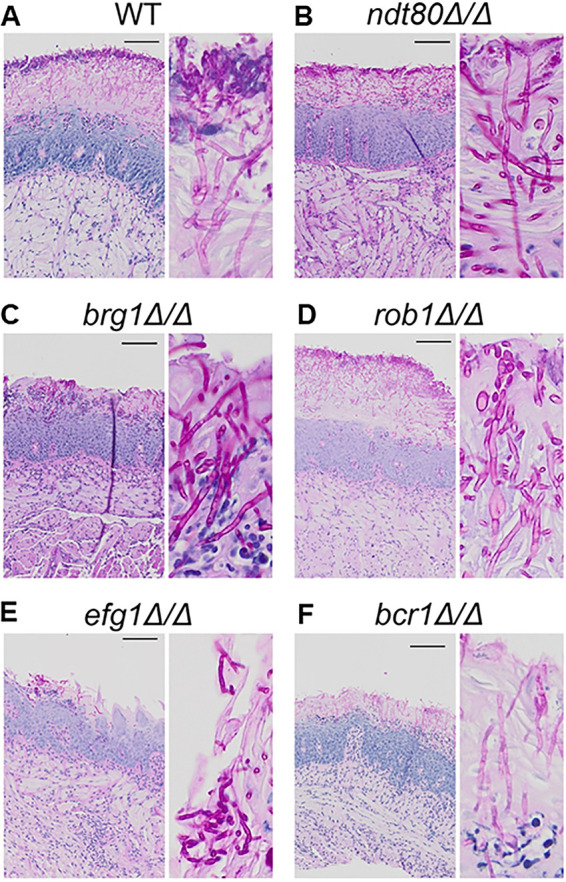
Transcription factor mutants with decreased infectivity undergo filamentation in tongue tissue. Histological sections of tongue tissue infected with the indicated strains were stained using the periodic acid-Schiff (PAS) reagent. C. albicans organisms stain fuchsia in lesions. Insets are provided to show morphology.
FIG 7
FIG 7
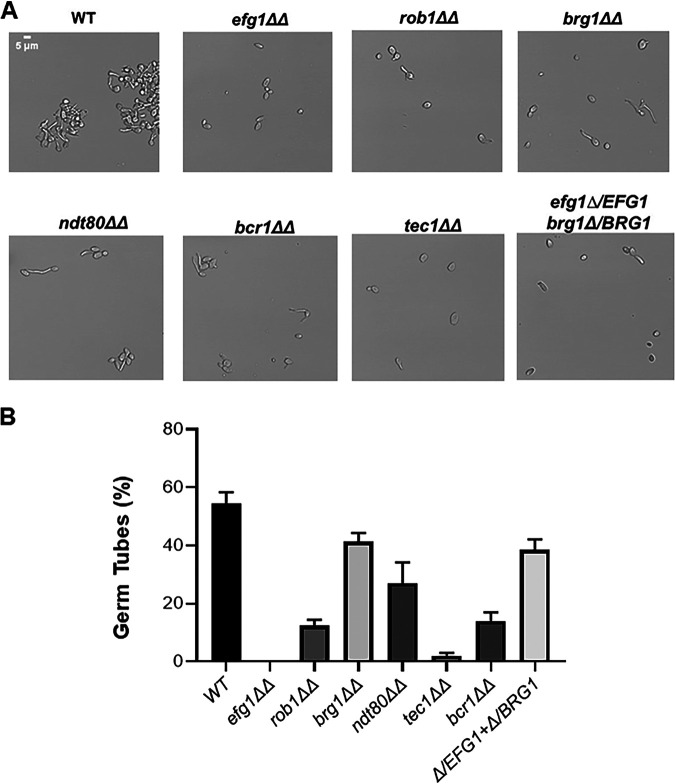
Biofilm-related transcription factor mutants are deficient for filamentation in human saliva. (A) The indicated strains were incubated in commercially sourced human saliva for 4 h at 37°C, fixed with formaldehyde, and imaged. The photomicrographs depict representative morphologies of the strains based on three biological replicates, with at least 100 cells evaluated in each replicate. (B) The bars indicate the percentage of germ tubes observed for each strain under the conditions described for panel A. The bars indicate means with error bars showing standard deviations. The statistical significance for changes from the WT were analyzed by ANOVA and Student's t test for individual comparisons, and statistical significance was defined as a P value of <0.05. Strains with a statistically significant change from the WT are indicated by an asterisk.
FIG 8
FIG 8
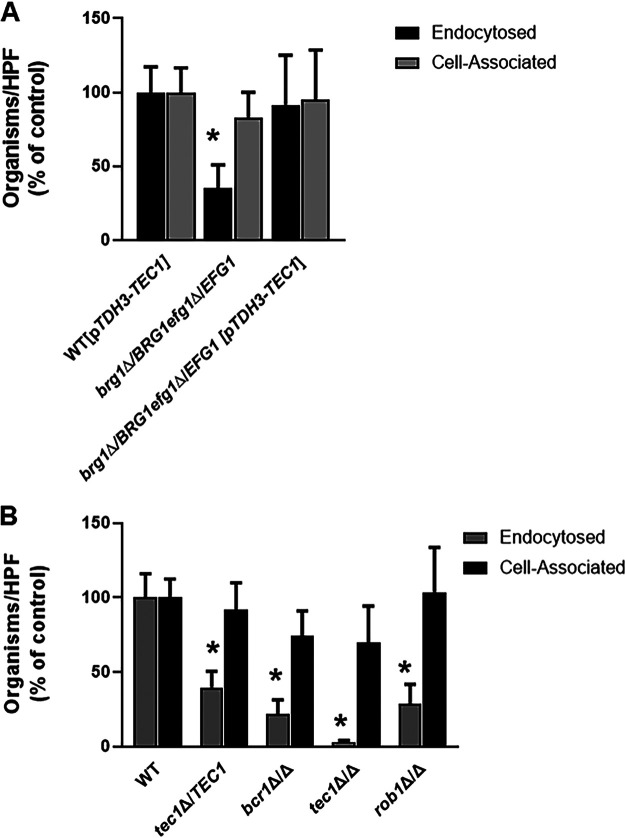
Transcription factor mutants with decreased infectivity in mouse model of oropharyngeal candidiasis have reduced induced endocytosis of oral epithelial cells. (A) The efg1Δ/EFG1 brg1Δ/BRG1 double heterozygous mutant adheres to oral epithelial cells to an extent similar to that of the WT but has reduced endocytosis. Bars indicate means from two independent replicates, and error bars are the standard deviations. Groups were compared by one-way ANOVA followed by post hoc Student's t test to identify individual strains with statistically significant differences (*, P < 0.05). (B) Homozygous deletion mutants with reduced infectivity show deficits in oral epithelial cell endocytosis but not adherence.

References

    1. Pappas PG, Lionakis MS, Arendrup MC, Ostrosky-Zeichner L, Kullberg BJ. 2018. Invasive candidiasis. Nat Rev Dis Primers 4:18026. doi: 10.1038/nrdp.2018.26. - DOI - PubMed
    1. Vila T, Sultan AS, Montelongo-Jauregui D, Jabra-Rizk MA. 2020. Oral candidiasis: a disease of opportunity. J Fungi 6:15. doi: 10.3390/jof6010015. - DOI - PMC - PubMed
    1. Millsop JW, Fazel N. 2016. Oral candidiasis. Clin Dermatol 34:487–494. doi: 10.1016/j.clindermatol.2016.02.022. - DOI - PubMed
    1. Cassone A, Cauda R. 2012. Candida and candidiasis in HIV-infected patients: where commensalism, opportunistic behavior and frank pathogenicity lose their borders. AIDS 26:1457–1472. doi: 10.1097/QAD.0b013e3283536ba8. - DOI - PubMed
    1. Break TJ, Oikonomou V, Dutzan N, Desai JV, Swidergall M, Freiwald T, Chauss D, Harrison OJ, Alejo J, Williams DW, Pittaluga S, Lee CR, Bouladoux N, Swamydas M, Hoffman KW, Greenwell-Wild T, Bruno VM, Rosen LB, Lwin W, Renteria A, Pontejo SM, Shannon JP, Myles IA, Olbrich P, Ferré EMN, Schmitt M, Martin D, Barber DL, Solis NV, Notarangelo LD, Serreze DV, Matsumoto M, Hickman HD, Murphy PM, Anderson MS, Lim JK, Holland SM, Filler SG, Afzali B, Belkaid Y, Moutsopoulos NM, Lionakis MS, Genomics and Computational Biology Core . 2021. Aberrant type I immunity drives susceptibility to mucosal fungal infections. Science 371:5731. doi: 10.1126/science.aay5731. - DOI - PMC - PubMed

Publication types