. 2022 Jan 10;41(1):19.
doi: 10.1186/s13046-021-02227-8.

METTL3 promotes colorectal carcinoma progression by regulating the m6A-CRB3-Hippo axis

Affiliations

METTL3 promotes colorectal carcinoma progression by regulating the m6A-CRB3-Hippo axis

Jiashu Pan et al. J Exp Clin Cancer Res. .

Abstract

Background: Colorectal carcinoma (CRC) is the third most common cancer and second most common cause of cancer-related deaths worldwide. Ribonucleic acid (RNA) N6-methyladnosine (m6A) and methyltransferase-like 3 (METTL3) play key roles in cancer progression. However, the roles of m6A and METTL3 in CRC progression require further clarification.

Methods: Adenoma and CRC samples were examined to detect m6A and METTL3 levels, and tissue microarrays were performed to evaluate the association of m6A and METTL3 levels with the survival of patients with CRC. The biological functions of METTL3 were investigated through cell counting kit-8, wound healing, and transwell assays. M6A epitranscriptomic microarray, methylated RNA immunoprecipitation-qPCR, RNA stability, luciferase reporter, and RNA immunoprecipitation assays were performed to explore the mechanism of METTL3 in CRC progression.

Results: M6A and METTL3 levels were substantially elevated in CRC tissues, and patients with CRC with a high m6A or METTL3 levels exhibited shorter overall survival. METTL3 knockdown substantially inhibited the proliferation, migration, and invasion of CRC cells. An m6A epitranscriptomic microarray revealed that the cell polarity regulator Crumbs3 (CRB3) was the downstream target of METTL3. METTL3 knockdown substantially reduced the m6A level of CRB3, and inhibited the degradation of CRB3 mRNA to increase CRB3 expression. Luciferase reporter assays also showed that the transcriptional level of wild-type CRB3 significantly increased after METTL3 knockdown but not its level of variation. Knockdown of YT521-B homology domain-containing family protein 2 (YTHDF2) substantially increased CRB3 expression. RNA immunoprecipitation assays also verified the direct interaction between the YTHDF2 and CRB3 mRNA, and this direct interaction was impaired after METTL3 inhibition. In addition, CRB3 knockdown significantly promoted the proliferation, migration, and invasion of CRC cells. Mechanistically, METTL3 knockdown activated the Hippo pathway and reduced nuclear localization of Yes1-associated transcriptional regulator, and the effects were reversed by CRB3 knockdown.

Conclusions: M6A and METTL3 levels were substantially elevated in CRC tissues relative to normal tissues. Patients with CRC with high m6A or METTL3 levels exhibited shorter overall survival, and METTL3 promoted CRC progression. Mechanistically, METTL3 regulated the progression of CRC by regulating the m6A-CRB3-Hippo pathway.

Keywords: Colorectal carcinoma; Crumbs3; Hippo pathway; Methyltransferase-like 3; RNA N6-methyladnosine.


Conflict of interest statement

The authors declare no competing interests.

Figures
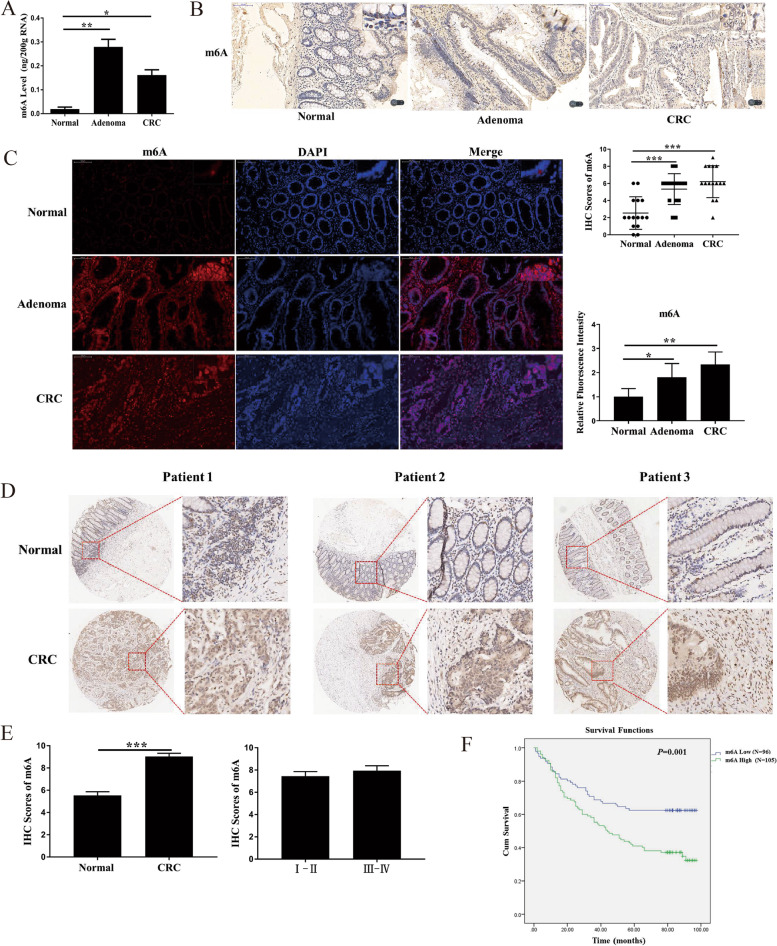
Fig. 1
Fig. 1
N6-methyladnosine level was substantially increased in both adenoma and colorectal carcinoma and associated with poor prognosis. N6-methyladnosine (m6A) levels in both adenoma and colorectal carcinoma (CRC) were assayed through (a) Methylation quantification assay, b Immunohistochemistry (IHC), and (c) Immunofluorescence. d Representative images of IHC staining for m6A level as obtained from 201 CRC tissues and 159 normal tissues; e IHC staining scores of m6A; f Kaplan–Meier overall survival analysis of m6A expression in patients with CRC. Data are presented as means ± standard deviations (SDs). *P < 0.05, **P < 0.01, ***P < 0.001
Fig. 2
Fig. 2
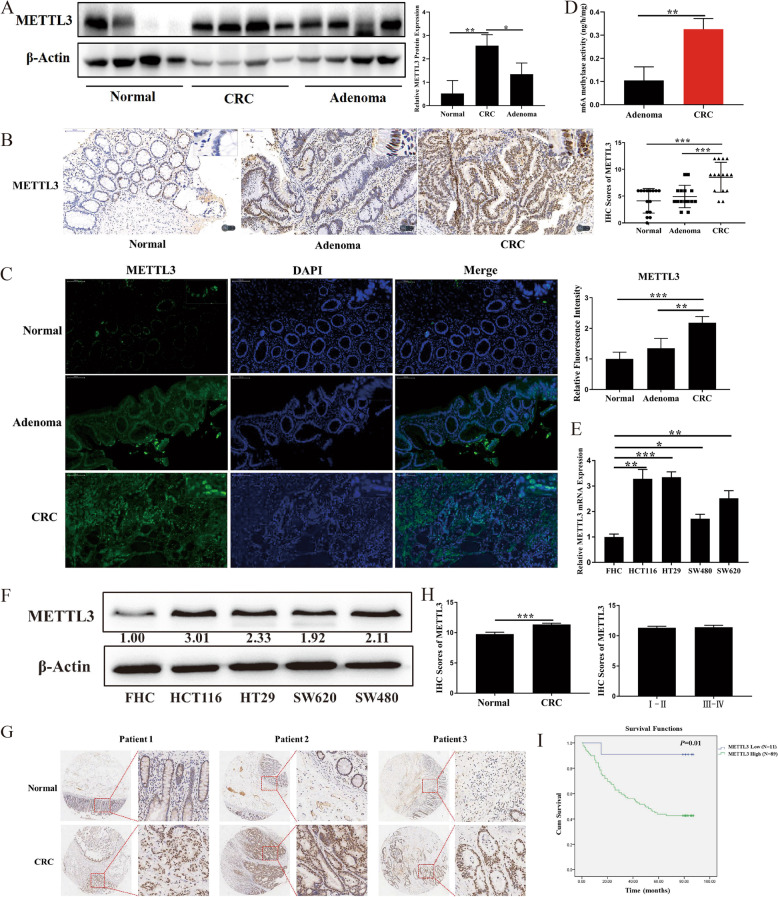
Methyltransferase-like 3 was substantially increased in colorectal carcinoma and associated with poor prognosis. Methyltransferase-like 3 (METTL3) expression in both adenoma and colorectal carcinoma (CRC) was assayed through (a) Western blot, b Immunohistochemistry (IHC), and c Immunofluorescence. d N6-methyladnosine (m6A) methylase activity was assayed. e METTL3 mRNA level in CRC cells; f METTL3 protein level in CRC cells; g Representative images of IHC staining for METTL3 level as obtained from 100 CRC tissues and 80 normal tissues; h METTL3 IHC staining scores; i Kaplan–Meier overall survival analysis of METTL3 expression in patients with CRC. Data are presented as means ± standard deviations (SDs). *P < 0.05, **P < 0.01, ***P < 0.001
Fig. 3
Fig. 3
Methyltransferase-like 3 drives colorectal carcinoma proliferation and invasion. a Expression of Methyltransferase-like 3 (METTL3) in HCT116 and SW620 cells with METTL3 knockdown; b Proliferation of HCT116 and SW620 cells after METTL3 knockdown. Transwell assays with METTL3 knockdown for (c) HCT116 cells and (d) SW620 cells. Wound healing assay with METTL3 knockdown for (e) HCT116 cells and (f) SW620 cells. Data are presented as means ± standard deviations (SDs). *P < 0.05, **P < 0.01, ***P < 0.001
Fig. 4
Fig. 4
Analysis of epitranscriptomic microarray. Analysis of differentially N6-methyladnosine (m6A)-methylated sites (DMS) (a) and differentially m6A-methylated genes (DMG) (b) at m6A methylation level; Analysis of DMSs (c) and DMGs (d) at m6A quantity level; e, f Analysis of Gene Ontology at m6A methylation level and m6A quantity level; g, h Analysis of Kyoto Encyclopedia of Genes and Genomes at m6A methylation level and m6A quantity level
Fig. 5
Fig. 5
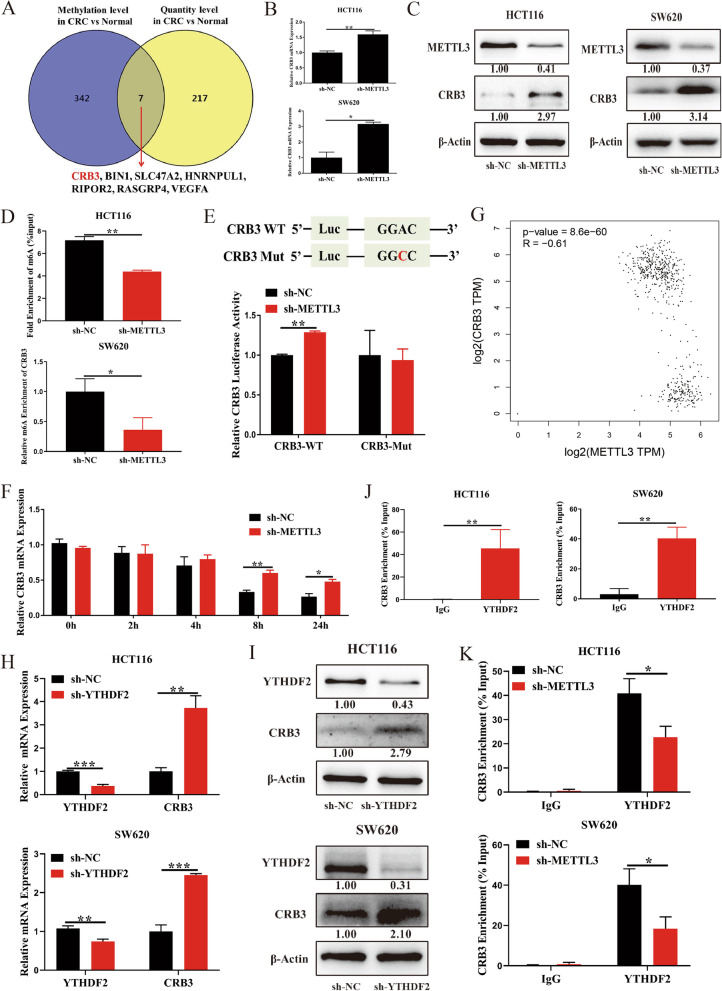
Methyltransferase-like 3 regulated the expression of crumbs3 in an N6-methyladnosine -dependent manner. a Overlapping differentially N6-methyladnosine (m6A)-methylated genes between m6A methylation level and quantity level as filtered through a Venn diagram; b Crumbs3 (CRB3) mRNA level as measured after methyltransferase-like 3 (METTL3) knockdown; c CRB3 protein level as measured after METTL3 knockdown; d The m6A level of CRB3 as measured after METTL3 knockdown; e Luciferase reporters performed to determine the effect of m6A modification on CRB3 expression; f CRB3 mRNA expression as detected with or without treatment of actinomycin D at indicated time points; g The correlation between METTL3 and CRB3 expression in The Cancer Genome Atlas database for CRC; h CRB3 mRNA level as measured after YTH domain–containing family protein 2 (YTHDF2) knockdown; i CRB3 protein level as measured after YTHDF2 knockdown; j-k The direct interaction was verified between the YTHDF2 and CRB3 mRNA. Data are presented as means ± standard deviations (SDs). *P < 0.05, **P < 0.01, ***P < 0.001
Fig. 6
Fig. 6
Crumbs3 inhibited colorectal carcinoma proliferation and invasion. Crumbs3 (CRB3) expression in both adenoma and colorectal carcinoma (CRC) as assayed through (a) qPCR and (b) Immunofluorescence; c Proliferation of HCT116 and SW620 cells as measured after CRB3 knockdown; Transwell assays performed with CRB3 knockdown in (d) HCT116 cells and (e) SW620 cells; Wound healing assay performed with CRB3 knockdown in (f) HCT116 cells and (g) SW620 cells. Data are presented as means ± standard deviations (SD). *P < 0.05, **P < 0.01, ***P < 0.001
Fig. 7
Fig. 7
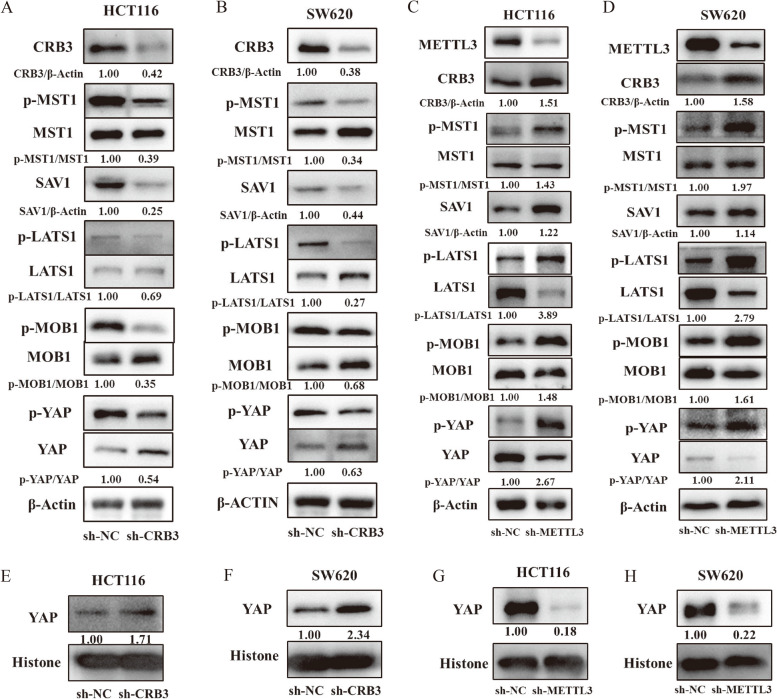
Methyltransferase-like 3 and crumbs3 could both regulate Hippo pathway. Hippo pathway as detected after (a, b) Crumbs3 (CRB3) knockdown or (c, d) Methyltransferase-like 3 (METTL3) knockdown in HCT116 and SW620 cells; Yes1-associated transcriptional regulator (YAP) protein level as detected after (e, f) CRB3 knockdown or (g, h) METTL3 knockdown in nuclei of HCT116 and SW620 cells. Data are presented as means ± standard deviations (SD). *P < 0.05, **P < 0.01, ***P < 0.001
Fig. 8
Fig. 8
The effect of methyltransferase-like 3 on colorectal carcinoma progression was rescued by crumbs3. The proliferation of HCT116 (a) and SW620 cells (b) was rescued after crumbs3 (CRB3) knockdown; Migration and invasion was rescued after CRB3 knockdown in HCT116 (c) and SW620 cells (d); The activation of hippo pathway was reversed after CRB3 knockdown in HCT116 (e) and SW620 cells (f). Data are presented as means ± standard deviations (SD). *P < 0.05, **P < 0.01, ***P < 0.001

References

    1. Sung H, Ferlay J, Siegel RL, Laversanne M, Soerjomataram I, Jemal A, Bray F. Global Cancer statistics 2020: GLOBOCAN estimates of incidence and mortality worldwide for 36 cancers in 185 countries. CA Cancer J Clin. 2021;71(3):209–249. - PubMed
    1. Meyer KD, Saletore Y, Zumbo P, Elemento O, Mason CE, Jaffrey SR. Comprehensive analysis of mRNA methylation reveals enrichment in 3′ UTRs and near stop codons. Cell. 2012;149(7):1635–1646. - PMC - PubMed
    1. Zhao BS, Roundtree IA, He C. Post-transcriptional gene regulation by mRNA modifications. Nat Rev Mol Cell Biol. 2017;18(1):31–42. - PMC - PubMed
    1. Li T, Hu PS, Zuo Z, Lin JF, Li X, Wu QN, Chen ZH, Zeng ZL, Wang F, Zheng J, et al. METTL3 facilitates tumor progression via an m(6)A-IGF2BP2-dependent mechanism in colorectal carcinoma. Mol Cancer. 2019;18(1):112. - PMC - PubMed
    1. Chen X, Xu M, Xu X, Zeng K, Liu X, Pan B, Li C, Sun L, Qin J, Xu T, et al. METTL14-mediated N6-methyladenosine modification of SOX4 mRNA inhibits tumor metastasis in colorectal cancer. Mol Cancer. 2020;19(1):106. - PMC - PubMed