


The COVID-19 hospitalization metric in the pre- and postvaccination eras as a measure of pandemic severity: A retrospective, nationwide cohort study
- PMID: 35012694
- PMCID: PMC9021586
- DOI: 10.1017/ice.2022.13
The COVID-19 hospitalization metric in the pre- and postvaccination eras as a measure of pandemic severity: A retrospective, nationwide cohort study
Abstract
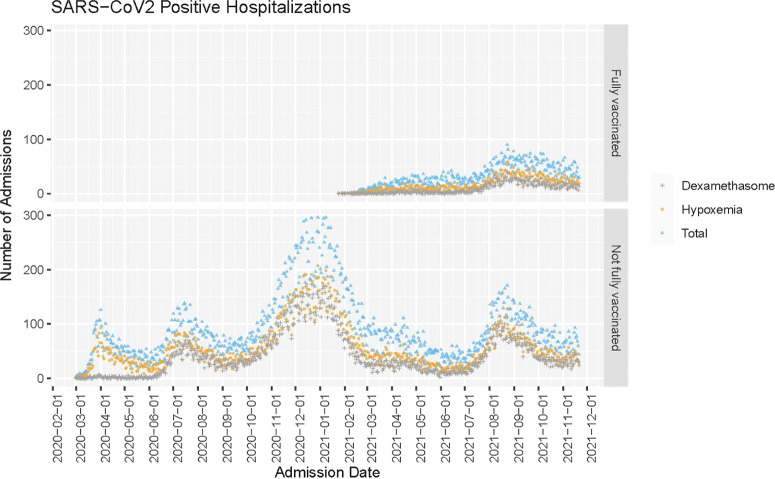
Background: Coronavirus disease 2019 (COVID-19) hospitalization definitions do not include a disease severity assessment. Thus, we sought to identify a simple and objective mechanism for identifying hospitalized severe cases and to measure the impact of vaccination on trends.
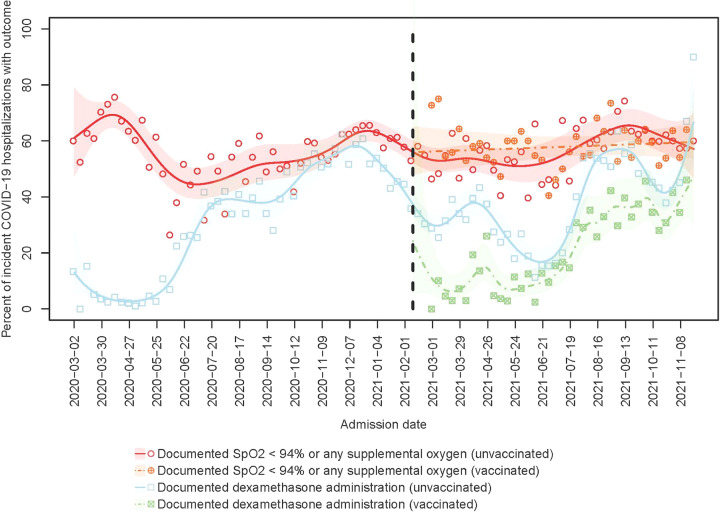
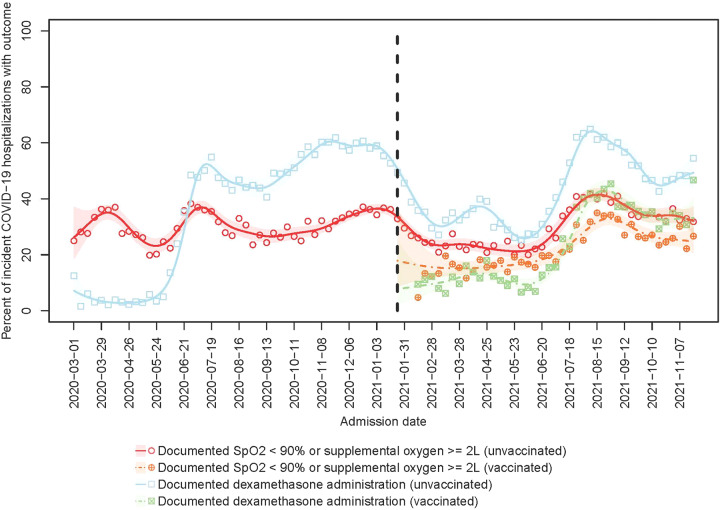
Methods: All admissions to a Veterans' Affairs (VA) hospital, where routine inpatient screening is recommended, between March 1, 2020, and November 22, 2021, with laboratory-confirmed severe acute respiratory coronavirus virus 2 (SARS-CoV-2) were included. Moderate-to-severe COVID-19 was defined as any oxygen supplementation or any oxygen saturation (SpO2) <94% between 1 day before and 2 weeks after the positive SARS-CoV-2 test. Admissions with moderate-to-severe disease were divided by the total number of admissions, and the proportion of admissions with moderate-to-severe COVID-19 was modelled using a penalized spline in a Poisson regression and stratified by vaccination status. Dexamethasone receipt and its correlation with moderate-to-severe cases was also assessed.
Results: Among 67,025 admissions with SARS-CoV-2, the proportion with hypoxemia or supplemental oxygen fell from 64% prior to vaccine availability to 56% by November 2021, driven in part by lower rates in vaccinated patients (vaccinated, 52% versus unvaccinated, 58%). The proportion of cases of moderate-to-severe disease identified using SpO2 levels and oxygen supplementation was highly correlated with dexamethasone receipt (correlation coefficient, 0.95), and increased after July 1, 2021, concurrent with δ (delta) variant predominance.
Conclusions: A simple and objective definition of COVID-19 hospitalizations using SpO2 levels and oxygen supplementation can be used to track pandemic severity. This metric could be used to identify risk factors for severe breakthrough infections, to guide clinical treatment algorithms, and to detect trends in changes in vaccine effectiveness over time and against new variants.
Figures
References
-
- Coronavirus disease 2019 (COVID-19)-Associated Hospitalization Surveillance Network (COVID-NET). Centers for Disease Control and Prevention website. https://www.cdc.gov/coronavirus/2019-ncov/covid-data/covid-net/purpose-m.... Published 2020. Accessed March 18, 2022.
-
- Vaccine Breakthrough Case Investigations Team. COVID-19 vaccine breakthrough infections reported to CDC—United States, January. Centers for Disease Control and Prevention website. https://www.cdc.gov/mmwr/volumes/70/wr/mm7021e3.html. Accessed March 18, 2022.
-
- COVID-19 Shared Data Resource (2020). VA Healthcare System website. https://www.va.gov. Published 2020. Accessed December 7, 2021.
Publication types
MeSH terms
Substances
LinkOut - more resources
Full Text Sources
Medical
Miscellaneous
