


What do we know about evidence-informed priority setting processes to set population-level health-research agendas: an overview of reviews
- PMID: 35013662
- PMCID: PMC8733764
- DOI: 10.1186/s42269-021-00687-8
What do we know about evidence-informed priority setting processes to set population-level health-research agendas: an overview of reviews
Abstract
Background: This overview aimed to synthesize existing systematic reviews to produce a draft framework of evidence-informed health priority setting that supports countries in identifying appropriate steps and methods when developing and implementing national research agendas.
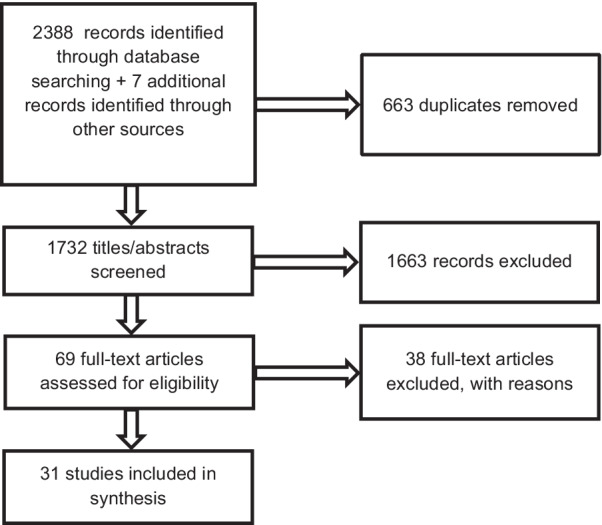
Main body: We searched Ovid MEDLINE® and the WHO Institutional Repository for Information Sharing from 2010 to 2020 for critical or systematic reviews that evaluated research priority setting exercises. We adapted the AMSTAR checklist to assess the quality of included reviews and used adapted frameworks for data extraction and analysis. The search resulted in 2395 titles, of which 31 were included. Populations included in the reviews typically involved patients, families and carers, researchers, clinicians, policymakers and research funders. The topics covered in the reviews varied from specific diseases or conditions, approaches for healthcare practice or research priority setting methods itself. All the included systematic reviews were of low or critically low quality. The studies were thematically grouped based on their main focus: identifying and engaging with stakeholders; methods; context; and health area.
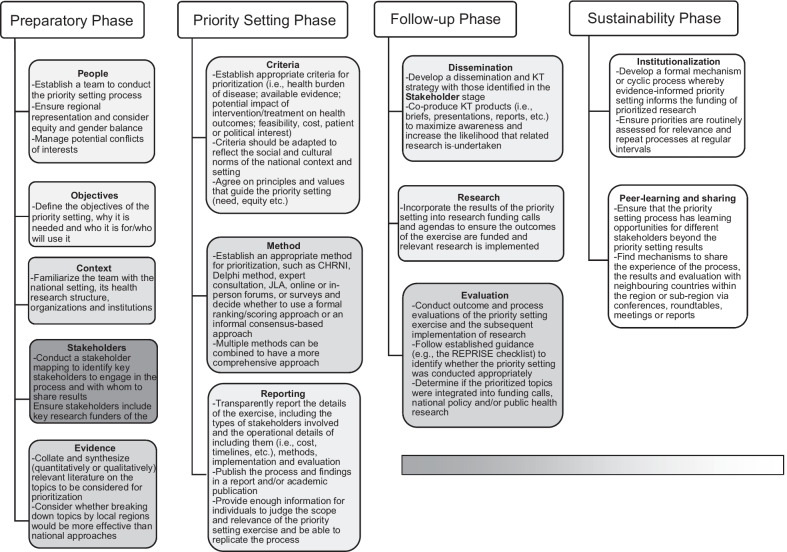
Conclusion: Our overview of reviews has reconfirmed aspects of existing frameworks, but has also identified new concepts for countries to consider while developing their national research agendas. We propose a preliminary framework for consideration that highlights four key phases: (1) preparatory, (2) priority setting, (3) follow-up phase and (4) sustainability phase, which have thirteen sub-domains to consider.
Keywords: National health research system; Overview of reviews; Research agenda; Research funding; Research priority setting; Resource allocation; Systematic review.
© The Author(s) 2022.
Conflict of interest statement
Competing interestsMN has previously worked on priority setting of research for other similar organizations and this research was included in this paper. She has received funding from the National Institute of Health Research, Cochrane, Public Health Wales, NHS Devon, EU Marie Skłodowska Curie initiative, EU Cost Action Peninsula Dental Social Enterprise, University of Plymouth, Shahid Behshti University of Medical Science for other research projects, but this had no influence on the current research, financial or otherwise. TS has previously worked on priority setting of research for other similar organizations, but they had no influence on this research, financial or otherwise. The authors have no other competing interests to declare. The authors alone are responsible for the views expressed in this article and they do not necessarily represent the views, decisions or policies of the institutions with which they are affiliated.
Figures
References
-
- Alqahtani S, Joseph J, Dicianno B, Layton NA, Toro ML, Ferretti E, Tuakli-Wosornu YA, Chhabra H, Neyedli H, Lopes CR, Alqahtani MM, Van de Vliet P, Kumagaya SI, Kim JB, McKinney V, Yang YS, Goldberg M, Cooper R. Stakeholder perspectives on research and development priorities for mobility assistive-technology: a literature review. Disabil Rehabil Assist Technol. 2021;16:362–376. doi: 10.1080/17483107.2019.1650300. - DOI - PubMed
-
- Booth A, Maddison J, Wright K, Fraser L, Beresford B. Research prioritisation exercises related to the care of children and young people with life-limiting conditions, their parents and all those who care for them: a systematic scoping review. Palliative Med. 2018;32:1552–1566. doi: 10.1177/0269216318800172. - DOI - PMC - PubMed
-
- Bourne AM, Johnston RV, Cyril S, Briggs AM, Clavisi O, Duque G, Harris IA, Hill C, Hiller C, Kamper SJ, Latimer J, Lawson A, Lin CC, Maher C, Perriman D, Richards BL, Smitham P, Taylor WJ, Whittle S, Buchbinder R. Scoping review of priority setting of research topics for musculoskeletal conditions. BMJ Open. 2018;8:e023962. doi: 10.1136/bmjopen-2018-023962. - DOI - PMC - PubMed
-
- Bragge P, Piccenna L, Middleton J, Williams S, Creasey G, Dunlop S, Brown D, Gruen R. Developing a spinal cord injury research strategy using a structured process of evidence review and stakeholder dialogue. Part II: background to a research strategy. Spinal Cord. 2015;53:721–728. doi: 10.1038/sc.2015.86. - DOI - PubMed
Excluded Studies
-
- Abramowitz SA, Hipgrave DB, Witchard A, Heymann DL. Lessons from the West Africa Ebola epidemic: a systematic review of epidemiological and social and behavioral science research priorities. L Infect Dis. 2018;218:1730–1738. - PubMed
-
- Barnes AP, Moxey AP, Ahmadi BV, Borthwick FA. The effect of animal health compensation on ‘positive’ behaviours towards exotic disease reporting and implementing biosecurity: a review, a synthesis and a research agenda. Prev Vet Med. 2015;122:42–52. doi: 10.1016/j.prevetmed.2015.09.003. - DOI - PubMed
-
- Bassetti CL, Ferini-Strambi L, Brown S, Adamantidi A, Benedetti F, Bruni O, Cajochen C, Dolenc-Groselj L, Ferri R, Gais S, Huber R. Neurology and psychiatry: waking up to opportunities of sleep. State of the art and clinical/research priorities for the next decade. Eur J Neurol. 2015;22:1337–1354. doi: 10.1111/ene.12781. - DOI - PubMed
-
- Buchholz SW, Klein T, Cooke C, Cook ML, Knestrick J, Dickins K. Introduction to four reviews addressing critical topics identified by the 2015 Nurse Practitioner Research Agenda Roundtable: priorities for policy, workforce, education, and practice. J Am Assoc Nurse Pra. 2018;30:667–672. doi: 10.1097/JXX.0000000000000035. - DOI - PubMed
Publication types
Grants and funding
LinkOut - more resources
Full Text Sources