Review
. 2022 May;12(5):2206-2223.
doi: 10.1016/j.apsb.2021.12.021. Epub 2022 Jan 4.

Emerging vaccine nanotechnology: From defense against infection to sniping cancer

Affiliations
Review

Emerging vaccine nanotechnology: From defense against infection to sniping cancer

Chan Feng et al. Acta Pharm Sin B. 2022 May.

Abstract

Looking retrospectively at the development of humanity, vaccination is an unprecedented medical landmark that saves lives by harnessing the human immune system. During the ongoing coronavirus disease 2019 (COVID-19) pandemic, vaccination is still the most effective defense modality. The successful clinical application of the lipid nanoparticle-based Pfizer/BioNTech and Moderna mRNA COVID-19 vaccines highlights promising future of nanotechnology in vaccine development. Compared with conventional vaccines, nanovaccines are supposed to have advantages in lymph node accumulation, antigen assembly, and antigen presentation; they also have, unique pathogen biomimicry properties because of well-organized combination of multiple immune factors. Beyond infectious diseases, vaccine nanotechnology also exhibits considerable potential for cancer treatment. The ultimate goal of cancer vaccines is to fully mobilize the potency of the immune system as a living therapeutic to recognize tumor antigens and eliminate tumor cells, and nanotechnologies have the requisite properties to realize this goal. In this review, we summarize the recent advances in vaccine nanotechnology from infectious disease prevention to cancer immunotherapy and highlight the different types of materials, mechanisms, administration methods, as well as future perspectives.

Keywords: Cancer; Diseases prevention; Immunotherapy; Infection; Nanotechnology; Nanovaccines; Vaccination; Vaccine.


Figures

Image 1
Graphical abstract
Figure 1
Figure 1
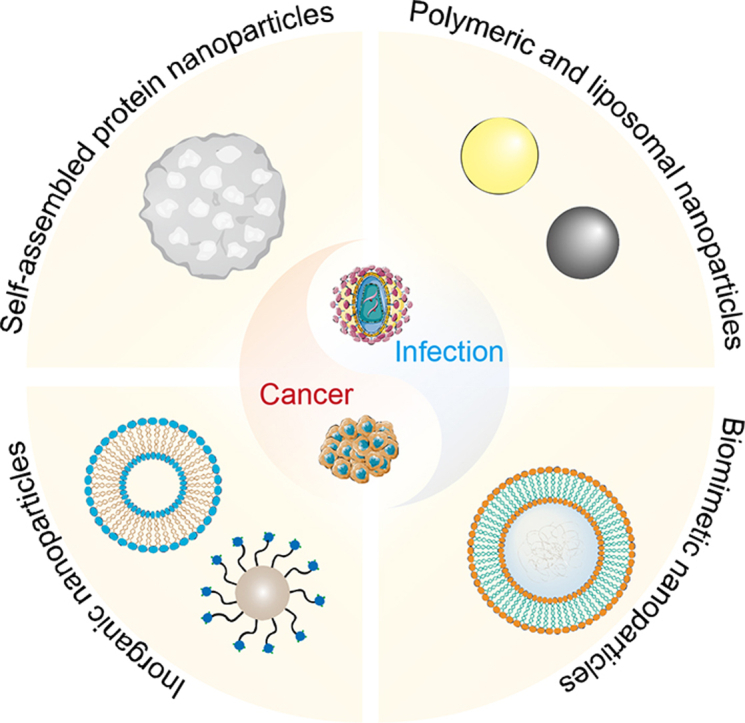
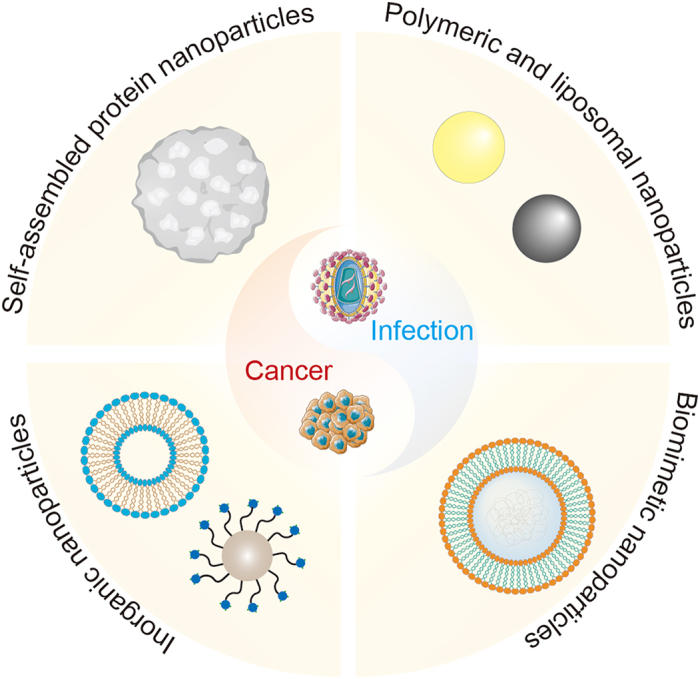
Schematic illustration of emerging vaccine nanotechnology for infectious diseases prevention and cancer immunotherapy. Main types of nanovaccines include self-assembled protein nanoparticles, inorganic nanoparticles, polymeric and liposomal nanoparticles and biomimetic nanoparticles.
Figure 2
Figure 2
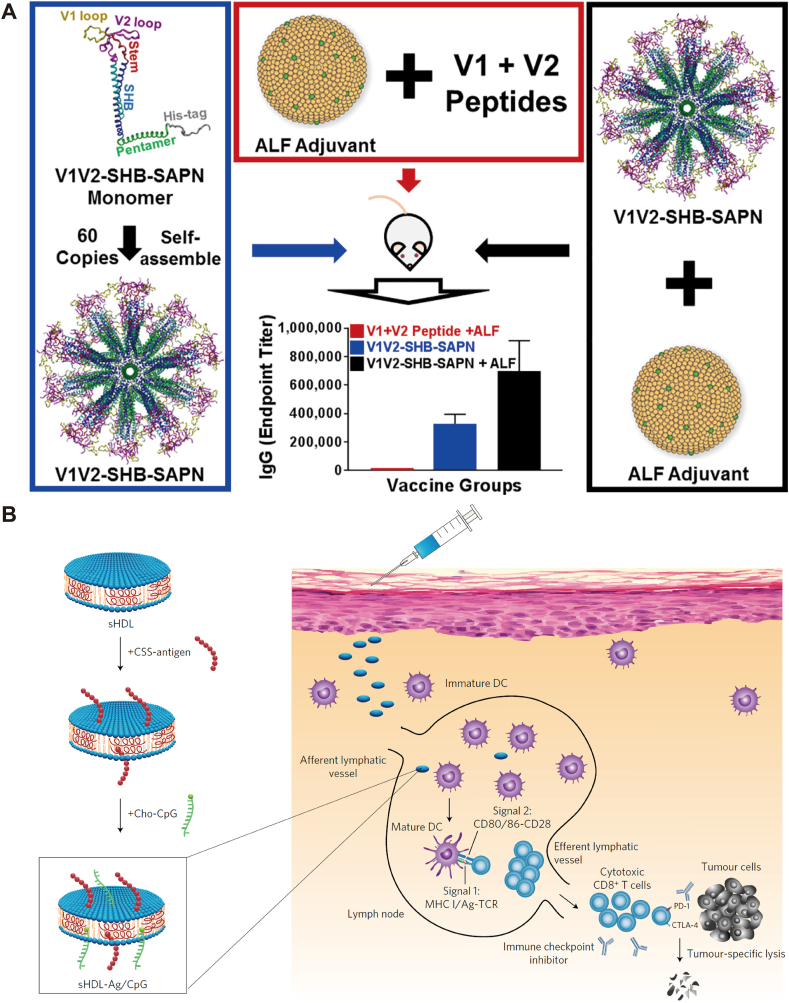
(A) Self-assembled protein nanoparticles as HIV vaccines. Fully assembled protein nanoparticles display 20 copies of trimers. The protein nanovaccine induces specific IgG in mice and the immune response can be enhanced with army liposome formulation (ALF) as adjuvant. Reprinted with permission from Ref. . Copyright © 2019. Elsevier. (B) Design and application of high-density lipoprotein-mimicking nanodisc platform composed of lipids and peptides for co-delivery of Ag and CpG for as cancer vaccine. Subcutaneous injection of the nanovaccine induce DC maturation and elite robust Ag-specific CD8+ T cell responses, killing target cancer cells. This nanovaccine can be used in combination immunotherapy with immune checkpoint blockade. Reprinted with permission from Ref. . Copyright © 2017 Springer Nature.
Figure 3
Figure 3
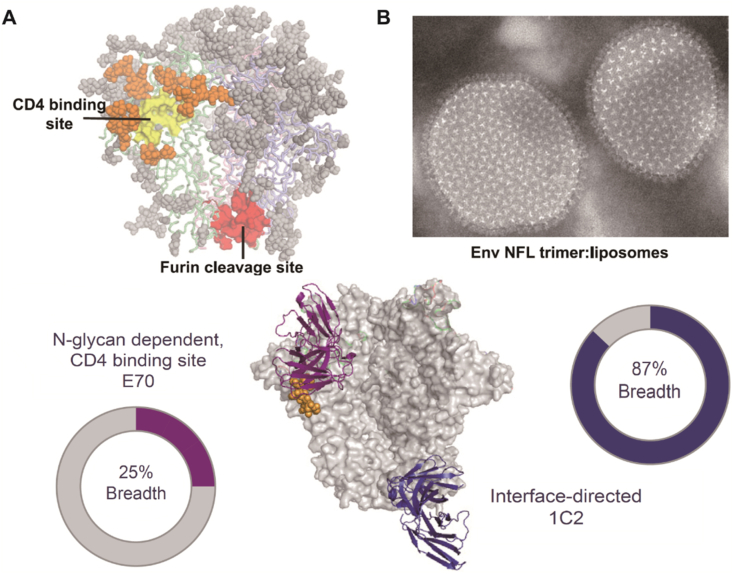
(A) HIV envelope trimer model. Conserved sites of vulnerability were highlighted as CD4bs (yellow) ringed with N-glycans (orange). The interface-directed antibody (1C2) showed significantly higher HIV neutralization breadth (87%) than N-glycan-dependent CD4-binding site E70 (25% HIV neutralization breadth) when vaccinating against a panel of clinical isolates. (B) Morphology of HIV envelope native flexibly linked trimer coupled to liposomes by negative stain electronic microscope. Reprinted with permission from Ref. . Copyright © 2019 Cell press.
Figure 4
Figure 4
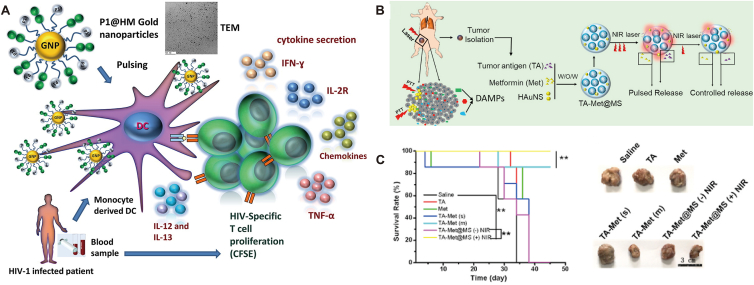
(A) Gold nanoparticle (GNP) decorated with high-mannoside-type oligosaccharides (P1@HM) and HIV-1-peptides-pulsed DC for HIV-specific T cell immunity. Reprinted with permission from Ref.  © Copyright 2018. Elsevier. (B) Fabrication of PLGA nanoparticle loaded with tumor antigen, metformin and hollow gold nanospheres (TA-Met@MS) as tumor vaccines. Photothermal therapy (PTT) stimulate the nanoparticle to release antigen and drug for inducing immunogenicity. (C) TA-Met@MS treatment prolonged the survival of tumor bearing mice and suppressed tumor progression. Reprinted with permission from Ref. . Copyright © 2021 Elsevier.
Figure 5
Figure 5
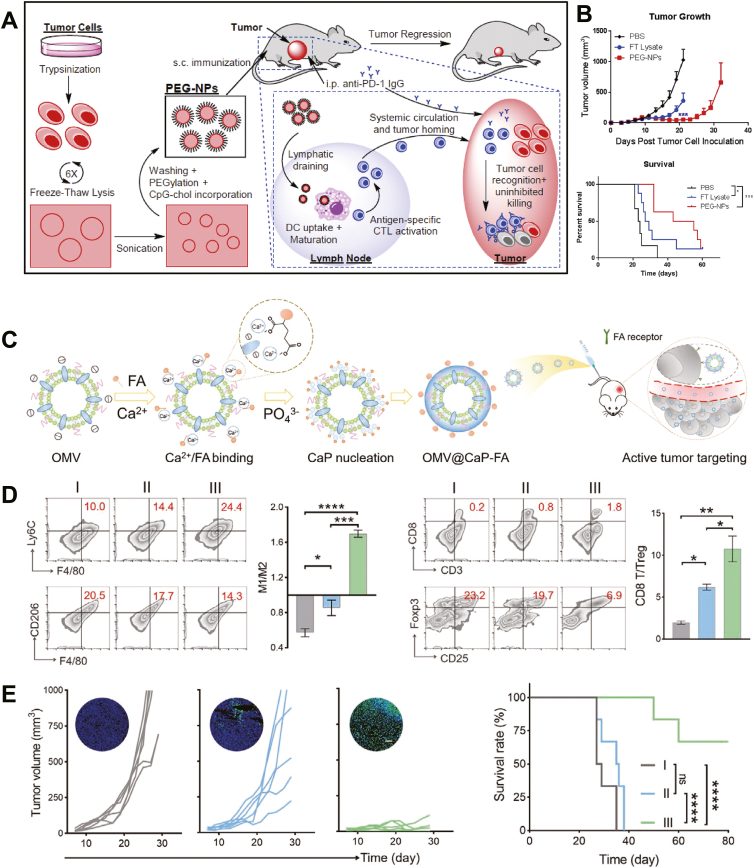
(A) Nanovesicles derived from tumor cell membrane as vaccine platform for cancer therapy. B16F10-OVA cell-derived nanovesicles (PEG-NPs) were obtain by freeze-thawing lysis, sonication, calcium-mediated aggregation, PEGylation, and cholesterol-linked CpG incorporation. Subcutaneous administrated PEG-NPs are taken up by DCs to activate antigen-specific cytotoxic CD8+ T lymphocytes, which recognize and kill cancer cells in synergy with immune checkpoint blockade. (B) PEG-NPs nanovaccines suppressed tumor growth and prolonged survival of tumor bearing mice. Reprinted with permission from Ref. . Copyright © 2018 Elsevier. (C) Fabrication of biomineralized OMVs (OMV@CaPs) by Ca2+ binding, CaP nucleation, crystal growth and folic acid modification as targeted tumor vaccines. (D) Flow cytometry analysis showing OMV@CaPs shifted the macrophages polarization from M2 to M1, and increased CD8+ T cell infiltration and decreased Treg in tumors. (E) OMV@CaPs suppressed tumor growth and prolonged survival of tumor bearing mice. Reprinted with permission from Ref. . Copyright © 2020 Wiley-VCH.

References

    1. Eppler H.B., Jewell C.M. Biomaterials as tools to decode immunity. Adv Mater. 2020;32:1903367. - PMC - PubMed
    1. Shields Iv C.W., Wang L.L.-W., Evans M.A., Mitragotri S. Materials for immunotherapy. Adv Mater. 2020;32:1901633. - PubMed
    1. Tang Z.M., Xiao Y.F., Kong N., Liu C., Chen W., Huang X.G., et al. Nano-bio interfaces effect of two-dimensional nanomaterials and their applications in cancer immunotherapy. Acta Pharm Sin B. 2021;11:3447–3464. - PMC - PubMed
    1. Tang Z.M., Zhang X.C., Shu Y.Q., Guo M., Zhang H., Tao W. Insights from nanotechnology in COVID-19 treatment. Nano Today. 2021;36:101019. - PMC - PubMed
    1. Tang Z.M., Kong N., Zhang X.C., Liu Y., Hu P., Mou S., et al. A materials-science perspective on tackling COVID-19. Nat Rev Mater. 2020;5:847–860. - PMC - PubMed

LinkOut - more resources