


Implant-supported removable partial dentures compared to conventional dentures: A systematic review and meta-analysis of quality of life, patient satisfaction, and biomechanical complications
- PMID: 35014207
- PMCID: PMC8874059
- DOI: 10.1002/cre2.521
Implant-supported removable partial dentures compared to conventional dentures: A systematic review and meta-analysis of quality of life, patient satisfaction, and biomechanical complications
Abstract
Objectives: The purpose of this systematic review and meta-analysis was to compare implant-supported removable partial dentures (ISRPDs) with distal extension removable partial dentures (DERPDs) in terms of patient-reported outcome measures (PROMs: patients' quality of life and satisfaction) and to determine mechanical and biological complications associated with ISRPDs.
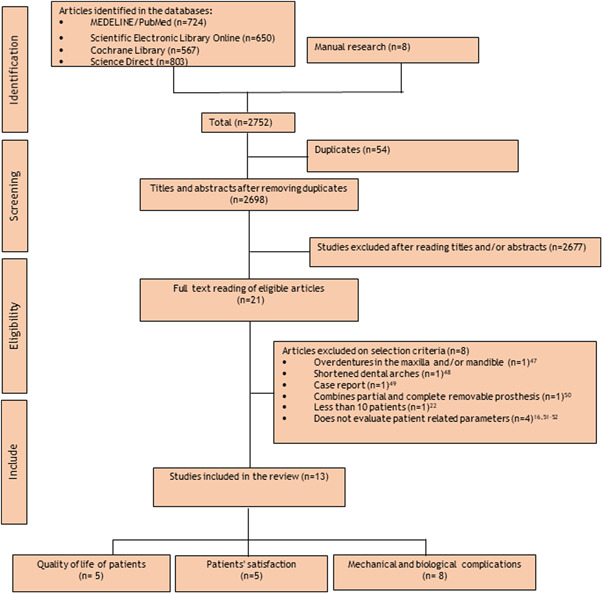
Material and methods: An electronic search was performed on four databases to identify studies treating Kennedy class I or II edentulous patients and which compared ISRPDs with DERPDs in terms of PROMS and studies, which evaluated mechanical and biological complications associated ISRPDs. Two authors independently extracted data on quality of life, patient satisfaction, and biomechanical complications from these studies. The risk of bias was assessed for each study, and for PROMs, the authors performed a meta-analysis by using a random-effects model.
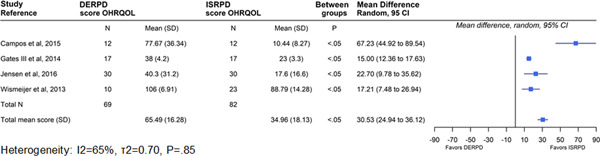
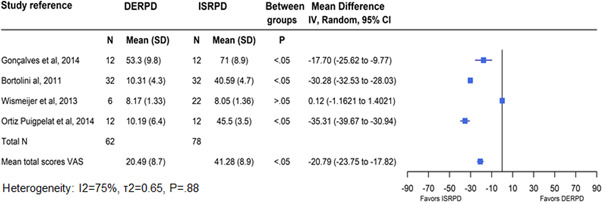
Results: Thirteen articles were included based on the selection criteria. The difference in mean scores for quality of life (30.5 ± 1.8; 95% confidence interval [CI], 24.9-36.1) and patient satisfaction (-20.8 ± 0.2; 95% CI, -23.7 to -17.8) between treatments with conventional and implant-supported removable dentures was statistically significant (p < .05). Implant-supported removable dentures improved patients' overall quality of life and satisfaction. Some mechanical and biological complications, such as clasp adjustment, abutment or implant loosening, marginal bone resorption, and peri-implant mucositis, were noted in ISRPDs during patient follow-up. Studies assessing PROMs were very heterogeneous (I2 = 65%, p = .85; I2 = 75%, p = .88).
Conclusions: ISRPDs significantly improved quality of life and patient satisfaction. Some mechanical and biological complications have been associated with ISRPDs treatment, requiring regular monitoring of patients to avoid the occurrence of these complications.
Keywords: implant-supported removable partial dentures; patient's satisfaction; quality of life; removable partial denture.
© 2021 The Authors. Clinical and Experimental Dental Research published by John Wiley & Sons Ltd.
Conflict of interest statement
The author declares that there is no conflict of interest.
Figures
References
-
- Albrektsson, T. , Zarb, G. , Worthington, P. , & Eriksson, A. (1986). The long‐term efficacy of currently used dental implants: A review and proposed criteria of success. The International Journal of Oral & Maxillofacial Implants, 1(1), 11–25. - PubMed
-
- Arinzeh, T. L. , Tran, T. , Mcalary, J. , & Daculsi, G. (2005). A comparative study of biphasic calcium phosphate ceramics for human mesenchymal stem‐cell‐induced bone formation. Biomaterials, 26(17), 3631–3638. - PubMed
-
- Armellini, D. B. , Heydecke, G. , Witter, D. J. , & Creugers, N. H. (2008). Effect of removable partial dentures on oral health‐related quality of life in subjects with shortened dental arches: A 2‐center cross‐sectional study. International Journal of Prosthodontics, 21(6), 524–530. - PubMed
-
- Bellia, E. , Audenino, G. , Ceruti, P. , & Bassi, F. (2020). Clinical assessment of short implants retaining removable partial dentures: 4‐year follow‐up. The International Journal of Oral & Maxillofacial Implants, 35(1), 207–213. - PubMed
Publication types
MeSH terms
Substances
Grants and funding
LinkOut - more resources
Full Text Sources
Medical
