


First-in-human experience of preload regulation with percutaneous transluminal caval flow regulation in heart failure with reduced ejection fraction patients
- PMID: 35014208
- PMCID: PMC8934920
- DOI: 10.1002/ehf2.13780
First-in-human experience of preload regulation with percutaneous transluminal caval flow regulation in heart failure with reduced ejection fraction patients
Abstract
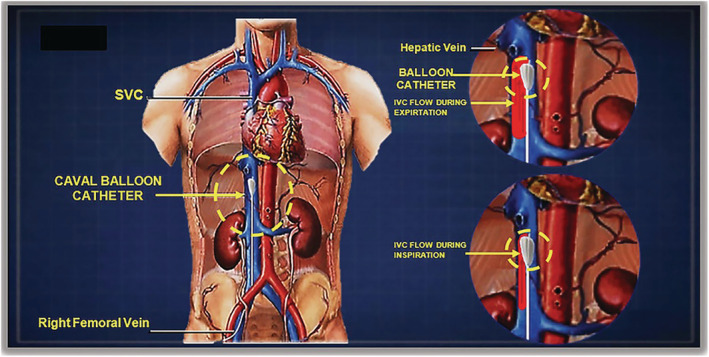
Aims: This study aims to investigate the acute haemodynamic effects of percutaneous transluminal flow regulation (PTCR®) with an inferior vena cava regulator balloon in heart failure patients. Preload reduction in heart failure has been achieved with high potency diuretics. However, no study has been conducted in humans to assess the effect of inferior vena cava intermittent occlusion for preload reduction.
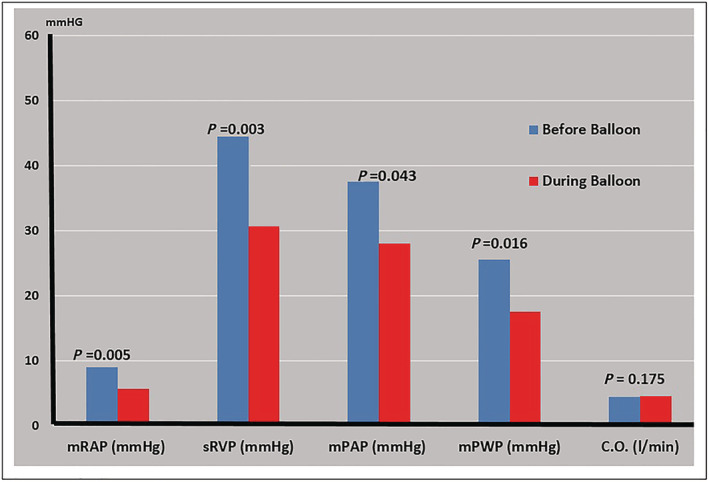
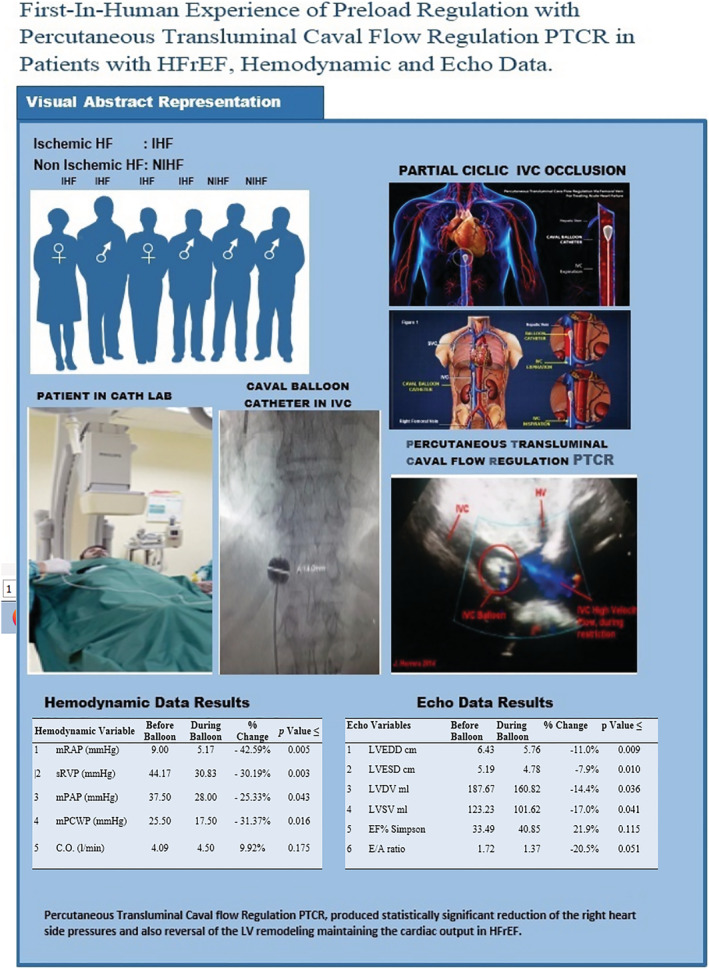
Methods and results: Six patients were included in the study: four men (55 ± 6 years old) and two women (63 ± 4 years old). Baseline evaluations included Doppler echocardiogram, coronary angiogram, and right heart catheterization. Caval balloon was kept inflated for 30 min, and right catheterization and control echocardiogram were performed while the balloon was still inflated. The balloon was then deflated and removed. Right haemodynamic variables were evaluated before balloon insertion and with the inflated balloon. The mean right atrial pressure decreased by 42.59% (P = 0.005); systolic right ventricular pressure decreased by 30.19% (P < 0.003); mean pulmonary arterial pressure decreased by 25.33% (P < 0.043); mean pulmonary capillary wedge pressure decreased by 31.37% (P > 0.016); and cardiac output increased by 9.92% (P < 0.175).
Conclusions: The haemodynamic and echocardiographic changes obtained in our study using PTCR® suggest that this innovative approach can play a beneficial role in the heart failure treatment.
Keywords: Caval flow regulation natural phenomenon; Dynamic regulation; Dynamic stenosis; Heart failure; Inferior vena cava; Percutaneous transluminal caval flow regulation PTCR®.
© 2022 The Authors. ESC Heart Failure published by John Wiley & Sons Ltd on behalf of European Society of Cardiology.
Conflict of interest statement
Igor F. Palacios declares having a relationship with the medical industry Abiomed. Juan A. Marqués declares having a relationship with the medical industry Merck Sharp & Dohme MSD.
Figures
References
-
- Androne AS, Hryniewicz K, Hudaihed A, Mancini D, Lamanca J, Katz SD. Relation of unrecognized hypervolemia in chronic heart failure to clinical status, hemodynamics, and patient outcomes. Am J Cardiol 2004; 93: 1254–1259. - PubMed
-
- Wayne LM. Fluid volume overload and congestion in heart failure: time to reconsider pathophysiology and how volume is assessed. Circ Heart Fail 2016; 9: e002922. - PubMed
-
- Constanzo MR, Guglin ME, Saltzberg MT, Jessup ML, Bart BA, Teerlink JR, Jaski BE, Fang JC, Feller ED, Haas GJ, Anderson AS. Ultrafiltration versus intravenous diuretics for patients hospitalized for acute decompensated heart failure. J Am Coll Cardiol 2007; 49: 675–683. - PubMed
-
- Herrera JE, Herrera JA, Marques JE, Mendoza I. A novel method to reduce preload mechanically in patients with congestive heart failure, the dynamic restriction of flow in the inferior vena cava. Eur J Heart Fail Supplements 2011; 10: 4. https://onlinelibrary.wiley.com/doi/epdf/10.1093/eurjhf/hsr005 - DOI
-
- Herrera JE, Herrera JA, Palacios IF. TCT‐428 first percutaneous transluminal caval flow restriction in one patent with heart failure. J Am Coll Cardiol 2014; 64: B125–B126.
Publication types
MeSH terms
LinkOut - more resources
Full Text Sources
Medical
