


Discriminative Accuracy of Chronic Obstructive Pulmonary Disease Screening Instruments in 3 Low- and Middle-Income Country Settings
- PMID: 35015039
- PMCID: PMC8753498
- DOI: 10.1001/jama.2021.23065
Discriminative Accuracy of Chronic Obstructive Pulmonary Disease Screening Instruments in 3 Low- and Middle-Income Country Settings
Abstract
Importance: Most of the global morbidity and mortality in chronic obstructive pulmonary disease (COPD) occurs in low- and middle-income countries (LMICs), with significant economic effects.
Objective: To assess the discriminative accuracy of 3 instruments using questionnaires and peak expiratory flow (PEF) to screen for COPD in 3 LMIC settings.
Design, setting, and participants: A cross-sectional analysis of discriminative accuracy, conducted between January 2018 and March 2020 in semiurban Bhaktapur, Nepal; urban Lima, Peru; and rural Nakaseke, Uganda, using a random age- and sex-stratified sample of the population 40 years or older.
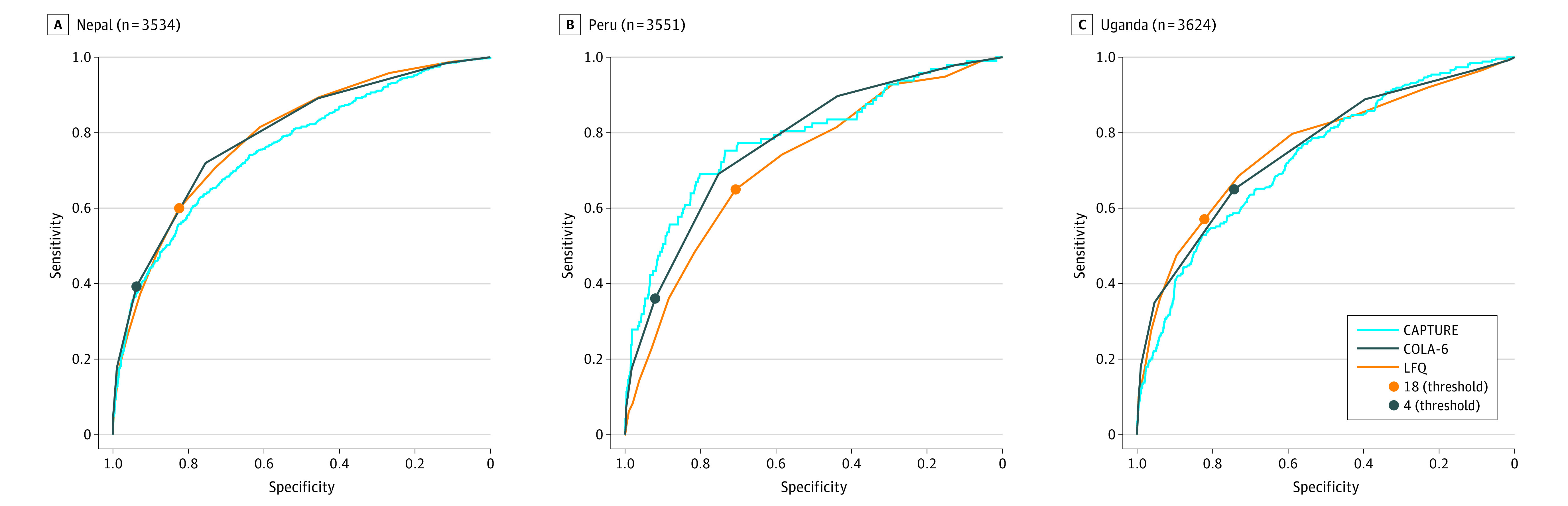
Exposures: Three screening tools, the COPD Assessment in Primary Care to Identify Undiagnosed Respiratory Disease and Exacerbation Risk (CAPTURE; range, 0-6; high risk indicated by a score of 5 or more or score 2-5 with low PEF [<250 L/min for females and <350 L/min for males]), the COPD in LMICs Assessment questionnaire (COLA-6; range, 0-5; high risk indicated by a score of 4 or more), and the Lung Function Questionnaire (LFQ; range, 0-25; high risk indicated by a score of 18 or less) were assessed against a reference standard diagnosis of COPD using quality-assured postbronchodilator spirometry. CAPTURE and COLA-6 include a measure of PEF.
Main outcomes and measures: The primary outcome was discriminative accuracy of the tools in identifying COPD as measured by area under receiver operating characteristic curves (AUCs) with 95% CIs. Secondary outcomes included sensitivity, specificity, positive predictive value, and negative predictive value.
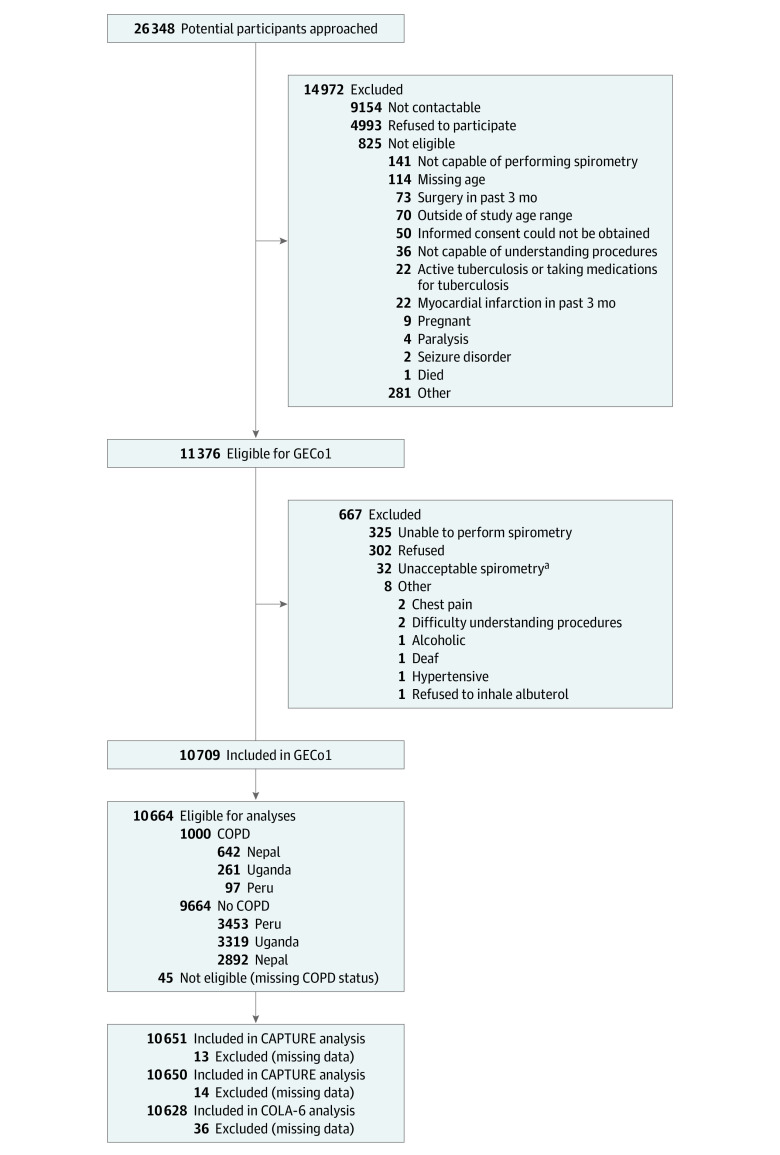
Results: Among 10 709 adults who consented to participate in the study (mean age, 56.3 years (SD, 11.7); 50% female), 35% had ever smoked, and 30% were currently exposed to biomass smoke. The unweighted prevalence of COPD at the 3 sites was 18.2% (642/3534 participants) in Nepal, 2.7% (97/3550) in Peru, and 7.4% (264/3580) in Uganda. Among 1000 COPD cases, 49.3% had clinically important disease (Global Initiative for Chronic Obstructive Lung Disease classification B-D), 16.4% had severe or very severe airflow obstruction (forced expiratory volume in 1 second <50% predicted), and 95.3% of cases were previously undiagnosed. The AUC for the screening instruments ranged from 0.717 (95% CI, 0.677-0.774) for LFQ in Peru to 0.791 (95% CI, 0.770-0.809) for COLA-6 in Nepal. The sensitivity ranged from 34.8% (95% CI, 25.3%-45.2%) for COLA-6 in Nepal to 64.2% (95% CI, 60.3%-67.9%) for CAPTURE in Nepal. The mean time to administer the instruments was 7.6 minutes (SD 1.11), and data completeness was 99.5%.
Conclusions and relevance: This study demonstrated that screening instruments for COPD were feasible to administer in 3 low- and middle-income settings. Further research is needed to assess instrument performance in other low- and middle-income settings and to determine whether implementation is associated with improved clinical outcomes.
Conflict of interest statement
Figures
Comment in
-
Screening for Chronic Obstructive Pulmonary Disease: Unmet Needs and Future Considerations.JAMA. 2022 Jan 11;327(2):126-128. doi: 10.1001/jama.2021.23255. JAMA. 2022. PMID: 35015050 No abstract available.
References
-
- Roth GA, Abate D, Abate KH, et al. ; GBD 2017 Causes of Death Collaborators . Global, regional, and national age-sex-specific mortality for 282 causes of death in 195 countries and territories, 1980-2017: a systematic analysis for the Global Burden of Disease Study 2017. Lancet. 2018;392(10159):1736-1788. doi:10.1016/S0140-6736(18)32203-7 - DOI - PMC - PubMed
-
- World Health Organization . Chronic obstructive pulmonary disease (COPD). Published 2020. Accessed September 2, 2021. https://www.who.int/news-room/fact-sheets
-
- Global Initiative for Chronic Obstructive Lung Disease (GOLD) . Global strategy for the diagnosis, management, and prevention of chronic obstructive pulmonary disease, 2022 report. Published 2021. Accessed December 16, 2021. https://goldcopd.org/2022-gold-reports-2/
-
- Beran D, Zar HJ, Perrin C, Menezes AM, Burney P; Forum of International Respiratory Societies Working Group Collaboration . Burden of asthma and chronic obstructive pulmonary disease and access to essential medicines in low-income and middle-income countries. Lancet Respir Med. 2015;3(2):159-170. doi:10.1016/S2213-2600(15)00004-1 - DOI - PubMed
Publication types
MeSH terms
Substances
Grants and funding
LinkOut - more resources
Full Text Sources
Medical
