Review
. 2022 Feb 17;82(4):716-727.
doi: 10.1016/j.molcel.2021.12.004. Epub 2022 Jan 10.

Now open: Evolving insights to the roles of lysine acetylation in chromatin organization and function

Affiliations
Review

Now open: Evolving insights to the roles of lysine acetylation in chromatin organization and function

Ying-Jiun C Chen et al. Mol Cell. .

Abstract

Protein acetylation is conserved across phylogeny and has been recognized as one of the most prominent post-translational modifications since its discovery nearly 60 years ago. Histone acetylation is an active mark characteristic of open chromatin, but acetylation on specific lysine residues and histone variants occurs in different biological contexts and can confer various outcomes. The significance of acetylation events is indicated by the associations of lysine acetyltransferases, deacetylases, and acetyl-lysine readers with developmental disorders and pathologies. Recent advances have uncovered new roles of acetylation regulators in chromatin-centric events, which emphasize the complexity of these functional networks. In this review, we discuss mechanisms and dynamics of acetylation in chromatin organization and DNA-templated processes, including gene transcription and DNA repair and replication.

Keywords: DNA repair; DNA replication; acetylation; acetyltransferase; chromatin organization; deacetylase; enhancer; transcription.


Conflict of interest statement

Declaration of interests S.Y.R.D. is a member of the advisory board for Molecular Cell.

Figures
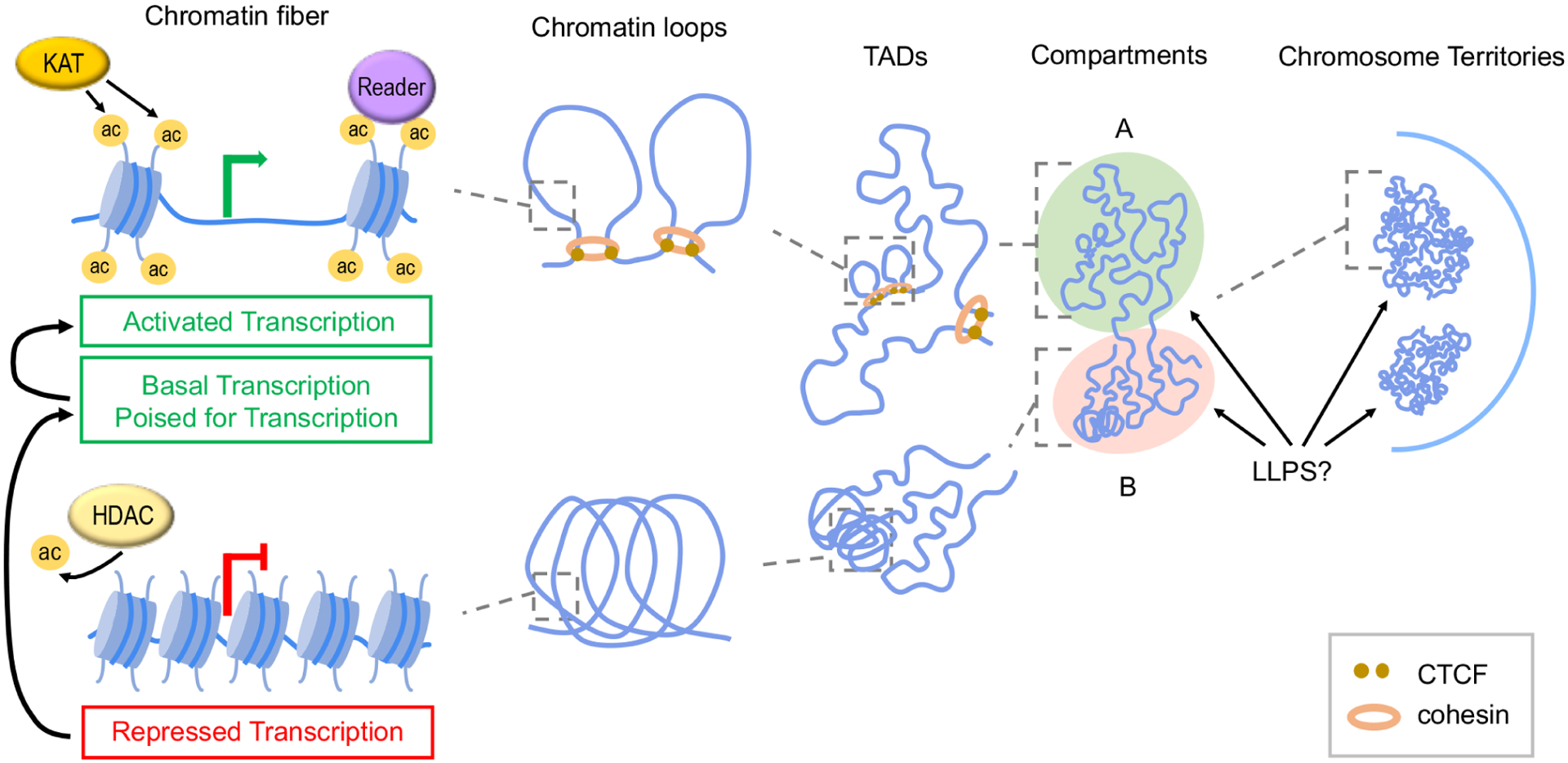
Figure 1.
Figure 1.. Association of histone acetylation with chromatin organization from local to higher-order scales.
Histone acetylation (ac) conferred by KATs and recognized by reader proteins inhibits inter-nucleosome interactions and generates an open chromatin configuration, which allows gene transcription of various levels. On the contrary, deacetylation by HDACs leads to shorter inter-nucleosome distances on the chromatin fiber and repressed transcription. Acetylated chromatin is able to form enhancer–promoter chromatin loops, whereas lack of acetylation facilitates more compact conformations. Architectural proteins CTCF and cohesin mediate formation of chromatin loops and TAD borders. TADs segregate into broadly A and B chromatin compartments, and these compartments further form individual chromosome territories. LLPS may contribute to the segregation of chromatin compartments and territories.
Figure 2.
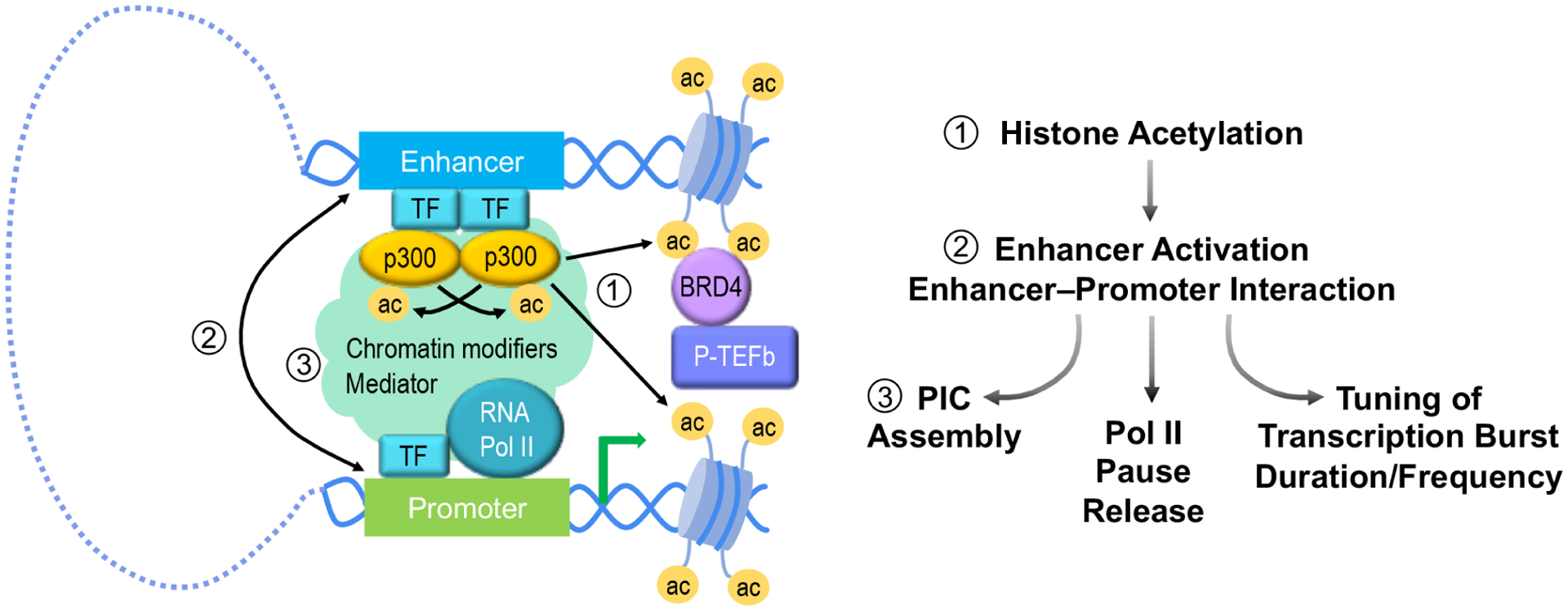
Figure 2.. Acetylation events in enhancer–promoter interactions.
Dimerization of TFs recruits two p300 molecules that trans-acetylate each other, activating their KAT activities. p300 acetylates H3K27 at both enhancer and promoter regions. BRD4 binds to acetylated histones and further recruits or activates P-TEFb to induce release of paused Pol II. Histone acetylation also promotes chromatin looping, allowing enhancer-bound TFs to interact with chromatin regulators and transcription machinery at cognate promoters. Collectively, histone acetylation is crucial for enhancer activation and EPIs, which enhance PIC assembly, release of paused Pol II, and/or tuning of transcriptional bursting.
Figure 3.
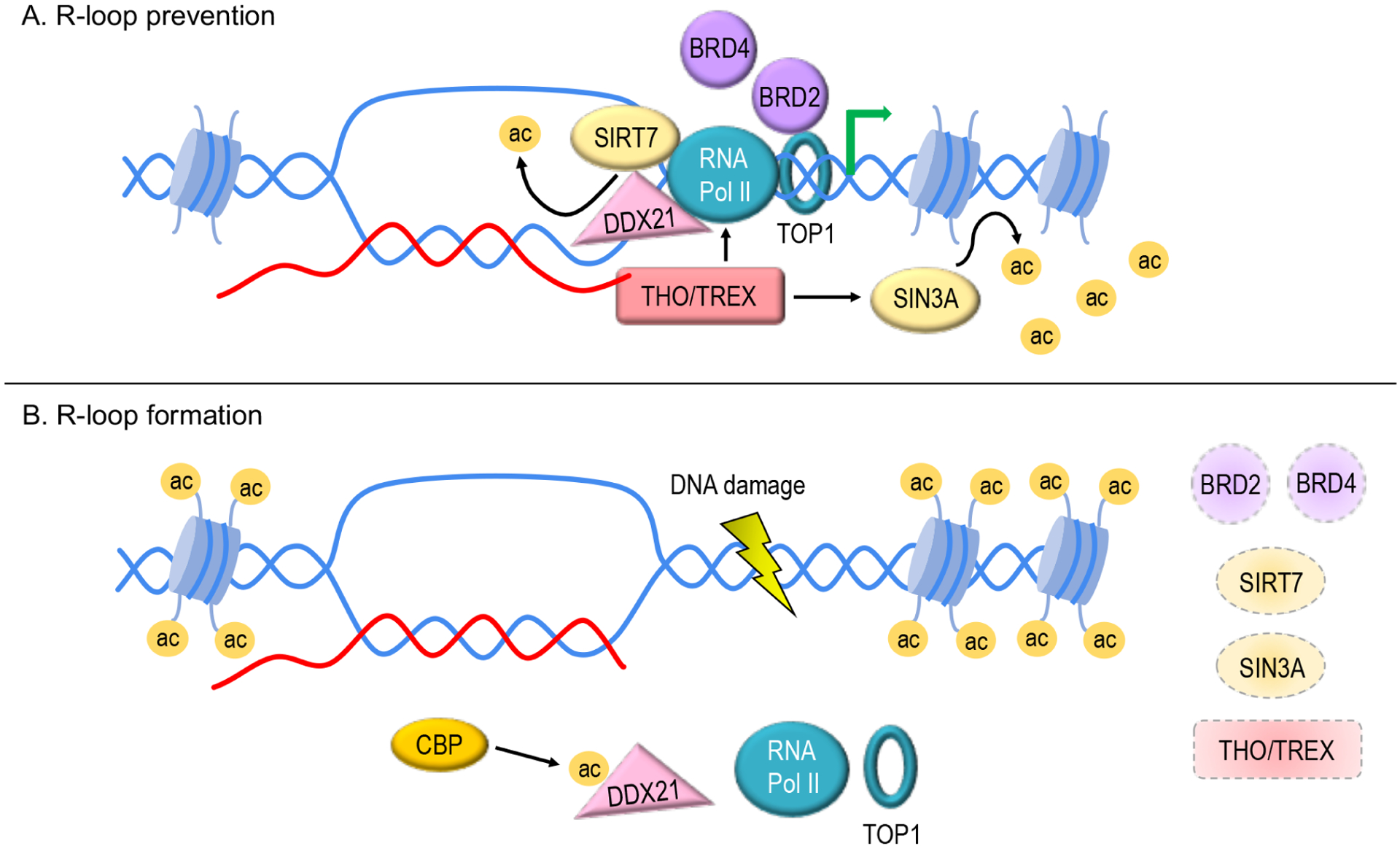
Figure 3.. Regulation of acetylation in prevention of R-loops and DNA damage.
A. Under normal conditions, the RNA-binding THO/TREX complex promotes Pol II activity and SIN3A-mediated histone deacetylation, which inhibits R-loop formation. BRD2 directly interacts with and enhances TOP1 activity to restrain R-loops. BRD4 also participates in R-loop prevention, but the direct mechanism of action is yet to be determined. SIRT7 deacetylates and activates the helicase activity of DDX21, and DDX21 unwinds the DNA–RNA hybrid strands to resolve R-loops. B. Upon inhibition or degradation of BRD2, BRD4, SIRT7, SIN3A and/or THO/TREX complex, R-loop accumulates and ultimately leads to DNA damage. Acetylation of DDX21 by CBP suppresses the activity of DDX21. Histone acetylation enhances transcription and thus increases the potential of R-loop formation.

References

    1. Baranello L, Wojtowicz D, Cui K, Devaiah Ballachanda N., Chung H-J, Chan-Salis Ka Y., Guha R, Wilson K, Zhang X, Zhang H, et al. (2016). RNA Polymerase II Regulates Topoisomerase 1 Activity to Favor Efficient Transcription. Cell 165, 357–371. - PMC - PubMed
    1. Billon P, Li J, Lambert JP, Chen Y, Tremblay V, Brunzelle JS, Gingras AC, Verreault A, Sugiyama T, Couture JF, et al. (2017). Acetylation of PCNA Sliding Surface by Eco1 Promotes Genome Stability through Homologous Recombination. Mol Cell 65, 78–90. - PubMed
    1. Bird AW, Yu DY, Pray-Grant MG, Qiu Q, Harmon KE, Megee PC, Grant PA, Smith MM, and Christman MF (2002). Acetylation of histone H4 by Esa1 is required for DNA double-strand break repair. Nature 419, 411–415. - PubMed
    1. Boltengagen M, Samel-Pommerencke A, Fechtig D, and Ehrenhofer-Murray AE (2021). Dynamics of SAS-I mediated H4 K16 acetylation during DNA replication in yeast. PLoS One 16, e0251660. - PMC - PubMed
    1. Brand M, Clayton J, Moroglu M, Schiedel M, Picaud S, Bluck JP, Skwarska A, Bolland H, Chan AKN, Laurin CMC, et al. (2021). Controlling Intramolecular Interactions in the Design of Selective, High-Affinity Ligands for the CREBBP Bromodomain. J Med Chem 64, 10102–10123. - PMC - PubMed

Publication types

LinkOut - more resources